


























Views
Downloads
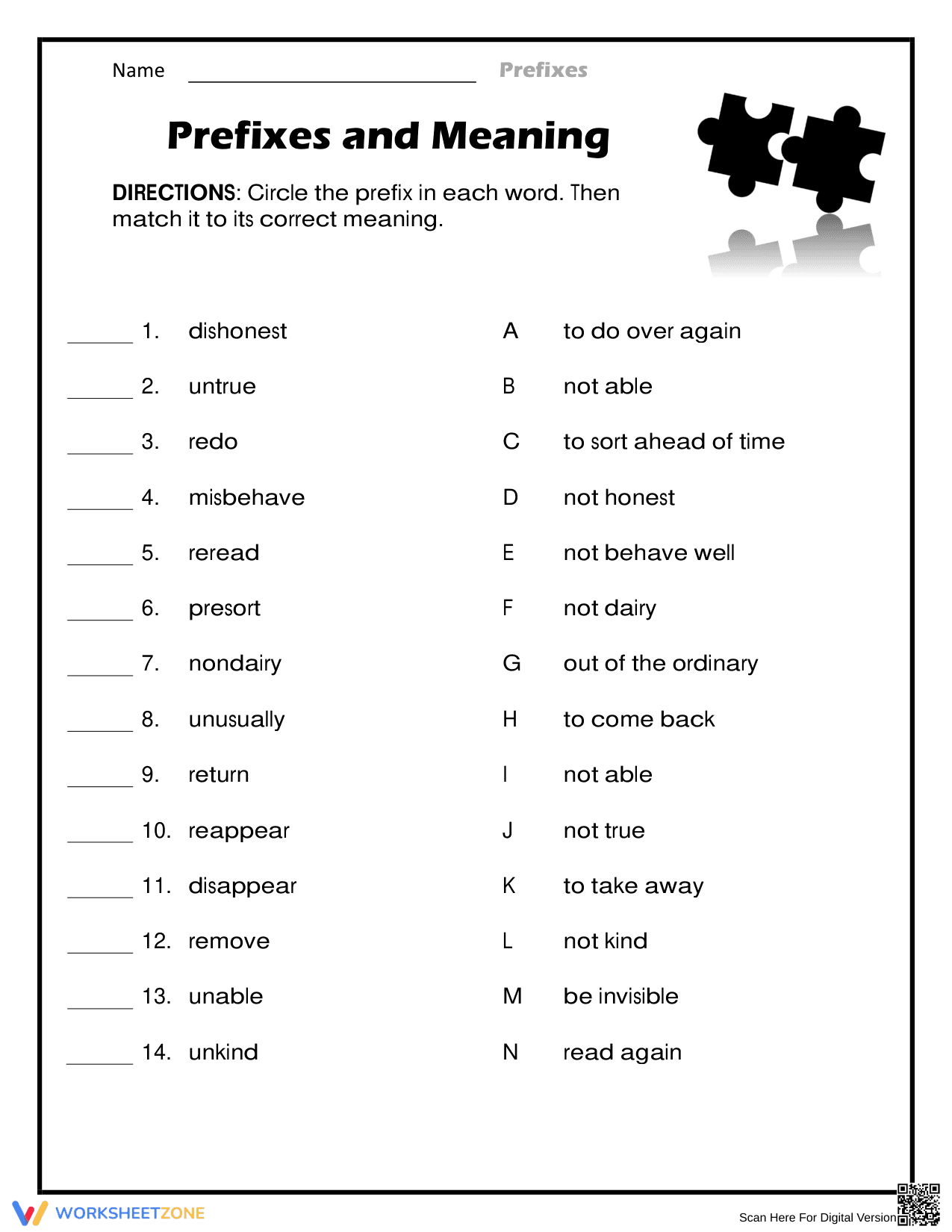

Essential Prefix Meaning Worksheet | Grade 3 Vocabulary
Paste this activity's link or code into your existing LMS (Google Classroom, Canvas, Teams, Schoology, Moodle, etc.).
Students can open and work on the activity right away, with no student login required.
You'll still be able to track student progress and results from your teacher account.
This Essential Prefix Meaning Worksheet provides Grade 3 students with a focused, 14-item matching activity designed to strengthen morphological awareness. By identifying common affixes like dis-, re-, and un-, learners build the foundational vocabulary skills necessary to decode complex words and improve overall reading comprehension. Students circle the prefix and then map the word to its definition.
At a Glance
- Grade: 3 · Subject: English Language Arts
- Standard:
CCSS.ELA-LITERACY.L.3.4.B— Use a known affix as a clue to the meaning of a word- Skill Focus: Prefix Identification and Word Meaning
- Format: 1 page · 14 problems · Answer key included · PDF
- Best For: Independent vocabulary practice and quick assessments
- Time: 10–15 minutes
What's Inside
The worksheet contains a single, high-density page featuring 14 carefully selected vocabulary words such as "dishonest," "redo," and "presort." Each item requires students to perform two distinct cognitive tasks: first, circling the prefix within the word, and second, matching the complete word to its corresponding meaning (A-N). This dual-action approach ensures students recognize the structural parts of words while simultaneously processing their semantic values. A full answer key is provided for efficient grading.
Zero-Prep Workflow
This resource is designed for a seamless, zero-prep workflow in busy classrooms. First, simply select the page and print copies for your entire class. Second, pass out the sheets as a bell-ringer or transitional activity during your literacy block. Third, use the included answer key for quick checks or allow students to self-correct their work. It is an ideal solution for emergency sub plans or last-minute literacy centers that require minimal teacher intervention.
Standards Alignment
This activity is strictly aligned to CCSS.ELA-LITERACY.L.3.4.B, which requires students to determine the meaning of the new word formed when a known affix is added to a known word. By working with prefixes such as mis-, pre-, and non-, students develop the structural analysis skills cited in most state standards. This standard code can be copied directly into lesson plans, IEP goals, or district curriculum mapping tools.
How to Use It
Use this worksheet as independent practice after an introductory lesson on prefixes. It serves as an excellent formative assessment to check understanding before moving to more complex suffix studies. Teachers should observe the "circling" phase to ensure students correctly identify prefix boundaries rather than just guessing. The worksheet typically takes 10-15 minutes to complete, making it a perfect fit for a structured ELA rotation or a quick vocabulary warm-up.
Who It's For
This resource is intended for Grade 2, 3, and 4 students who are developing their vocabulary and word-study skills. It is particularly effective for English Language Learners (ELLs) who benefit from the explicit matching of word parts to concrete definitions. Pair this worksheet with a prefix anchor chart or a short reading passage that features these words in context to provide a comprehensive literacy experience.
The Essential Prefix Meaning Worksheet supports morphological awareness, a key predictor of reading success. According to Fisher & Frey (2014), explicit instruction in word parts allows students to independently understand the meanings of thousands of words in complex texts. This worksheet targets the CCSS.ELA-LITERACY.L.3.4.B standard, focusing on using known affixes as clues to word meaning. By engaging in 14 matching tasks, learners practice the repetition necessary to move structural patterns into long-term memory. This type of structured practice is essential for bridging the gap between decoding and fluency. Educators can rely on this printable resource as an evidence-based tool for vocabulary intervention, ensuring that all learners have the structural tools required for grade-level literacy achievement and successful academic communication.


