


























Views
Downloads

Printable Multiple Meaning Words Worksheet | Grade 3 ELA
Paste this activity's link or code into your existing LMS (Google Classroom, Canvas, Teams, Schoology, Moodle, etc.).
Students can open and work on the activity right away, with no student login required.
You'll still be able to track student progress and results from your teacher account.
Help students navigate the complexities of the English language with this targeted homonym practice. This worksheet focuses on identifying the correct definition of words with multiple meanings based on sentence context. Learners strengthen their reading comprehension and vocabulary precision, ensuring they can distinguish between various word usages.
At a Glance
- Grade: 3 · Subject: English Language Arts
- Standard:
CCSS.ELA-LITERACY.L.3.4.A— Use sentence-level context as a clue to the meaning of a word or phrase- Skill Focus: Contextual definition selection for multiple-meaning words (homonyms)
- Format: 3 pages · 6 problems · Answer key included · PDF
- Best For: Vocabulary centers and independent practice sessions
- Time: 15–20 minutes
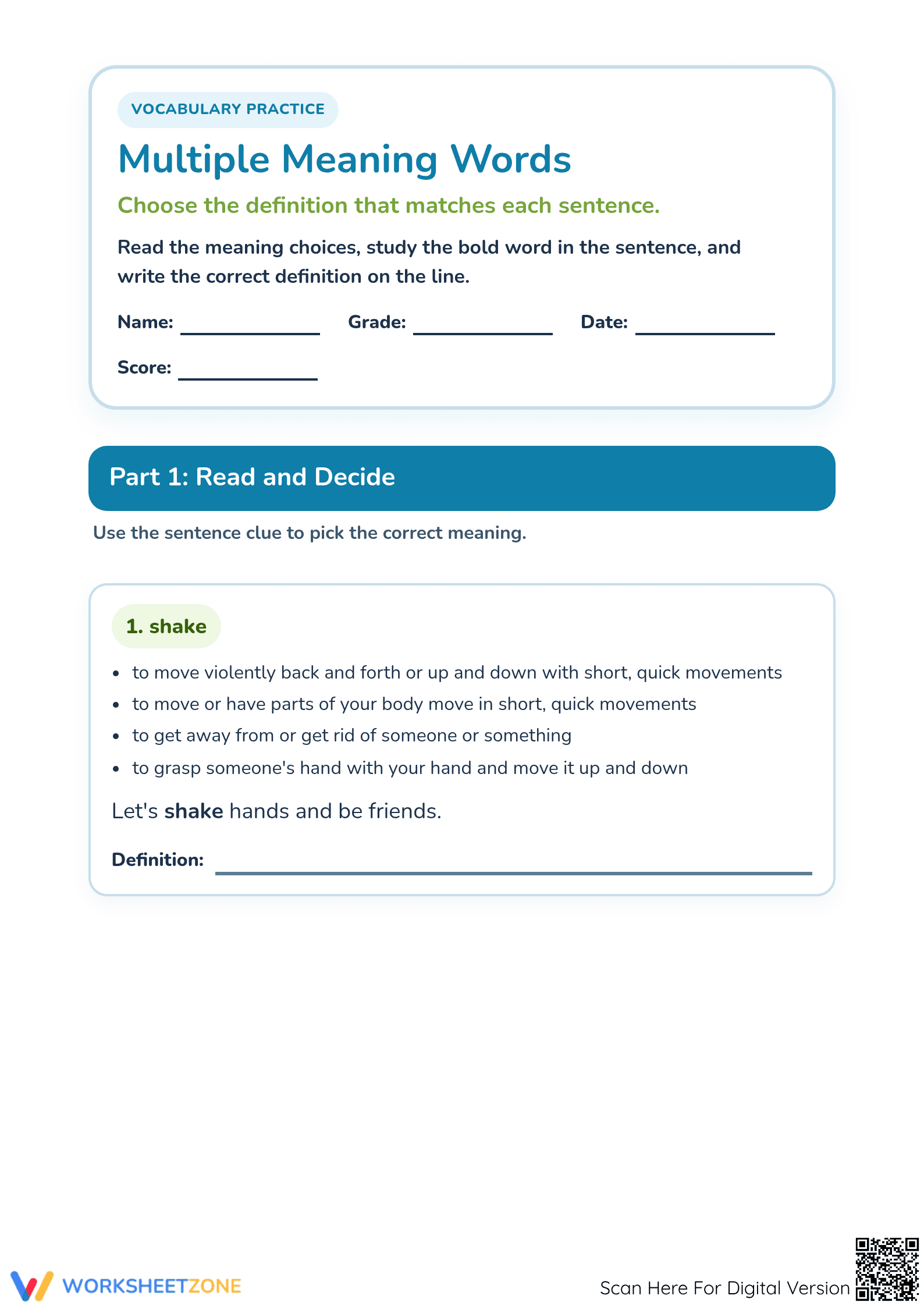
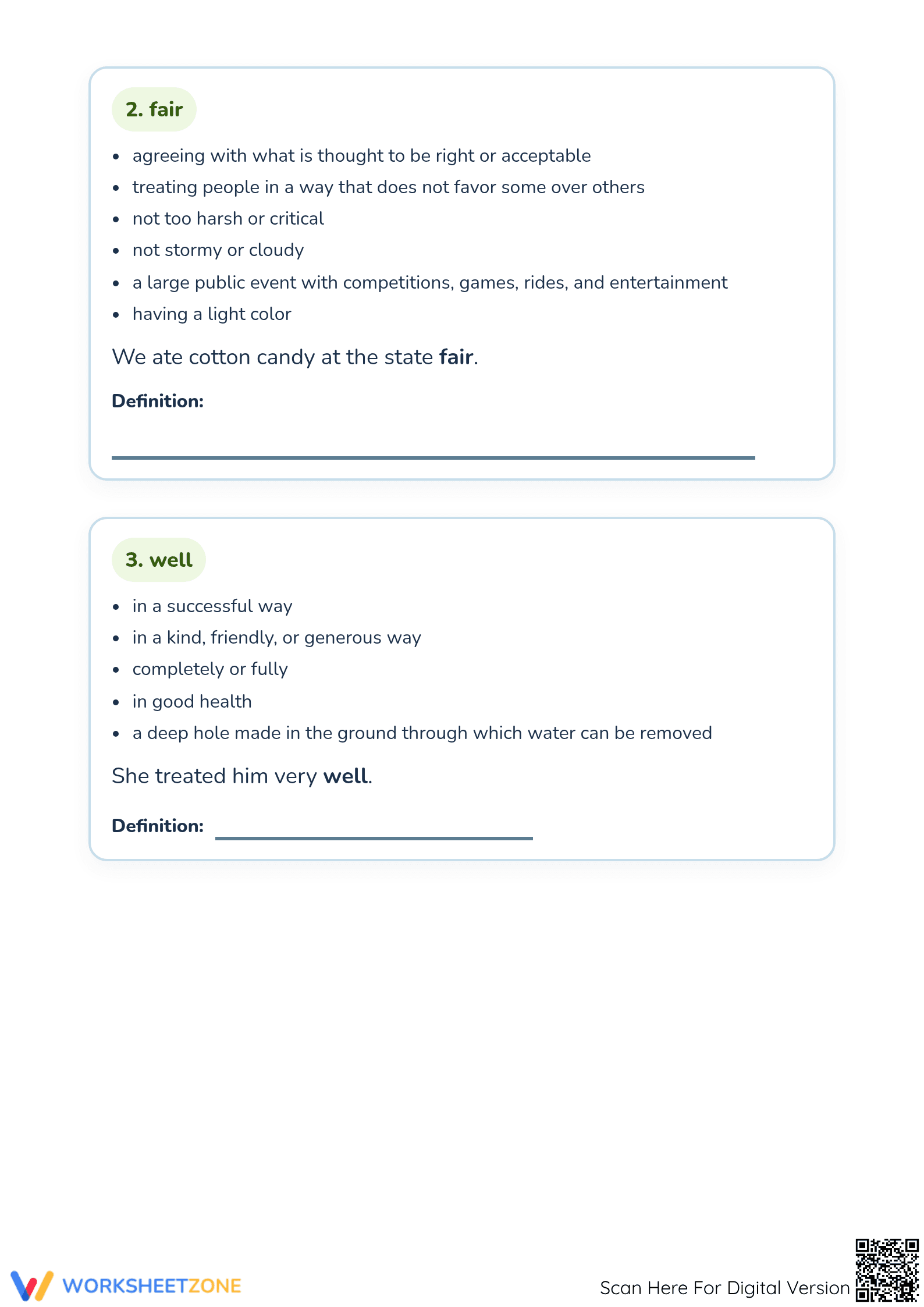
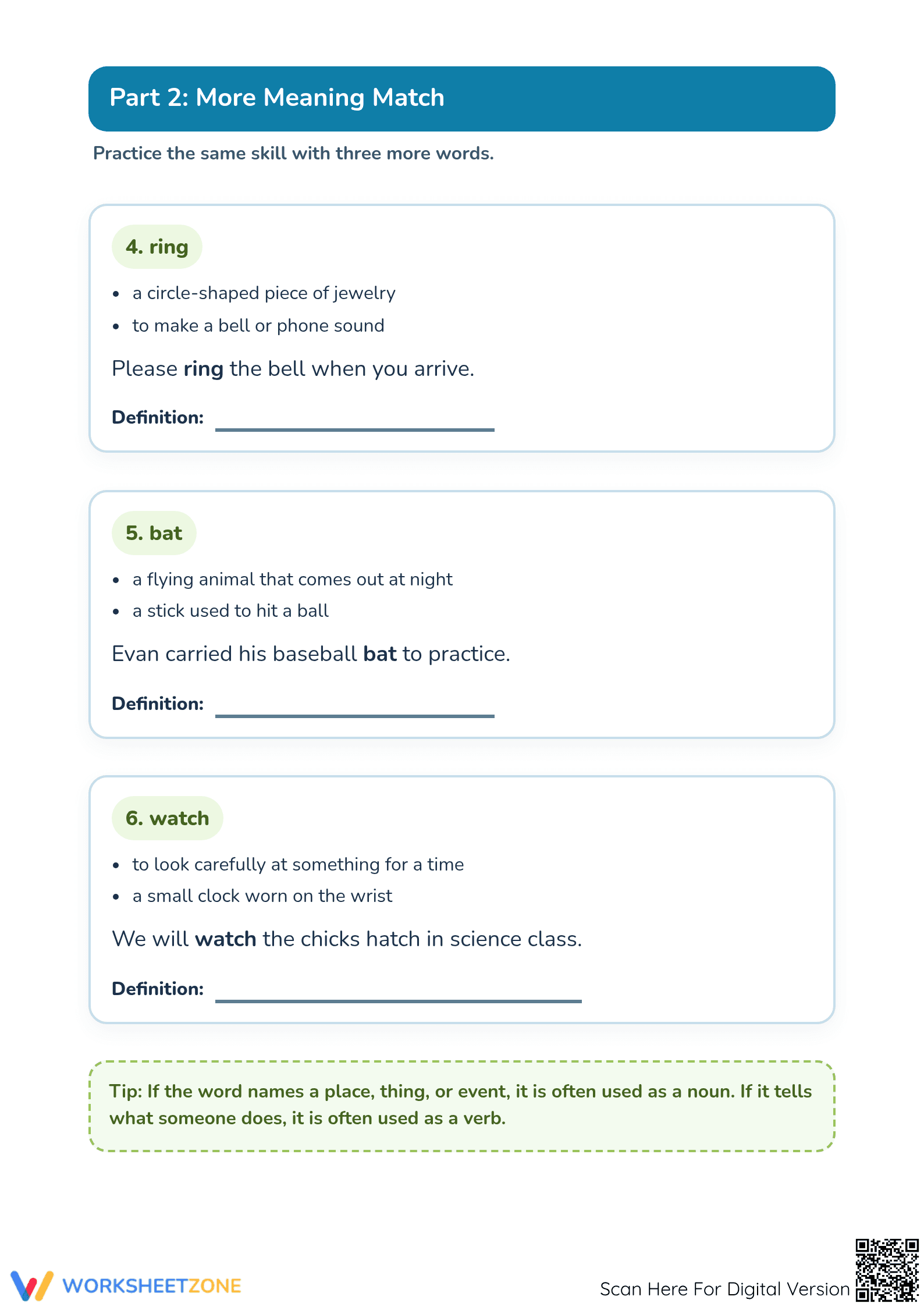
This 3-page PDF resource provides a structured environment for vocabulary development. The worksheet is divided into "Read and Decide" and "More Meaning Match." Across 6 unique tasks, students analyze a common homonym like "shake" or "fair." A specific sentence follows, challenging the student to select and transcribe the definition that fits the provided context. A full answer key is included.
Skill Progression
- Guided practice: Page 1 features detailed definition lists that highlight subtle differences in usage for initial word sets.
- Supported practice: Page 2 provides a broader range of options to refine selection skills using common high-frequency homonyms.
- Independent practice: Part 2 encourages students to apply strategies to words like "ring" and "bat" with reduced scaffolding.
This approach builds mastery through repetition and the gradual release of responsibility.
Standards Alignment
This resource is strictly aligned to CCSS.ELA-LITERACY.L.3.4.A, which requires students to use context as a clue to word meaning. By requiring students to write out matching definitions, the worksheet also supports CCSS.ELA-LITERACY.L.3.6, reinforcing academic vocabulary. Both standard codes can be copied directly into lesson plans, IEP goals, or district curriculum mapping tools.
How to Use It
Deploy this worksheet during the independent portion of a vocabulary lesson. It serves as an excellent formative assessment tool; teachers should observe whether students can identify specific clues in the sentence that signal the correct definition. Expect students to complete all three pages in approximately 15 to 20 minutes. It works well as a follow-up to direct instruction.
Who It's For
This resource is designed for Grade 3 students but is effective for Grade 2 enrichment or Grade 4 remediation. It is particularly beneficial for English Language Learners (ELLs) who may struggle with the multiple nuances of high-frequency words. Pair this worksheet with a homonym anchor chart or a short reading passage for a comprehensive experience.
Vocabulary acquisition through contextual analysis is a cornerstone of effective literacy instruction. According to the NAEP framework, the ability to derive meaning from context is a significant predictor of overall reading success. This Grade 3 ELA worksheet directly addresses this need by focusing on CCSS.ELA-LITERACY.L.3.4.A, requiring students to evaluate 6 distinct homonyms within varied sentence structures. Research from Fisher & Frey (2014) emphasizes that "close reading" strategies, including the identification of multiple-meaning words, are essential for accessing complex texts. By providing multiple definition choices and requiring written responses, this resource moves beyond simple recognition to deep conceptual understanding. It ensures that students can navigate homonyms like "watch," "well," and "shake" without confusion, building the linguistic agility required for higher-grade reading demands. The inclusion of a targeted tip regarding parts of speech further aligns with best practices in morphological and syntactic awareness.


