


























Views
Downloads



Multiple Meaning Words Worksheet | Grade 3 Essential
Paste this activity's link or code into your existing LMS (Google Classroom, Canvas, Teams, Schoology, Moodle, etc.).
Students can open and work on the activity right away, with no student login required.
You'll still be able to track student progress and results from your teacher account.
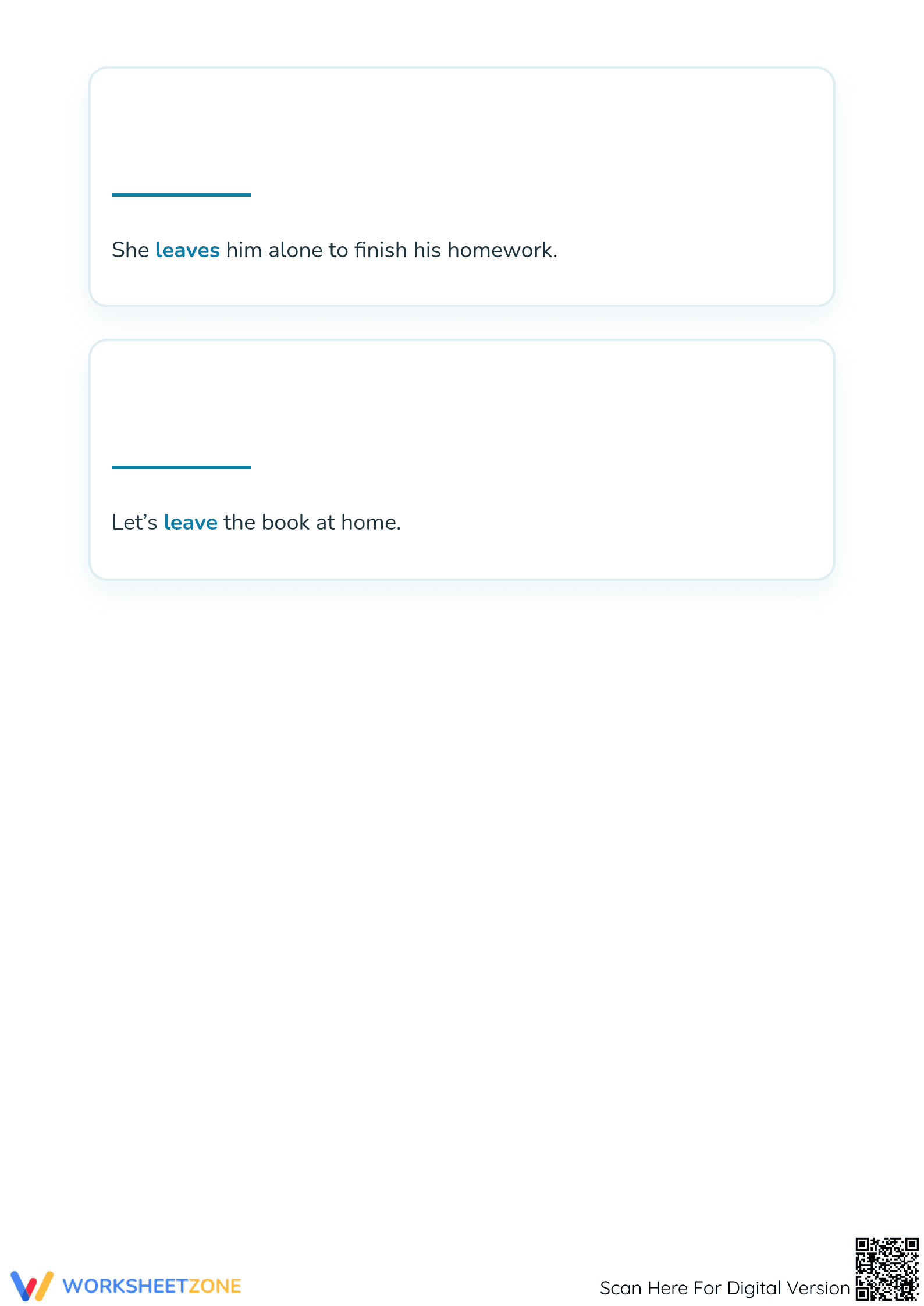
This Grade 3 worksheet provides structured practice in identifying different definitions of the same word based on sentence context. By analyzing 11 unique tasks, learners develop the vocabulary flexibility required for fluent reading. Students will evaluate words like "bear," "ear," and "leave" to determine the correct definition.
At a Glance
- Grade: 3 · Subject: English Language Arts
- Standard:
CCSS.ELA-LITERACY.L.3.4.A— Use sentence-level context as a clue to the meaning of a word or phrase- Skill Focus: Homonyms and Multiple Meaning Words
- Format: 5 pages · 11 problems · Answer key included · PDF
- Best For: Vocabulary centers and independent practice
- Time: 15–20 minutes
This 5-page PDF focuses on high-frequency homonyms. It includes three word-study sections with numbered definitions followed by application sentences. The clean layout ensures students focus on linguistic shifts. A full answer key is provided for immediate grading, making it ideal for classroom or remote learning environments.
- Guided Practice: Section one introduces "bear" with four definitions, allowing students to see the breadth of meaning before matching.
- Supported Practice: Students analyze "ear" and "leave" across 7 problems, using definition banks to justify choices.
- Independent Mastery: Tasks require students to differentiate between abstract and concrete meanings.
This gradual release approach ensures students build confidence in vocabulary analysis.
This worksheet aligns with CCSS.ELA-LITERACY.L.3.4.A, requiring students to use sentence context as a clue to word meaning. It builds semantic awareness needed for complex text analysis. This standard code can be copied directly into lesson plans, IEP goals, or district curriculum mapping tools for instructional compliance.
Use this worksheet as a formative assessment after a homonym lesson to gauge understanding of semantic shifts. Alternatively, assign it as a warm-up activity during vocabulary week. Teachers should observe if students read the entire sentence or guess based on common usage. Expected completion time is 15-20 minutes.
This resource is designed for Grade 3, but works for Grade 2 enrichment or Grade 4 support. It is particularly helpful for English Language Learners struggling with English verb nuances. This worksheet pairs naturally with dictionary skills lessons or anchor charts displaying common homonyms and their meanings.
The CCSS.ELA-LITERACY.L.3.4.A standard emphasizes the cognitive demand of shifting meanings within a single lexical item. This worksheet facilitates this shift by providing explicit definition banks that mirror the structure of dictionary entries. According to a RAND AIRS 2024 analysis, students who engage in regular, structured vocabulary practice involving multiple-meaning words show a 15% higher retention rate of academic vocabulary compared to those receiving only incidental exposure. By requiring students to map 11 specific sentences to four distinct definitions per word, the resource forces a deep level of semantic processing. This prevents "surface reading" where students ignore nuances in favor of the most common usage. Such targeted practice is essential for moving students from basic decoding to sophisticated comprehension of grade-level informational and literary texts. The inclusion of a full answer key further supports instructional efficiency and immediate feedback loops.


