Homonyms PDF Worksheets for 3rd Grade
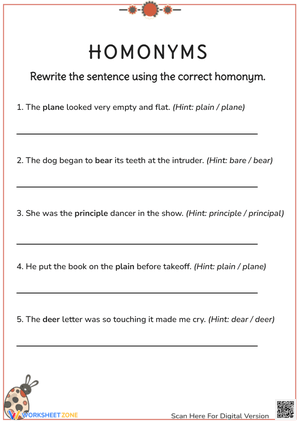
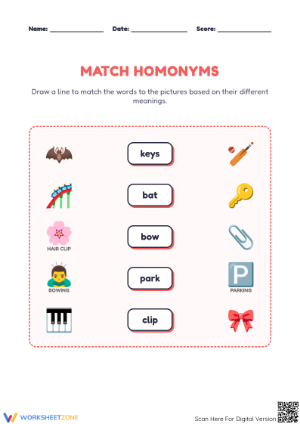
These homonyms pdf worksheets for 3rd grade give teachers a targeted, print-and-use set of exercises for one of the more demanding vocabulary skills in the third-grade ELA strand: recognizing that a familiar word carries more than one meaning and using surrounding text to select the right one. The set centers on high-frequency multiple-meaning words — bat, bark, ring, light, fair, bank — and moves students from identifying alternate definitions into applying them inside real sentences.
The Specific Skills Each Worksheet Builds
Each worksheet in the set targets a distinct exercise type, arranged so the progression moves from recognition to independent application — the sequence that produces the most reliable skill transfer into independent reading.
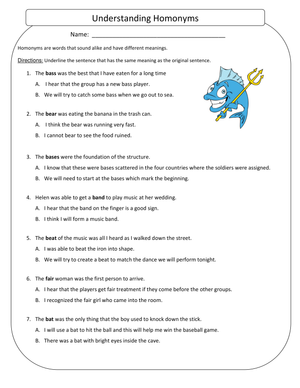
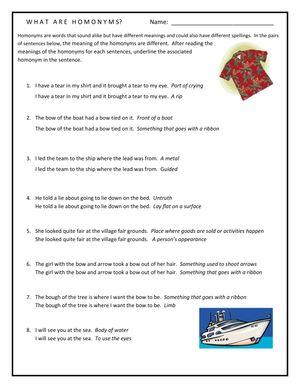
- Context clue reading: Students read a complete sentence and mark which meaning of the bolded homonym fits the context. The sentences are constructed so that neither definition is obviously wrong without reading carefully — the exact condition students face in chapter books and informational passages.
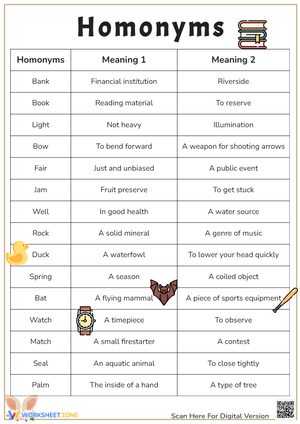
- Definition matching: Students connect a word to two different definitions, labeling each one. This functions well as a pre-teaching step before sentence-level work, giving students the working vocabulary they need before encountering the word in a live context.
- Fill-in-the-blank with word banks: Students choose between two meanings or forms of a homonym to complete a sentence. The task requires reading the full sentence before committing — which reinforces the active reading habit the whole set aims to build.
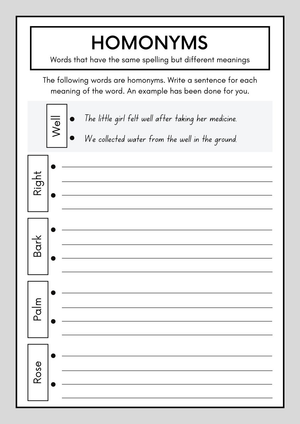
- Illustrating both meanings: Students sketch each meaning of a word in separate boxes. Third graders who can name both meanings out loud will sometimes stall on this task, which surfaces a conceptual gap worth addressing before the class moves on.
Mistakes Students Make That These Worksheets Surface
Third graders know most of these words orally. Ask a student what "bark" means, and they'll give you both the tree covering and the dog sound without hesitating. The problem shows up in print: students read a sentence, activate the first familiar definition that comes to mind, and stop evaluating the context. A student working through a nature passage will read "the bark was loud" and picture a tree rather than a dog — because the surrounding passage already framed the word as outdoor-and-natural before the critical sentence appeared. Each worksheet addresses this by placing the same homonym in two contrasting sentences, one per meaning, so students have to actively shift frames rather than carry one interpretation through the entire exercise.
The word "fair" produces a different pattern. Students who associate it primarily with a carnival will misread it in sentences like "The judge made a fair decision," sometimes answering that the judge attended a fair. This isn't a failure of reading ability — it's a vocabulary-flexibility gap, and these exercises expose it early enough to correct it. After working through one worksheet on "fair," most students hold both definitions simultaneously and let the sentence's context clues do the selecting.
Working These Exercises Into Your Lesson Plan
The most effective placement for these worksheets is the day after students first encounter a target homonym in a read-aloud or shared text. That 24-hour gap matters: students who sleep on a new vocabulary concept process it differently than students who complete the written practice the same hour they first heard the word. Using one worksheet the following morning — during the first five to eight minutes of ELA or as part of the morning warm-up — doubles as a quick formative check on what actually held from the previous lesson.
These homonyms pdf worksheets for 3rd grade work especially well as Friday review tasks, using the last 10 minutes of your ELA block to consolidate the week's vocabulary before the weekend interrupts retrieval. For literacy centers, pair each worksheet with the class anchor chart of that week's multiple-meaning words. Students complete the context clue exercises first, consult the chart if they're stuck, then use the definition-matching section to verify. Having students write out the correct meaning in full — rather than circling a letter — produces more durable recall for most students.
Adjusting the Set for Mixed-Ability Classrooms
With homonyms pdf worksheets for 3rd grade, students reading below grade level often need a meaning reference available while they work. A small index card listing both definitions of that worksheet's target word reduces cognitive load enough that the student can focus on the actual context-clue skill rather than burning working memory on basic definition recall. The common mistake is pulling this support too early — keep it in place until a student shows consistent accuracy across three or four worksheets before removing it.
Students working above grade level benefit from the illustrating-both-meanings task as a springboard. After completing the standard exercises, they write original sentences for each meaning, then swap with a partner who must identify which meaning is used. This moves practice from receptive to expressive vocabulary — a meaningful stretch that stays anchored in the same skill the rest of the class is building, rather than drifting into disconnected enrichment work.
Standard Alignment
The homonyms pdf worksheets for 3rd grade in this set address CCSS.ELA-LITERACY.L.3.4, the Language standard requiring students to determine or clarify the meaning of unknown and multiple-meaning words and phrases, choosing flexibly from a range of strategies, with an emphasis on sentence-level context clues. In classroom terms, this standard sits at the junction of vocabulary instruction and reading comprehension — students aren't memorizing definitions in isolation; they're practicing the active monitoring that keeps meaning intact across a full passage. The worksheets give teachers a direct way to build toward this standard through varied, context-dependent practice that mirrors what students actually have to do during independent reading.
Frequently Asked Questions
What's the difference between homonyms, homophones, and homographs — and which term should I use with my class?
At the third-grade level, the practical distinction matters more than the terminology. Homophones sound the same but spell differently — bear and bare, to and two. Homographs share spelling but may differ in pronunciation — bow (the knot) and bow (the gesture after a performance). Homonyms, in everyday classroom use, refers to words that share spelling or pronunciation but carry different meanings. L.3.4 groups all of these under the broader term "multiple-meaning words," and many teachers use that label in instruction, reserving the specific categories for students who are ready to make finer distinctions.
Which multiple-meaning words appear most often in third-grade reading materials?
Bat, bark, ring, light, bank, fair, and rock show up most frequently in grade-level chapter books and informational texts. The worksheets in this set prioritize those words because students will almost certainly encounter them in authentic reading before the year ends — which makes the practice directly transferable rather than abstract vocabulary drilling.
Can these worksheets double as informal assessments?
Yes. When completed without discussion or anchor-chart support, the context clue and fill-in-the-blank exercises reveal clearly which students are applying the strategy independently and which are guessing. Collecting a completed worksheet mid-unit and noting which sentences produced the most errors tells you exactly where to focus instruction before moving on to the next word group.
What's the best way to introduce a homonym before students work independently?
A brief physical routine takes two or three minutes and measurably reduces guessing errors during independent work. Before students pick up a pencil, have them act out both meanings of the target word. For "wave," half the class does an ocean wave with their arms; the other half waves hello to a friend across the room. This pre-teaching step creates a physical memory tied to each definition — one that most students access automatically when they hit a difficult sentence and need to decide which meaning fits.
Clear All