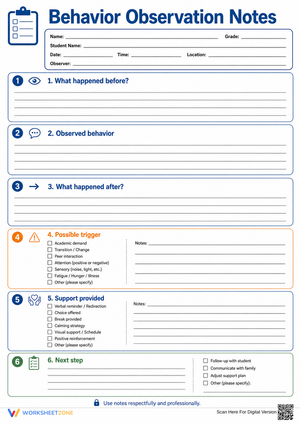
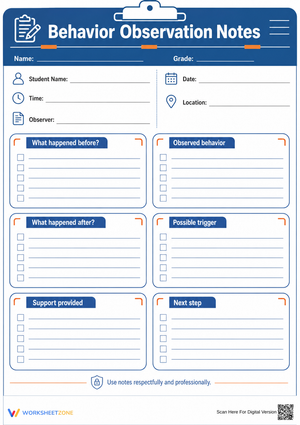
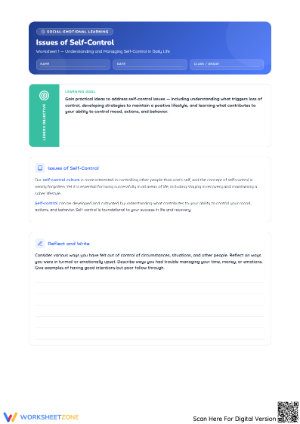
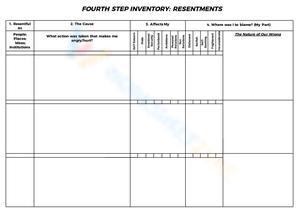
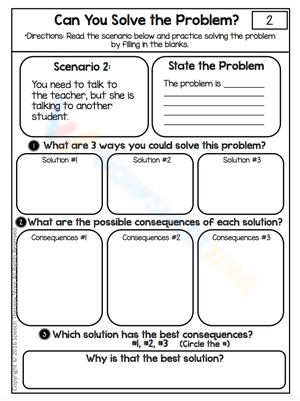
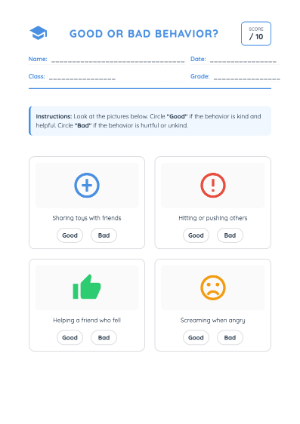
These 10th grade social skills worksheets printable resources replace abstract emotion-identification exercises with concrete, scenario-driven tasks that require students to produce a real output — a drafted text message, a scripted conversation opener, a written self-advocacy email to a teacher or potential employer. The worksheets cover four core areas: peer dynamics and personal boundaries, digital etiquette, self-advocacy in academic and early workplace settings, and active listening. Each worksheet stands alone, so teachers can sequence them according to what their students need right now rather than following a fixed progression.
What Each Worksheet Covers
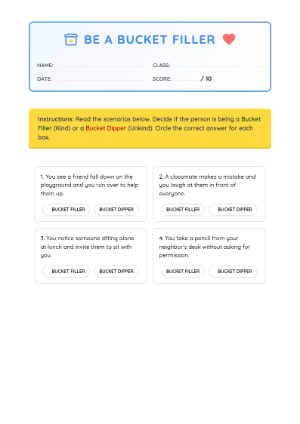
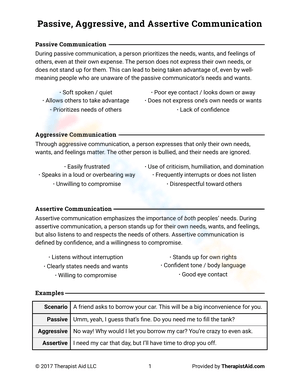
Peer dynamics worksheets present case studies of friendship and group-work conflicts and ask students to identify where a situation crossed a boundary, then draft the assertive response they would actually deliver. Digital etiquette worksheets use social media scenarios — a screenshot shared without permission, a public comment intended to humiliate — and ask students to trace the chain of social harm and compose a repair strategy. Self-advocacy worksheets give students prompts for requesting deadline extensions, navigating a job interview question they don't know how to answer, and raising a grade concern with a teacher in writing without sounding accusatory. Active listening worksheets structure partner conversations around a three-step response protocol: restate the other person's point, name the underlying feeling, then respond — a sequence many 10th graders have never attempted deliberately.
Why This Format Works at This Grade Level
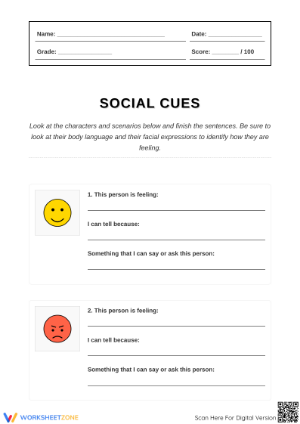
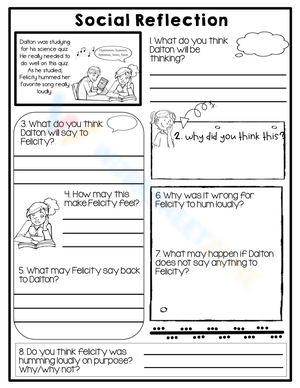
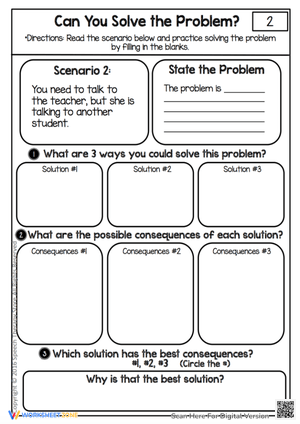
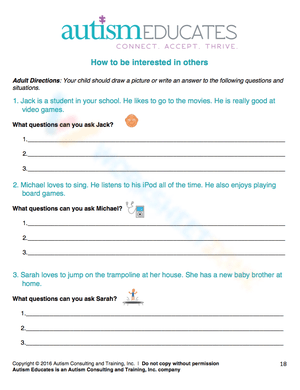
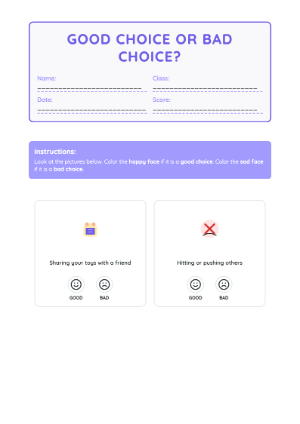
By 10th grade, most students have sat through lessons where they were asked to label how a cartoon face feels. Those tasks serve a purpose in elementary school because the developmental goal is recognizing basic affect. At 16, the goal is different: students need practice managing competing social pressures while regulating their own responses in real time. The scenario-based format here applies that principle directly. Instead of asking "how does Maya feel?" a prompt reads: "Your manager just scheduled you for a Saturday shift that conflicts with a college visit. Write the exact message you'd send." That shift in cognitive demand — from recognition to production — is where genuine social competence develops. These 10th grade social skills worksheets printable resources center on that production demand throughout; the work is never simply to name an emotion but to decide what to do and articulate it clearly in writing.
Common Misconceptions to Watch For and Correct
The most consistent error across student responses is a register gap, not a comprehension gap. When asked to write a professional email requesting a deadline extension, students routinely produce text-message phrasing: hey can i get more time my grandma is visiting. The student understands the situation and often has a legitimate reason — the problem is that no one has explicitly named the difference between texting a friend and addressing an adult professional. The worksheet creates the teaching moment, but the teacher has to name the gap and require a revision before the activity does its actual work.
A second consistent pattern appears in the boundary-setting scenarios. Students correctly identify the violated boundary in the abstract — "she shouldn't have shared my private texts" — but then write a confrontation script that escalates rather than resolves the situation. They hold the right value; they haven't yet developed the phrasing that reflects it. Running those drafts aloud in small groups, where peers can hear how the words land, closes that gap faster than written feedback alone.
Standard Alignment
These worksheets align with CASEL's Relationship Skills and Social Awareness competency domains — the two areas most emphasized in grades 9–10 as students begin moving toward post-secondary decisions. Relationship Skills at this level includes assertive communication, resisting negative peer pressure, and productive collaboration across diverse groups. Social Awareness covers perspective-taking, recognizing how personal behavior affects group dynamics, and demonstrating respect in both physical and digital spaces. The digital etiquette worksheets also address ISTE Student Standard 2 (Digital Citizen), which covers online safety, the permanence of digital footprints, and respectful online communication. For students with IEPs that include social-communication goals, the written response format produces dated, portfolio-ready evidence usable directly in quarterly progress reviews.
How to Work These Worksheets Into Your Weekly Schedule
Advisory periods are the most reliable home for these materials. Distributing a scenario-based worksheet at the start of Monday advisory gives students a reflective task they can complete independently in about ten minutes. Running the group discussion on Thursday — after three days of living with the scenario — produces noticeably richer conversation than processing it the same day. That spacing also creates a natural formative loop: what a student wrote in isolation on Monday often shifts substantially after hearing how peers read the same situation.
Outside advisory, the fit is clean without being forced. Health teachers running units on mental wellness or internet safety can place the boundary-setting and digital etiquette worksheets directly into those lessons with no additional prep. English teachers running Socratic seminars have used the active listening worksheet as a pre-discussion protocol — students fill it out while annotating their reading, and the discussions that follow are more grounded as a result. These 10th grade social skills worksheets printable resources integrate into existing class structures without displacing academic content, which is what makes consistent, year-long use realistic rather than aspirational.
Differentiating the Set for Mixed-Readiness Classrooms
For students working below grade level — particularly those with IEPs targeting social-communication goals — the scenario-based format holds but the entry point adjusts. Adding sentence starters in the margin ("One thing I would say is...", "The reason this feels unfair is...") lowers the linguistic barrier without reducing the cognitive demand. The student still has to reason through the situation and produce a real response. For students who complete tasks quickly and write strong, nuanced answers, the natural extension is to reverse the task: instead of responding to a conflict scenario, they write a new one of equivalent complexity and trade with a partner. Building the scenario requires a much deeper understanding of what makes a social situation genuinely difficult — more so than answering a prompt does.
Frequently Asked Questions
At what point in the year should these worksheets be introduced?
The peer dynamics and active listening worksheets work best in the first six weeks, before group projects and Socratic seminars place real collaborative demands on students. Those who have rehearsed the validated-response protocol in writing handle peer disagreements in group settings more effectively than those encountering it cold. The digital etiquette and self-advocacy worksheets fit better mid-year, when students are actively navigating semester grades, early job applications, or college visit scheduling. That timing means the practice arrives close to when the real situation does, which strengthens transfer.
Are these worksheets useful in general education classes, or only in advisory and SEL settings?
General education teachers use them effectively — English, health, and social studies are the most common placements outside of dedicated advisory blocks. The self-advocacy email prompt has immediate practical value in any class where students need to communicate with a teacher about an assignment. The prompts carry enough built-in structure that facilitating the activity doesn't require SEL training or extra prep; the worksheet carries the instructional weight.
How do completed worksheets support IEP documentation for students with social-communication goals?
Because each worksheet requires a written response — a drafted message, a scripted exchange, a structured reflection — the completed sheets become dated artifacts showing how a student reasoned through a social situation at a specific point in the school year. A folder of these across a semester tells a more precise growth story than anecdotal observation logs. These 10th grade social skills worksheets printable resources give case managers concrete written evidence to cite when composing quarterly progress reports or updating goal language — and placing a September response next to a February response makes growth visible in parent-teacher conferences in a way that verbal summaries rarely do.