


























Views
Downloads

Kindergarten Career Goals — Printable No-Prep Worksheet
Paste this activity's link or code into your existing LMS (Google Classroom, Canvas, Teams, Schoology, Moodle, etc.).
Students can open and work on the activity right away, with no student login required.
You'll still be able to track student progress and results from your teacher account.
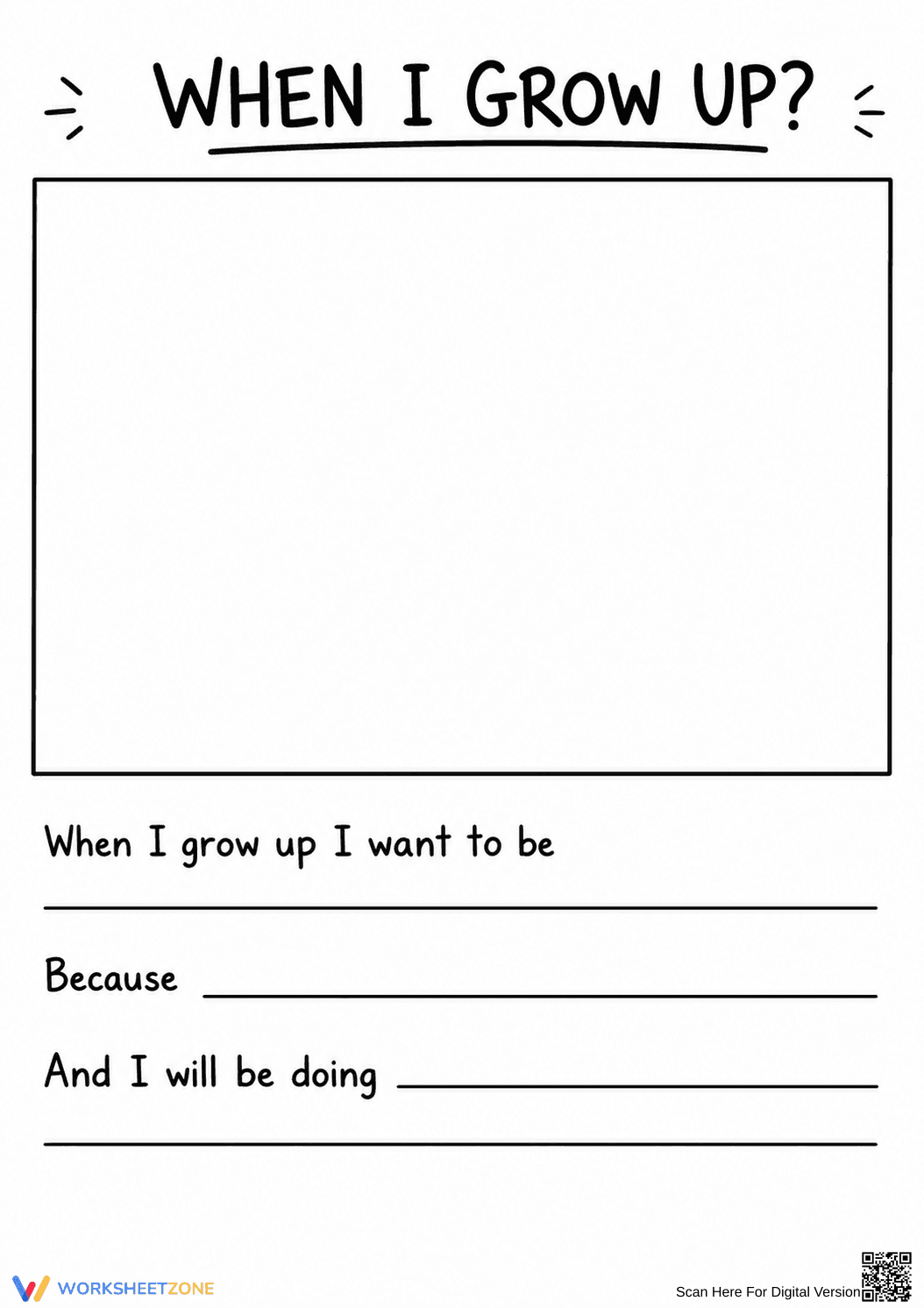
This Kindergarten career exploration worksheet helps young learners articulate their future aspirations by combining drawing and basic sentence completion. Students will visualize their dream job and practice foundational writing skills to explain their choice.
At a Glance
- Grade: Kindergarten · Subject: English
- Standard:
CCSS.ELA-LITERACY.W.K.2— Use drawing and writing to compose informative texts- Skill Focus: Sentence completion and career exploration
- Format: 1 page · 4 tasks · No answer key · PDF
- Best For: Morning work or writing centers
- Time: 15–20 minutes
This single-page resource features a large illustration box for students to draw themselves in their future career. Below the drawing space, three guided sentence starters prompt students to name their desired job, provide a reason for their choice, and describe what they will be doing. The open-ended format accommodates various writing abilities, from phonetic spelling to dictated responses.
- Print (1 min): Simply print the single-page PDF. No special materials or cutting required.
- Distribute (1 min): Hand out to students along with crayons, markers, and pencils.
- Review (3 mins): Read the sentence prompts aloud for early readers and model an example on the board.
With under two minutes of total teacher prep time, this worksheet is an excellent addition to emergency sub plans or spontaneous writing blocks.
Aligned to primary standard CCSS.ELA-LITERACY.W.K.2: Use a combination of drawing, dictating, and writing to compose informative/explanatory texts in which they name what they are writing about and supply some information about the topic. Both standard codes can be copied directly into lesson plans, IEP goals, or district curriculum mapping tools.
Use this worksheet during a community helpers unit or as an engaging back-to-school icebreaker. It works beautifully as an independent writing center activity after a whole-class read-aloud about different professions. As a formative assessment tip, observe how students use phonetic spelling to complete the "Because" prompt, noting their ability to connect a reason to their stated career choice. Expected completion time is 15 to 20 minutes.
Designed for Kindergarten and first-grade students developing early writing and expressive skills. The combination of drawing and writing provides natural differentiation, allowing pre-writers to express complex ideas visually while practicing letter formation. It pairs perfectly with community helper anchor charts or career day presentations.
Integrating career exploration into early childhood education fosters essential goal-setting skills and promotes a deeper understanding of community awareness among young learners. By directly aligning with the primary standard CCSS.ELA-LITERACY.W.K.2, this engaging activity ensures that kindergarten students effectively use a combination of drawing, dictating, and writing to compose informative texts about their future aspirations. According to Fisher & Frey (2014), providing structured sentence frames significantly lowers the affective filter for early writers, allowing them to focus their cognitive energy on content generation rather than struggling with complex syntax. This carefully guided approach not only helps young learners articulate their reasoning with greater confidence but also builds critical foundational literacy skills while they actively explore their personal interests. Furthermore, connecting visual representation with written language reinforces vocabulary acquisition and helps students organize their thoughts sequentially, setting a strong precedent for future academic success and lifelong learning.


