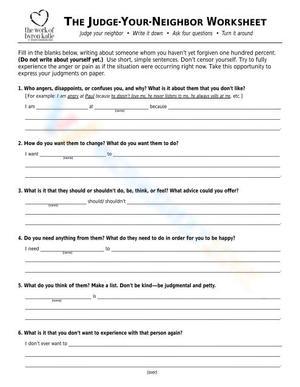
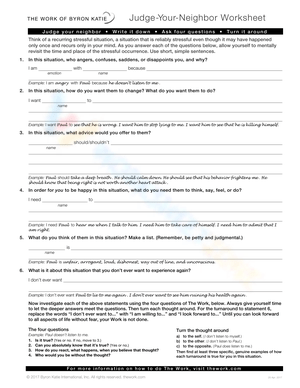
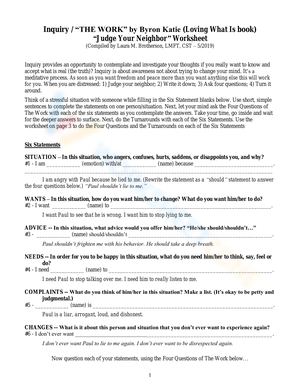
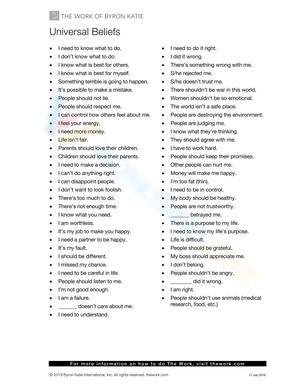
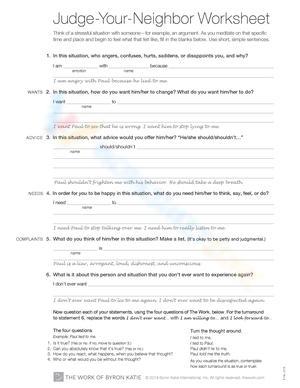
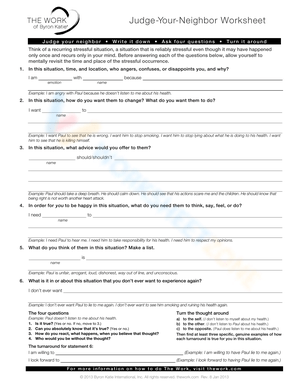
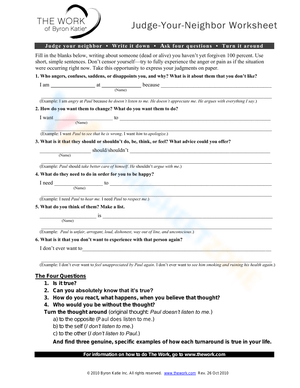
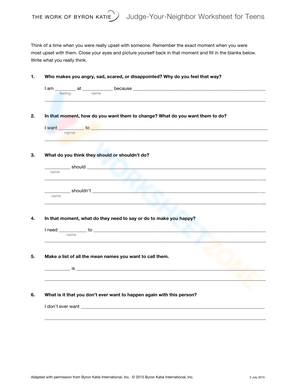
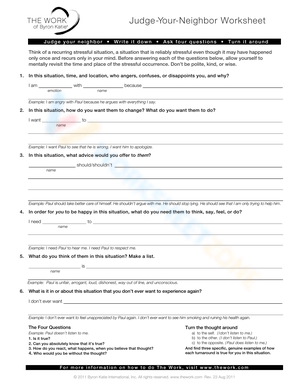
These 10th grade judge your neighbor worksheets printable put the mechanics of social judgment directly in front of students — not as a lecture on kindness, but as a structured examination of the specific thinking behind a snap reaction. Each worksheet isolates the gap between what a student actually observed and what they concluded, giving teachers a repeatable format that works in advisory, counseling, health class, or a restorative conversation after a real conflict.
What Students Work Through in Each Worksheet
The core task across the set is separating observation from interpretation. Students begin by describing a specific behavior they noticed — what someone said, did, or wore — and then write out the conclusion they drew. From there, each worksheet asks them to name the evidence they used, list what information was missing, and generate at least two alternative explanations for the same behavior. That three-step move — observe, conclude, interrogate — is the structural engine of every worksheet in the set.
Beyond that core sequence, students practice four connected skills:
- Identifying the source of a judgment — whether it came from direct experience, a rumor, a stereotype, or a single past interaction
- Distinguishing feeling from fact — separating "I felt dismissed" from "She ignored me on purpose"
- Writing alternative interpretations — generating explanations that account for context the student did not have
- Composing a revised statement — rewriting the original conclusion in language that is more accurate and less blame-driven
Tenth graders are generally capable of sustained written reflection, which makes this format more productive than it would be at earlier grades. They can hold two contradictory explanations at once and evaluate which has more support — a cognitive skill that only begins stabilizing in mid-adolescence.
Mistakes Students Make That These Worksheets Help You Catch
The most common error is conflating observation with evidence. A student writes "She always acts like she's better than everyone," presents this as a fact, and then lists no actual observable behaviors to support it. The worksheet surfaces this immediately: when students reach the evidence section and realize they have nothing concrete, they either go blank or quietly revise their original claim. Both responses are productive, but you need to be ready to name what just happened.
A second pattern is premature certainty in the alternative-explanations section. Students who struggle with perspective-taking will write one alternative, mark it as unlikely, and conclude their original judgment was therefore correct. Walking through a real example before independent work — "She didn't wave back. Maybe she didn't see me. Maybe she's embarrassed about something I don't know about. Maybe she's dealing with something that has nothing to do with me." — shows students that alternatives are meant to be expanded, not ranked and eliminated.
A subtler pattern appears with students who perform self-awareness without actually practicing it. They write "I know I shouldn't judge" in the reflection box without engaging with the specific thought they had. Prompting those students to write the actual judgment — not just the awareness that judging is wrong — is often where the most useful thinking begins.
Recommended Lesson-Planning Strategies for These Worksheets
The most effective structure is private writing before any group discussion. Give students six to eight minutes to complete the observation and conclusion sections independently before you open the room. The 10th grade judge your neighbor worksheets printable work best when students have already committed something to paper — they are far less likely to simply echo whoever speaks first in discussion.
For advisory, a 20-minute block holds the full sequence: three minutes to introduce the scenario, seven minutes for independent writing, six minutes for partner exchange using a sentence frame like "One explanation I hadn't considered was...", and four minutes for a whole-group debrief. In a longer class period, build in time for students to revise their original conclusions after hearing a partner's perspective. That revision step — writing a second draft of the judgment after new information enters — is where the deepest work tends to happen.
The worksheets also hold up as a restorative tool after a real conflict. In that context, have each student complete the worksheet independently before any shared conversation. Working through the format first creates a common vocabulary — observation, conclusion, evidence, alternative — that keeps a restorative discussion from collapsing into competing accounts of who did what.
Why Grade 10 Is the Right Developmental Moment for This Work
Social cognition at 15 and 16 is genuinely more sophisticated than it was two years earlier, but it is not yet stable under pressure. Students at this age can identify bias in the abstract and still defend their own quick judgments with full confidence. That gap — between theoretical understanding and in-the-moment behavior — is exactly what structured written reflection addresses. When students have to write a judgment down and then examine it against observable evidence, they are doing something they almost never do naturally in real time.
The other developmental factor is the role of group identity. Tenth graders are deeply embedded in peer group dynamics, and judgments at this age often attach to group membership — "those people always..." or "kids like her..." — rather than individual behavior. Each worksheet anchors claims in specific, observable acts, which quietly dismantles the group-level generalization without requiring a direct confrontation about bias.
Differentiating These Worksheets Across Ability Levels and Settings
For students who find open-ended reflection difficult, provide a completed model — a filled-in example showing a neutral scenario (someone cutting in the lunch line) worked through every section of the worksheet. Seeing a finished example reduces the cognitive demand of the blank page without removing the expectation for original thinking. For students who work quickly and stay surface-level, add one sentence to the revision prompt: "Now write your revised statement again, but this time include one specific piece of information you wish you had known before you concluded anything." That constraint forces depth without restructuring the whole task.
In counseling or small-group settings, the 10th grade judge your neighbor worksheets printable can be used with more personally sensitive scenarios than you would risk with a full advisory class. With the right relational context, students in those groups often produce the most specific and honest responses in the set — detailed enough to become a reference point in follow-up sessions.
For students in an English or philosophy class examining reasoning and ethics, each worksheet pairs naturally with a short reading on the fundamental attribution error or confirmation bias. Both concepts are accessible at this level, and the worksheet format holds up in that academic context without modification. The scenarios change; the reflection structure stays the same.
Frequently Asked Questions
Are these worksheets appropriate after a real conflict, or only for preventive lessons?
Both contexts work, but the approach differs. As a preventive lesson, use neutral or fictional scenarios and treat the task as an intellectual exercise in examining judgment patterns. After a real conflict, have each student complete the worksheet independently using the actual situation — and review their responses before bringing anyone into a shared conversation. The worksheet creates structured thinking before emotional reactivity can close the discussion down.
How do I handle a student who won't write down their actual judgment because they feel defensive or embarrassed?
Give them permission to use a fictional version: "Write about a judgment someone else might make in this situation." That one adjustment usually unlocks the reflection because it removes the student from the immediate hot seat. In most cases, the fictional judgment they write turns out to be nearly identical to their own — which is worth noting quietly in a follow-up conversation.
Can these worksheets be used outside of advisory and counseling?
A teacher using the 10th grade judge your neighbor worksheets printable in a health class will find they align naturally with units on communication, stereotyping, conflict resolution, and mental health. In social studies, the same framework transfers to historical and civic contexts — examining how communities have drawn conclusions about other groups based on incomplete information. The worksheet structure doesn't change; the scenarios do.
How long does each worksheet take to complete?
Most students finish the core observation and reflection sections in 10 to 15 minutes. The revision and transfer sections add another five to eight minutes. A full lesson using one worksheet — including discussion — runs comfortably in 25 to 30 minutes, which fits a standard advisory block or the opening portion of a longer class period.












 Interactive Worksheet Maker
 Quiz Maker
 Word Search Maker
 Crossword Puzzle Maker
 Word Scramble Generator
 Sentence Scramble Generator
 Handwriting Worksheet Generator
 Name Tracing Generator
 Fill In The Blank Generator