


























Views
Downloads

Essential Resentment Inventory Worksheet | Grade 12+
Paste this activity's link or code into your existing LMS (Google Classroom, Canvas, Teams, Schoology, Moodle, etc.).
Students can open and work on the activity right away, with no student login required.
You'll still be able to track student progress and results from your teacher account.
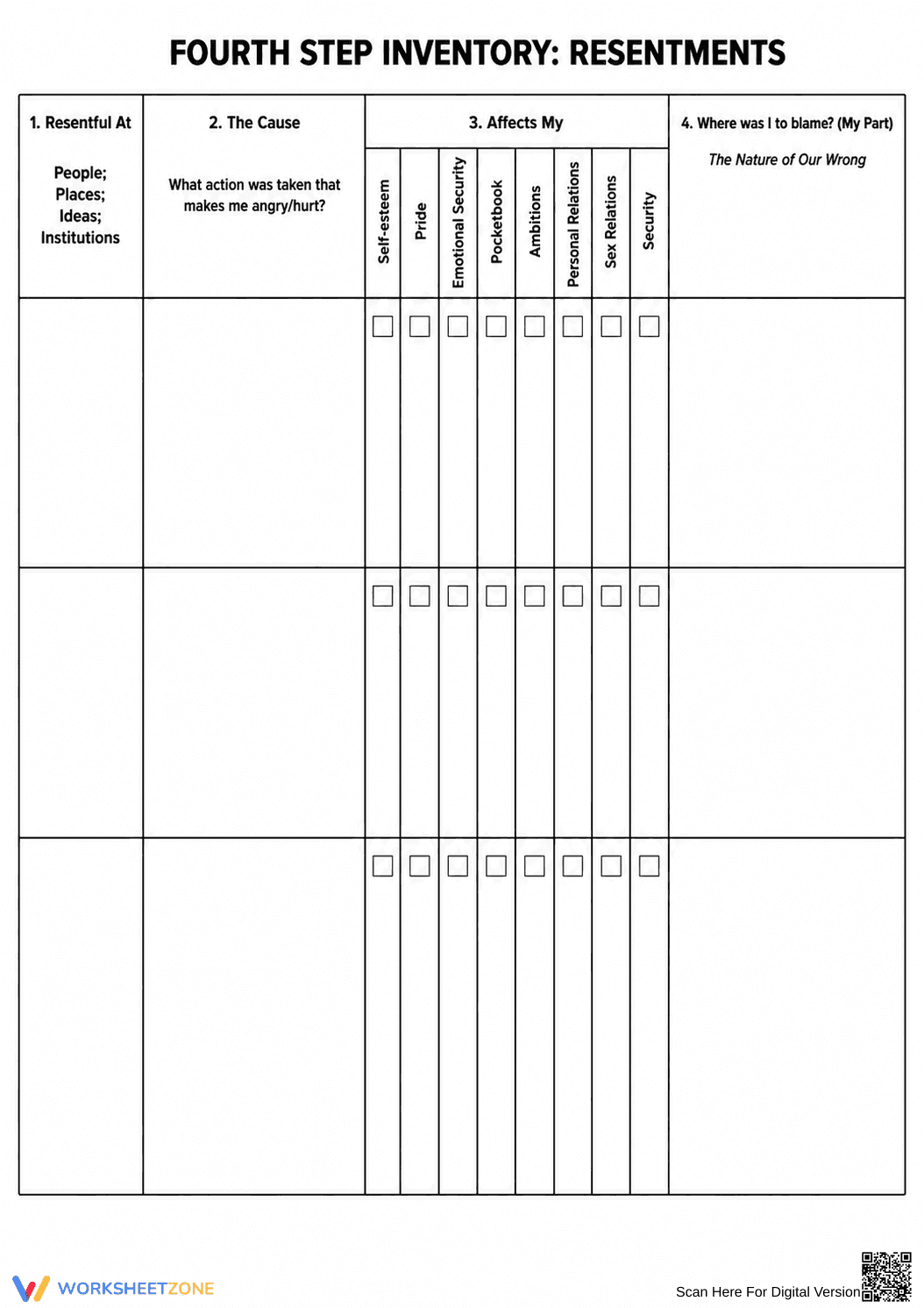
This resentment inventory worksheet provides a structured framework for students to process complex emotions and develop self-awareness. By documenting specific grievances and analyzing their internal impact, learners move from reactive anger to proactive self-reflection. This tool is essential for fostering emotional intelligence and personal accountability in high school or adult education settings.
At a Glance
- Grade: 12 · Subject: Behavior Activities
- Standard:
CCSS.ELA-LITERACY.W.11-12.10— Write routinely for reflection and self-analysis to build emotional awareness.- Skill Focus: Emotional self-regulation
- Format: 1 page · 3 entries · No answer key · PDF
- Best For: Counseling, SEL, or personal growth
- Time: 20–30 minutes
What's Inside
The worksheet features a clean, four-column grid designed for deep emotional inventory. Students identify the source of resentment (people, places, or institutions), describe the specific cause of their anger, and use a checkbox system to track how the feeling affects their self-esteem, security, or personal relations. The final column prompts an honest assessment of the student's own role in the situation, encouraging accountability.
Zero-Prep Workflow
- Print: Select the single-page PDF and print copies for the entire group in under 30 seconds.
- Distribute: Hand out the worksheets at the start of a counseling session or SEL block with no additional materials required.
- Review: Spend 10 minutes facilitating a private reflection period, followed by an optional, safe-space discussion. Total teacher preparation time is less than 2 minutes.
Standards Alignment
This resource aligns with `CCSS.ELA-LITERACY.W.11-12.10`. This standard requires students to write routinely over extended time frames for a range of tasks and purposes. This worksheet fulfills the requirement for reflective, purpose-driven writing that builds self-regulation. Both standard codes can be copied directly into lesson plans, IEP goals, or district curriculum mapping tools.
How to Use It
Use this worksheet during a Social-Emotional Learning (SEL) unit focused on conflict resolution or as a targeted intervention following a behavioral incident. It serves as an excellent formative assessment tool; observe if students can move beyond surface-level blame to identify specific internal impacts. Completion typically takes 20 to 30 minutes depending on the depth of reflection.
Who It's For
This resource is designed for Grade 11-12 students, adult learners, and individuals in school counseling programs. It is particularly effective for students working on behavioral IEP goals related to self-regulation. Pair this with an anchor chart on "I-Statements" or a direct instruction lesson on the psychology of resentment.
According to Fisher & Frey (2014), structured writing prompts that require students to analyze their own experiences and emotional states are critical for developing metacognitive skills and self-regulation. This worksheet aligns with the CCSS.ELA-LITERACY.W.11-12.10 standard by providing a rigorous framework for routine reflective writing. By categorizing the "Nature of Our Wrong" and identifying specific impacts on self-esteem and security, students engage in the high-level cognitive task of self-evaluation. Research indicates that when students are given clear structures to process interpersonal conflict, they are more likely to adopt prosocial behaviors and reduce classroom disruptions. This printable tool offers a practical application of these principles, ensuring that emotional inventory becomes a manageable, repeatable process for learners. It is a reliable resource for educators seeking to integrate behavioral health with academic writing standards in a high school or adult learning environment.


