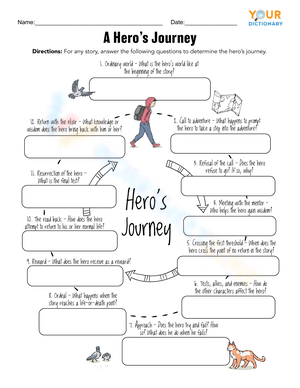
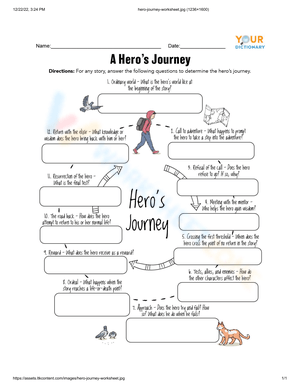
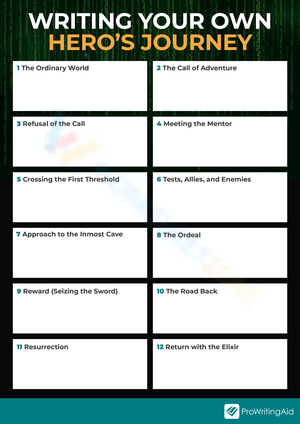
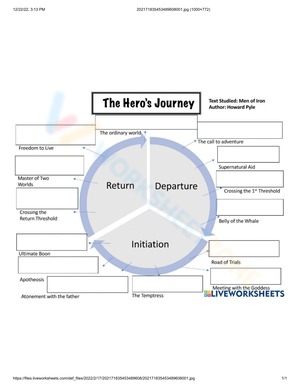
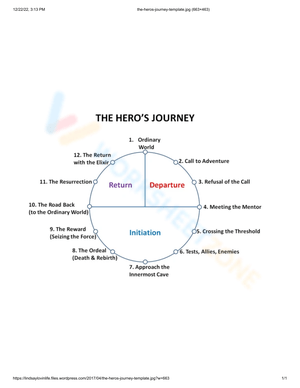
These 10th grade heros journey worksheets printable give teachers a structured analysis frame for moving students past plot summary and into the harder work of tracing how a character actually changes. Each worksheet focuses on one layer of the narrative arc — from the inciting call through the trials, the ordeal, and the return — requiring students to gather text evidence rather than simply name stages. The set works across novels, myths, short stories, and film study without needing a full redesign for each new text.
What Each Worksheet Targets
The worksheets break the hero's journey into discrete analytical tasks rather than presenting a single open-ended organizer. That distinction matters because an empty box labeled "the journey" gives students no guidance about the difference between recounting plot events and explaining what those events accomplish. Separating the stages forces deliberate interpretive decisions at every point in the arc.
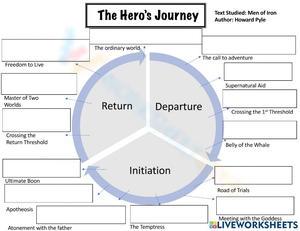
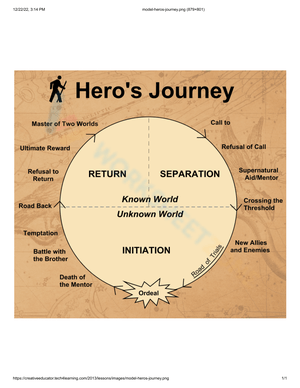
- Stage identification with student-facing definitions — plain-language descriptions of what each stage accomplishes narratively, not just what happens during it.
- Evidence boxes — space for direct quotations, scene references, or closely paraphrased details that prove the stage is present in the text.
- Character change prompts — targeted questions about fear, motivation, and the specific moment when the character's internal state shifts.
- Theme connection — a section asking students to explain what the journey reveals about a larger idea, not just what happens to the protagonist.
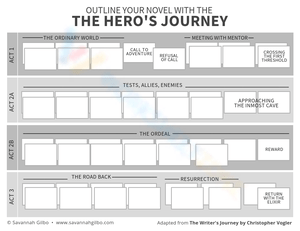
- Creative narrative planning — one worksheet where students apply the arc to an original story they design, which functions well as a pre-writing tool in a narrative writing unit.
The evidence boxes produce the most noticeable payoff in actual classroom use. Students who can name "the ordeal" without locating it in the text are doing pattern recognition, not analysis. Requiring a specific citation at every stage forces students to slow down and decide whether a scene truly qualifies — which is precisely the interpretive judgment this format builds.
Why the Return Stage Deserves the Most Classroom Time
Most instruction on this pattern concentrates on the call to adventure and the trials because those stages are the easiest to locate and the most dramatic. The return gets compressed into an ending. That's a missed opportunity. When students explain what the character brings back to the community — changed knowledge, a painful truth, a skill or understanding acquired through loss — they stop retelling events and start analyzing impact.
In practice with 10th grade heros journey worksheets printable, that shift becomes visible quickly. A student who writes "Odysseus goes home" is doing something fundamentally different from a student who writes "Odysseus returns carrying the understanding that loyalty survives what absence destroys." The return stage prompt — "What does the character bring back, and how does it affect the people around them?" — is the one question most likely to push a student across that line. Teachers who add a short "Why does this matter?" box inside the return stage section consistently see more substantive written responses than those who treat the return as a summary prompt.
The Analysis Errors That Show Up Most Often in Student Work
The most persistent error we see in student work on the hero's journey is collapsing the transformation and the ordeal into a single event. Students write that the character "went through something hard and changed," treating both stages as identical. The transformation is the internal reconfiguration that follows the ordeal — the character must carry forward a changed belief or commitment, not simply survive a difficult scene. A prompt that asks "What did the character believe before this moment, and what do they believe differently after it?" reliably separates those two stages in student thinking. Without that prompt, most students merge them automatically.
A second error: students who correctly identify six or seven stages will then write a theme statement that ignores the journey entirely, as if the two tasks were unrelated exercises. The theme connection section works best when teachers model explicitly how the arc points toward the message — for instance, showing how a character who refuses the call, eventually accepts it, and then transforms through failure points toward a theme about pride or avoidance. That modeling takes about ten minutes and prevents the disconnect from appearing in student work.
Fitting These Worksheets Into Your Planning Calendar
The most effective approach is to resist assigning the full arc organizer all at once. Start with the first two or three stages completed together as a whole class, thinking aloud about whether a scene genuinely functions as a threshold crossing or merely precedes one. That distinction — does this moment serve a structural purpose, or is it only a plot event? — is the interpretive judgment students need to practice before working independently. The first shared session also normalizes the idea that stage placement is sometimes arguable, which keeps students from treating the worksheet as a hunt for one fixed answer.
Small groups then take a section of the journey and present their stage, evidence, and explanation to the class. The ensuing discussion is where the most substantial learning happens — students debate whether a scene belongs to one stage or another, whether a particular character truly functions as the mentor, and whether certain stages are absent from the text. Those arguments are not confusion to correct; they are evidence of careful reading. Teachers who use 10th grade heros journey worksheets printable across a full unit report that the small-group presentation structure consistently generates more textual specificity than whole-class, teacher-led analysis alone.
- Before reading: Preview the arc stages and key vocabulary; complete stage one together using a short excerpt.
- During reading: Pause after major turning points for brief evidence gathering on the current stage.
- After reading: Use the full organizer as seminar preparation or as a pre-writing frame for an analytical essay.
- Extension: Have students design an original short narrative using the arc as a planning structure.
Standard Alignment
These worksheets align most directly with CCSS.ELA-LITERACY.RL.9-10.3, which asks students to analyze how complex characters develop across a text, interact with other characters, and advance the plot or develop the theme. Every stage prompt on the character change worksheets targets that standard — students are not simply noting what happens but explaining how the character's responses to challenge reveal what the character is becoming. RL.9-10.5, which addresses how an author's structural choices shape a text's effects, maps to the stage identification and theme connection work. When students examine why the hero's arc is structured as a departure followed by trials followed by a return, they are analyzing authorial choice, not just narrative convention.
Adjusting These Worksheets for a Mixed-Readiness Classroom
For students who freeze at open-ended analytical prompts, the identification worksheets work best as a starting point — name the stage, summarize what happened, identify one challenge the character faces. That ceiling is low enough to produce complete responses without shutting down thinking. The key is not leaving students there permanently; once they identify stages reliably, they are ready for the next layer, which adds evidence and explanation.
Students ready for deeper analysis use the evidence-and-explanation worksheet, which asks them to quote or closely paraphrase, explain why the quoted moment proves the stage is present, and then connect the stage to a specific character trait. That third move — connecting stage to trait — is where comprehension depth beyond recognition becomes visible in student writing. For students working on original narratives, the planning worksheet gives them the arc as a structural frame for pre-writing without requiring mastery of literary analysis first.
One honest limitation: this format frustrates students who have already internalized the arc and want to write extended analytical prose rather than fill labeled boxes. For those students, the worksheet functions best as a planning document rather than a submission — they use it to organize evidence and then write from it in paragraphs, turning in only the written response.
Frequently Asked Questions
What should teachers do when a text doesn't map cleanly onto the arc?
The misalignment is often the richest discussion point in the unit. When students try to locate stages that aren't present, discover two stages compressed into one scene, or find that the arc runs in a nontraditional order, the analytical question becomes why the author made that structural choice. A set of 10th grade heros journey worksheets printable that leaves room for students to note "stage absent or modified — explain the effect" produces sharper analytical writing than a format that requires students to force every text into twelve tidy boxes.
How do these worksheets connect to social-emotional learning goals?
The character change prompts and the return stage section give teachers a natural opening into conversations about self-awareness, empathy, and decision-making under pressure. When students examine whether a character accepts help, how early mistakes shape later choices, and what the character carries back to the community, they are practicing the reflective thinking that SEL frameworks ask students to apply to their own experience. The worksheets don't require that conversation — they create the conditions for it when teachers are ready to facilitate it.
Which texts pair well with this framework at the 10th grade level?
The arc maps clearly onto texts commonly taught at this level — The Odyssey, Beowulf, The Alchemist, and mythology from a range of cultural traditions. It also transfers well to film, which is useful when teachers want students to practice the framework on something they can pause and revisit before applying it to a longer prose text. Contemporary realistic novels often require students to assess where the classical arc is present, partially present, or deliberately subverted — and that assessment is itself a strong analytical task for 10th graders.
Can a substitute teacher run a productive lesson using these worksheets?
Once students have completed one or two worksheets earlier in the unit, a single organizer from the set can sustain a productive class period during film study or independent reading with minimal front-loading. The stage definitions printed on each worksheet give students enough reference to work without the classroom teacher present. That's one practical advantage of a consistent printed format — familiarity with the structure reduces the time students spend figuring out directions and increases the time they spend reading and writing.












 Interactive Worksheet Maker
 Quiz Maker
 Word Search Maker
 Crossword Puzzle Maker
 Word Scramble Generator
 Sentence Scramble Generator
 Handwriting Worksheet Generator
 Name Tracing Generator
 Fill In The Blank Generator