10th Grade Growth Mindset PDF Worksheets
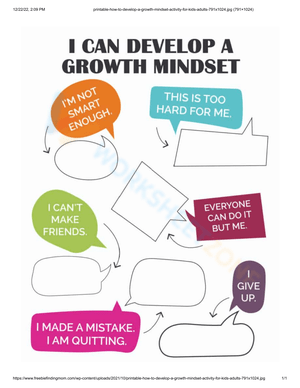
These 10th grade growth mindset pdf worksheets give teachers a concrete way to move the "effort equals growth" conversation out of the abstract and into students' actual academic lives — attaching mindset reflection directly to assessment data, course content, and the specific frustrations that surface in sophomore year. Each worksheet is formatted to match the intellectual register that 10th graders expect: no motivational slogans, no cartoonish graphics, just evidence-grounded exercises built on brain science students can actually respect. The set addresses neuroplasticity, fixed-mindset triggers, metacognitive strategy evaluation, and the critical distinction between productive struggle and ineffective repetition.
The Specific Skills These Worksheets Build
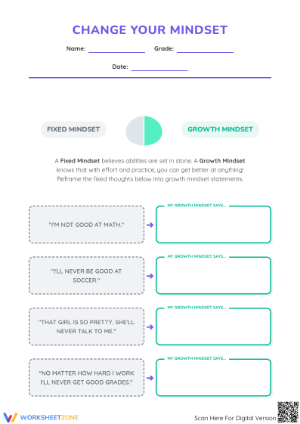
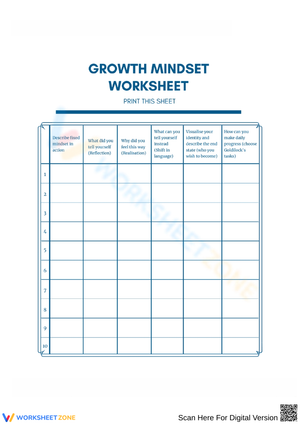
The exercises move through several distinct cognitive tasks rather than cycling through the same reflection prompt reworded. Students map their own fixed-mindset triggers — the specific classroom moments that pull them toward disengagement — and write a scripted self-response they can use when those moments arrive. Other exercises guide students through an exam wrapper sequence: after receiving a graded assessment, they document how they prepared, identify the point at which their strategy broke down, and commit to one specific adjustment for the next cycle. That final step carries the most instructional weight — the worksheet demands a concrete commitment, not a vague "study more next time."
The neuroplasticity exercises ask students to connect the concept to their own experience rather than read a passage and answer recall questions. Students annotate a short explanation of neural pathway formation, then write a paragraph describing a skill they built through repeated failure — an athletic move, a second language, a musical passage, whatever applies to them. Two exercises address metacognition directly: students evaluate whether their current study method for a given class is producing results proportional to the time they're investing, and if not, name a replacement strategy they'll test in the next unit. That is a measurably different prompt than "reflect on your learning," and the specificity shows in what students actually write.
Student Missteps These Exercises Consistently Surface
The most consistent error is students conflating effort with effective effort. A student will write, "I studied for two and a half hours," and treat that as sufficient evidence of a growth mindset — without reflecting on what they actually did during those hours or whether it produced any learning. The exam wrapper worksheet is built to surface this gap: it asks students to name the strategy, not just the duration. Plan to push on this distinction in discussion, because students who haven't been asked to examine their own thinking will default to time as a proxy for work quality.
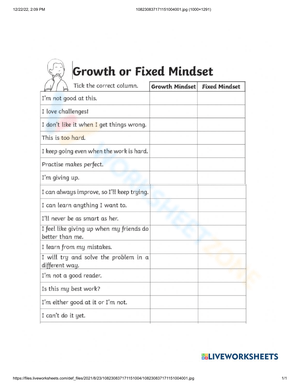
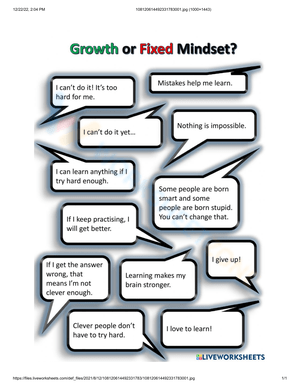
A subtler problem appears in the fixed-mindset trigger exercises. When asked to name their triggers, most 10th graders initially write something socially presentable — "I get frustrated when I don't understand things right away" — which tells a teacher almost nothing. The prompts that work require a second level of specificity: which class, which type of task, what the internal voice actually says. Getting students to write "When I get called on in Algebra II and I don't know the answer, I tell myself I'm just not a math person" requires modeling and usually a second draft. Treat the first attempt as a rough draft — the honesty typically comes in revision.
Building These Worksheets Into Your Lesson-Planning Calendar
The exam wrapper worksheet earns the most traction when it follows an assessment that surprised students — a quiz they expected to pass and didn't. That emotional context makes the reflection feel necessary rather than procedural. Return it within two class periods of handing back the assessment, while how they prepared is still fresh in their minds. Teachers who wait until the following week report that students complete it mechanically, without the self-investigation that makes it useful. These 10th grade growth mindset pdf worksheets function as formative tools, not summative ones — the grade matters far less than the quality of reasoning visible in the responses.
The neuroplasticity and trigger-identification exercises work well at the start of a semester or immediately before a unit students historically struggle with — the analytical essay sequence in AP English, lab reports in chemistry, timed writing in any course. Placing the reflection there frames the challenging work ahead as expected and workable rather than as an audition for innate talent. Advisory periods and AVID sections are natural homes for this material, but these exercises also fit into the first ten minutes of any class where the teacher wants to set a productive tone before a difficult lesson.
Extending and Adjusting the Exercises Across a Mixed-Ability Sophomore Class
Students who struggle with extended writing will find the open-ended reflection prompts frustrating for reasons that have nothing to do with mindset. For those students, the same exercise functions better as a discussion guide — the teacher reads the prompt aloud, the student responds verbally, then writes one summarizing sentence. This keeps the cognitive work on the mindset content rather than on writing mechanics, which is what the exercise is actually measuring.
Students in honors or AP tracks present a different challenge: they have often succeeded academically on raw aptitude and have little experience sitting with genuine failure. For these students, the exam wrapper prompt benefits from an added layer — not just "what will I change" but "what's the hardest version of that change I'm willing to commit to?" The career-readiness reflection can also be extended by asking students to interview someone working in a field they're considering and bring back a documented account of a setback that person experienced. Teachers who extend the exercises this way are essentially using 10th grade growth mindset pdf worksheets as a research-plus-reflection format, which adds academic rigor without losing the personal investment the reflection requires.
Standard Alignment
These worksheets address CASEL's self-awareness and self-management competencies, which sit at the center of most state-adopted SEL frameworks. Self-awareness appears in the trigger-identification and neuroplasticity exercises; self-management appears in the exam wrapper and metacognitive strategy evaluation. Within CASEL's K–12 scope and sequence, both competencies are specifically prioritized in the 9–12 band because adolescents at this stage are developmentally ready to monitor and adjust their own learning against real academic outcomes — not as a hypothetical exercise, but because the complexity of high school coursework gives them actual consequences to test those strategies against. Illinois, California, and several other states have adopted SEL standards that map directly to these competency descriptors, making this work documentable as formal SEL instruction. In states without standalone SEL standards, teachers often embed these exercises under ELA speaking and listening standards that address self-reflection and collaborative discussion.
Frequently Asked Questions
Can these worksheets be used in subject-area classes rather than advisory or counseling?
Subject-area use is often more effective than advisory use. When a student completes an exam wrapper in the context of their actual chemistry or history class, the reflection is anchored to a real academic outcome rather than a hypothetical. The exercises function identically regardless of the course — any teacher who returns graded work can fold them into the feedback cycle.
How do I prevent students from filling these out dishonestly just to finish the assignment?
The exercises that require specific evidence — naming the exact assignment, the exact strategy used, the exact point of breakdown — are much harder to fake than open-ended prompts. Requiring students to attach the actual graded paper to the exam wrapper dramatically improves response quality, because the evidence is sitting in front of them. When responses are consistently vague, that's usually a signal the prompt needs a stronger introduction, not that students are being deliberately dishonest.
How often should students use these exercises across the school year?
Two or three deep reflections per semester outperform monthly check-ins that students begin treating as routine. Spaced use — tied to actual assessment results or meaningful academic transitions — keeps the reflection genuine. Using 10th grade growth mindset pdf worksheets four or five times across the year, each time in a genuinely different context, builds the habit more reliably than clustering them into a single mindset unit where students complete them as a set and then never return to the ideas.
Do these worksheets help with test anxiety?
They address one of test anxiety's most common roots: the fixed-mindset belief that a single assessment is a permanent verdict on a student's capability. Reframing a test as a progress check — one data point in a longer arc of development — lowers the perceived stakes. The strategy-evaluation exercises also give students a sense of procedural control over their preparation, which is one of the most reliable anxiety moderators available at the classroom level. What these exercises don't do is replace counseling support for students with clinical-level anxiety — they're classroom tools with real reach, but that reach has limits.
Clear All