These 10th grade wise mind pdf worksheets give health teachers, school counselors, and advisory period leads a direct tool for teaching one of DBT's most accessible concepts to adolescents who are, developmentally, at peak vulnerability to emotion-driven decision-making. The set covers all three states of mind — Emotion Mind, Reasonable Mind, and Wise Mind — through structured formats that work inside a standard class period without requiring clinical training on the teacher's part.
Concepts Each Worksheet Addresses
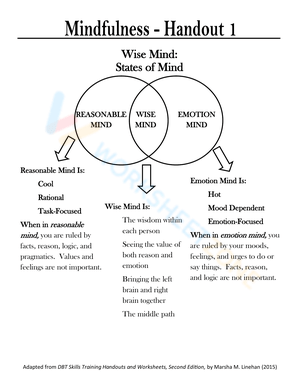
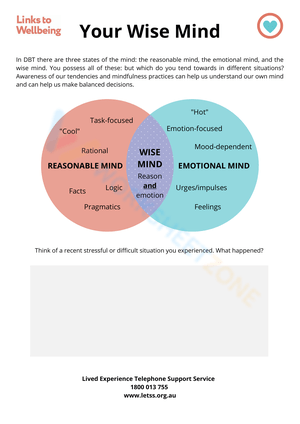
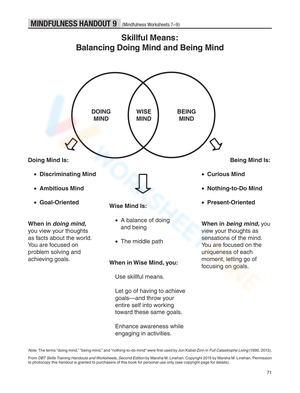
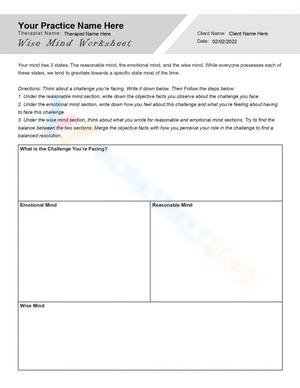
The Wise Mind framework rests on a three-part model that teenagers can grasp quickly once the vocabulary is in place. Emotion Mind is the state that fires when a student reads a dismissive comment on a group chat and types back something they'll regret. Reasonable Mind is the state that tells a student to analyze every variable before making any decision, stripping out the emotional reality of the situation entirely. Wise Mind is the synthesis — the state that notices the hurt, acknowledges it as valid, and then chooses a response that doesn't make things worse.
Each worksheet in the set targets a specific layer of this skill:
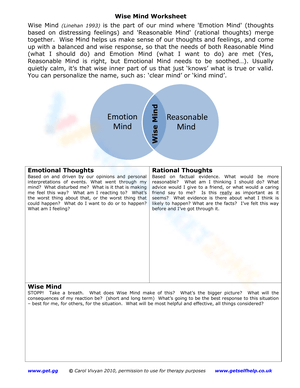
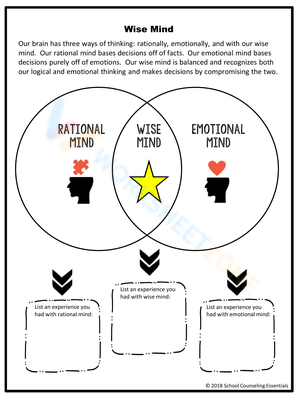
- Venn diagram exercises where students map their logical thoughts and emotional reactions to a scenario, then draft a response drawing from both circles
- Scenario analysis sheets built around authentic 10th-grade situations — a group project partner who contributes nothing, exam prep running alongside a packed extracurricular schedule
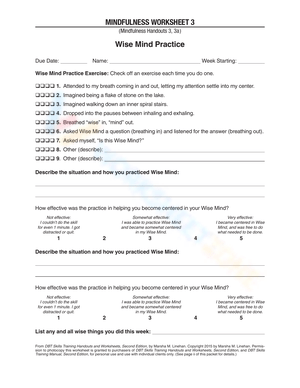
- Reflection logs where students record a real decision they made that day and identify which state of mind was in charge
- Prompted rewrite exercises that ask students to take an impulsive Emotion Mind response and reconstruct it in Wise Mind language
Why This Skill Lands Differently at This Grade Level
The prefrontal cortex — the region governing impulse control, long-range planning, and emotional regulation — is not fully developed until the mid-twenties. At fifteen or sixteen, students are routing most interpersonal decisions through the limbic system first. That isn't a character flaw; it's a developmental fact. What makes the Wise Mind model especially well-matched to 10th grade is that it does not ask students to suppress emotions or pretend they don't exist. It asks them to notice, name, and then consult reason before acting. That two-step is exactly the metacognitive habit that transfers to nearly every high-stakes adolescent moment — from deciding whether to send a message they haven't thought through to navigating a conflict with a close friend.
The Venn diagram format externalizes a cognitive process that is otherwise invisible. Putting "I felt humiliated" in the left circle and "the teacher was explaining policy, not calling me out" in the right circle makes the internal conflict visible and manageable. Students who struggle to self-reflect in the abstract engage immediately when a worksheet gives their competing thoughts a container to live in.
Building These Worksheets Into Your Weekly Lesson Plans
The most natural home for this material is advisory, homeroom, or a standalone health or SEL block. A few English teachers have pulled individual worksheets into character analysis units, where Wise Mind language gives students useful vocabulary for discussing why literary characters make the choices they do — a low-effort cross-curricular integration that usually lands well. For counselors running small groups, the scenario analysis worksheets work as 15-minute structured activities followed by open discussion; the reflection logs work as take-home assignments between sessions. Used consistently as warm-ups, these 10th grade wise mind pdf worksheets take around 10–12 minutes to complete and leave time for a brief class debrief before transitioning to the main lesson.
Introduce the Venn diagram worksheet first, and run a collective example before asking students to apply it personally. The scenario that works most reliably: a text message that goes unanswered for several hours. It's universal, non-threatening, and precisely illustrates all three states. Emotion Mind assumes rejection — they're ignoring me on purpose. Reasonable Mind dismisses the feeling — people get busy; there's nothing to be upset about. Wise Mind holds both — I feel hurt by this, and that makes sense, and I'll reach out later when I'm calmer. Once students have worked through a collective example, the personal application feels far less exposing.
Errors Students Make That These Worksheets Help You Catch
The most consistent pattern is what might fairly be called Reasonable Mind cosplay — students who fill the Wise Mind circle with responses that are entirely logical and contain zero emotional acknowledgment. A student who writes "I will set aside how I feel and focus on the facts" has not reached Wise Mind; they've relabeled Reasonable Mind. This is worth addressing explicitly before independent work begins, because the misunderstanding is common and, left uncorrected, reinforces emotional suppression rather than integration — the opposite of what the framework intends.
A second pattern: students who write "I felt bad" as their entire Emotion Mind response. This is almost never avoidance; it's a vocabulary deficit. Students who haven't yet developed the emotional granularity to distinguish between shame, disappointment, and embarrassment default to vague language. Posting a brief emotion vocabulary list — ten or twelve words covering the most common states — resolves this in most cases. Students who can access more precise language consistently produce richer, more honest Venn diagrams and reflection logs.
Standard Alignment
These worksheets align to the CASEL framework under two core competencies. Self-Awareness — recognizing one's emotions, thoughts, and values and understanding how they influence behavior — is directly addressed each time a student identifies which state of mind they are operating from and articulates why. Self-Management — managing emotions and behaviors effectively across situations — is practiced whenever a student maps out a Wise Mind response to a stressful scenario rather than reacting from the Emotion Mind default. Both competencies appear in CASEL's K-12 scope-and-sequence with explicit application to high school beginning in grades 9–10. Introducing the Wise Mind framework in 10th grade positions students to build on the skill meaningfully in their junior and senior year SEL work.
Adjusting These Worksheets Across Ability Levels
Students new to SEL vocabulary benefit from having the three states of mind defined in a reference sidebar they can consult while working. Without that anchor, cognitive effort goes toward recalling definitions rather than applying them — exactly the wrong place to spend mental bandwidth when the goal is emotional reflection. For students already fluent with DBT concepts through prior counseling or an earlier SEL course, the scenario analysis worksheets extend naturally: ask them to identify the specific cognitive distortions embedded in the Emotion Mind response, or to draft a Wise Mind approach to a more complex version of the same scenario. The reflection logs are the most naturally tiered element in the set — students with stronger metacognitive development produce detailed entries without prompting, while students earlier in that development respond well to sentence starters printed directly on the worksheet.
Frequently Asked Questions
Do teachers need a counseling background to use these worksheets?
No. The 10th grade wise mind pdf worksheets in this set are written in plain classroom language, not clinical DBT terminology. A health teacher, advisory period lead, or English teacher running an SEL unit can facilitate these activities without any prior training in DBT. If a student's responses suggest deeper distress, that is a signal to involve the school counselor — but the worksheets are designed for general classroom use and do not require clinical facilitation.
How long does each worksheet take to complete?
Most individual worksheets take 10–20 minutes. The Venn diagram worksheet paired with a collective warm-up example and brief debrief fits in 25–30 minutes. Scenario analysis worksheets paired with small-group discussion run closer to 40 minutes. Reflection logs are typically assigned as independent work outside of class time.
Can these be used in individual counseling sessions rather than whole-class settings?
The scenario analysis and reflection log formats translate directly to one-on-one counseling work. In that context, 10th grade wise mind pdf worksheets serve as conversation anchors — the student completes a section, and the counselor uses it as a starting point for discussion rather than having the student work through it silently. The Venn diagram format is particularly useful for externalizing a conflict a student is actively trying to work through.












 Interactive Worksheet Maker
 Quiz Maker
 Word Search Maker
 Crossword Puzzle Maker
 Word Scramble Generator
 Sentence Scramble Generator
 Handwriting Worksheet Generator
 Name Tracing Generator
 Fill In The Blank Generator