




























1 / 4
0
Views
0
Downloads

0.0
0
Save
0 Likes
Share
Developing Good Habits Worksheet
0 Views
0 Downloads

Paste this activity's link or code into your existing LMS (Google Classroom, Canvas, Teams, Schoology, Moodle, etc.).
Students can open and work on the activity right away, with no student login required.
You'll still be able to track student progress and results from your teacher account.
Information
Description
What It Is:
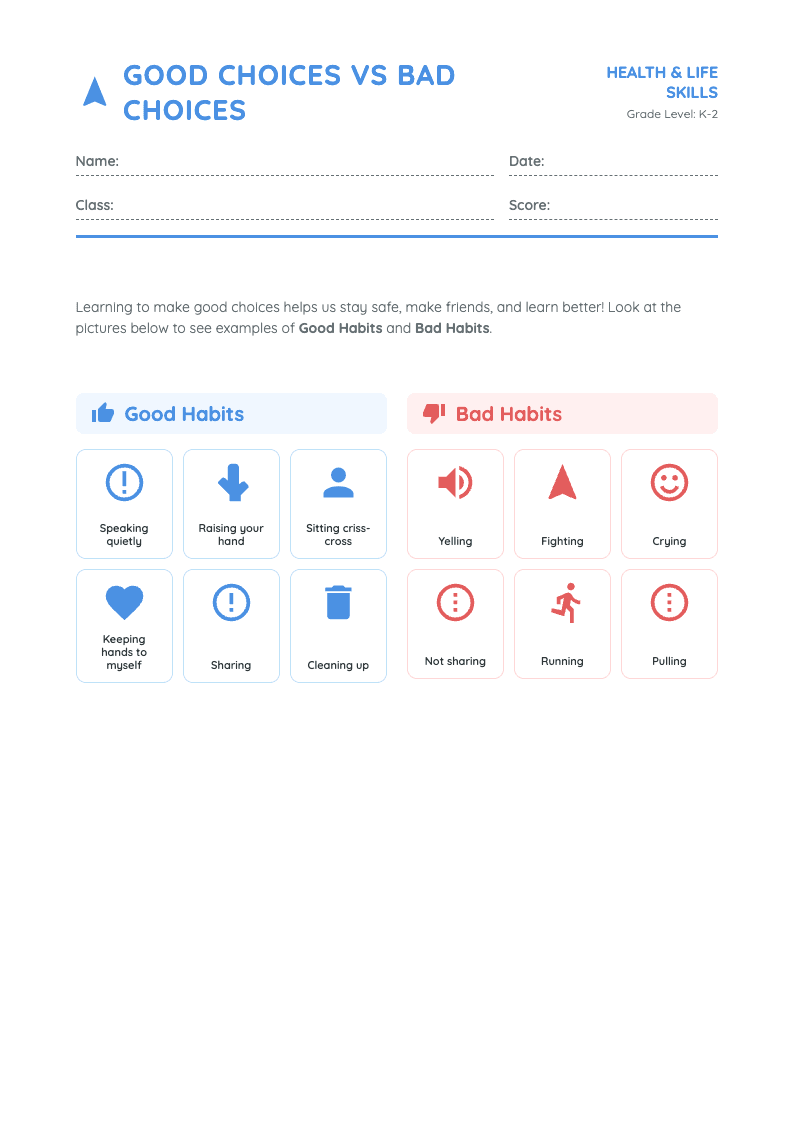
This is a colorful educational worksheet that visually contrasts 'Good Habits' and 'Bad Habits.' It presents a series of illustrated scenarios, each depicting a specific behavior. Good habits include actions like 'Speaking quietly,' 'Raising your hand,' 'Sitting criss-cross,' 'Keeping hands to yourself,' 'Sharing,' 'Cleaning up,' 'Being a good friend,' 'Taking turns,' 'Listening to your teacher,' 'Being kind,' 'Reading more,' and 'Playing nicely.' Bad habits include actions like 'Yelling,' 'Fighting,' 'Crying,' 'Not sharing,' 'Running,' 'Pulling,' 'Pushing,' 'Being a bully,' 'Laughing at others,' 'Kicking,' 'Not listening,' and 'Making a mess.'
Grade Level Suitability:
This worksheet is most suitable for preschool and early elementary school students (Kindergarten - 2nd Grade). The concepts are simple and easily understood through the illustrations, making it accessible for young children learning about appropriate behavior.
Why Use It:
This worksheet helps children identify and differentiate between positive and negative behaviors. It promotes social-emotional learning by visually representing the consequences of different actions, encouraging children to make positive choices and develop good habits. It can also be a good starting point for discussions about empathy and respect.
How to Use It:
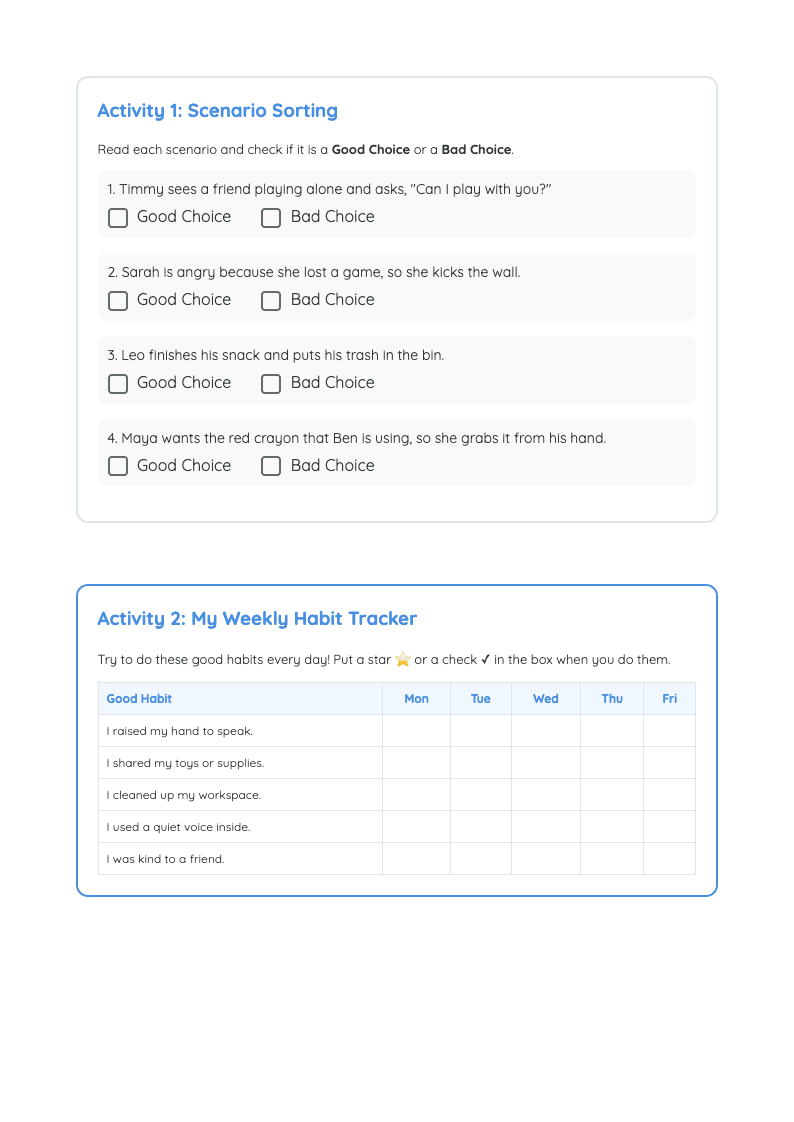
Use this worksheet as a visual aid during discussions about classroom rules and expected behavior. You can go through each scenario, asking children to identify whether it's a good or bad habit and why. The worksheet can also be used as a reference tool for students to consult when making behavioral choices.
Target Users:
The target users are preschool and early elementary school teachers, parents, and counselors who want to teach children about good and bad habits in a visually engaging way. It is also beneficial for children who are learning about social skills and appropriate behavior in a classroom or home setting.
This is a colorful educational worksheet that visually contrasts 'Good Habits' and 'Bad Habits.' It presents a series of illustrated scenarios, each depicting a specific behavior. Good habits include actions like 'Speaking quietly,' 'Raising your hand,' 'Sitting criss-cross,' 'Keeping hands to yourself,' 'Sharing,' 'Cleaning up,' 'Being a good friend,' 'Taking turns,' 'Listening to your teacher,' 'Being kind,' 'Reading more,' and 'Playing nicely.' Bad habits include actions like 'Yelling,' 'Fighting,' 'Crying,' 'Not sharing,' 'Running,' 'Pulling,' 'Pushing,' 'Being a bully,' 'Laughing at others,' 'Kicking,' 'Not listening,' and 'Making a mess.'
Grade Level Suitability:
This worksheet is most suitable for preschool and early elementary school students (Kindergarten - 2nd Grade). The concepts are simple and easily understood through the illustrations, making it accessible for young children learning about appropriate behavior.
Why Use It:
This worksheet helps children identify and differentiate between positive and negative behaviors. It promotes social-emotional learning by visually representing the consequences of different actions, encouraging children to make positive choices and develop good habits. It can also be a good starting point for discussions about empathy and respect.
How to Use It:
Use this worksheet as a visual aid during discussions about classroom rules and expected behavior. You can go through each scenario, asking children to identify whether it's a good or bad habit and why. The worksheet can also be used as a reference tool for students to consult when making behavioral choices.
Target Users:
The target users are preschool and early elementary school teachers, parents, and counselors who want to teach children about good and bad habits in a visually engaging way. It is also beneficial for children who are learning about social skills and appropriate behavior in a classroom or home setting.


