


























Views
Downloads

Hero's Journey Guide | Essential Grade 9-10
Paste this activity's link or code into your existing LMS (Google Classroom, Canvas, Teams, Schoology, Moodle, etc.).
Students can open and work on the activity right away, with no student login required.
You'll still be able to track student progress and results from your teacher account.
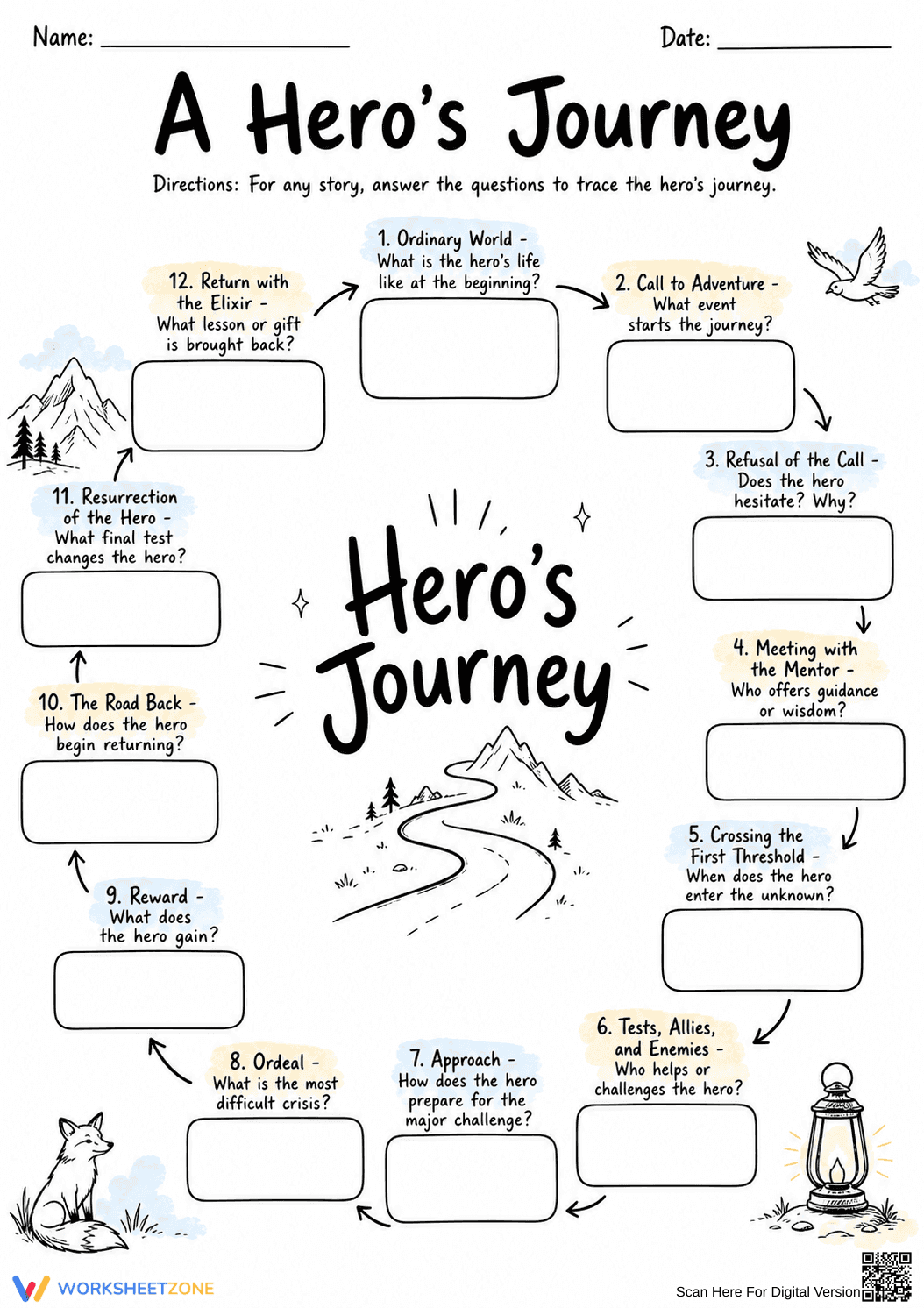
This Grade 9-10 narrative analysis worksheet provides a structured framework for students to deconstruct complex stories using the monomyth framework. By mapping 12 distinct stages of character development and plot progression, students gain a deeper understanding of how authors craft compelling journeys. This resource ensures students move beyond basic plot summaries toward rigorous literary analysis.
At a Glance
- Grade: 9-10 · Subject: English
- Standard:
CCSS.ELA-LITERACY.RL.9-10.3— Analyze how complex characters develop and interact to advance the plot.- Skill Focus: Narrative Structure Analysis
- Format: 1 page · 12 problems · Answer key included · PDF
- Best For: Novel studies and film analysis units
- Time: 45–60 minutes
The worksheet features a visually engaging circular diagram representing the cyclical nature of the hero's journey. It includes 12 specific prompt boxes covering every major milestone from the Ordinary World to the Return with the Elixir. Each box contains a targeted question designed to elicit evidence-based responses, helping students identify the "Call to Adventure," "Meeting with the Mentor," and the "Ordeal."
This resource is designed for a zero-prep classroom workflow. Teachers can print the single-page PDF in less than 30 seconds. Distribution takes approximately 1 minute during the transition to independent work. Reviewing student responses is streamlined by the visual layout, allowing for a quick 5-minute formative check at the end of the period. It is an ideal sub-plan or supplementary activity for any literature unit.
Aligned to CCSS.ELA-LITERACY.RL.9-10.3, this worksheet requires students to analyze how complex characters develop over the course of a text and interact with other characters to advance the plot. By identifying the "Tests, Allies, and Enemies" stage, students specifically address character interaction. Both standard codes can be copied directly into lesson plans, IEP goals, or district curriculum mapping tools.
Use this worksheet as a summative assessment after finishing a novel like The Odyssey or The Hunger Games. Alternatively, use it as a viewing guide during a film analysis of a classic hero's journey movie. Teachers should observe whether students can distinguish between the "Approach" and the "Ordeal" to gauge their grasp of narrative tension. Completion typically takes 45 to 60 minutes.
This guide is built for middle and high school students in English Language Arts or Creative Writing courses. It is particularly effective for visual learners who benefit from seeing the "loop" of the narrative. It pairs naturally with a character trait anchor chart or a direct instruction lesson on Joseph Campbell’s monomyth theory.
The Hero's Journey Narrative Guide is a specialized tool for mastering CCSS.ELA-LITERACY.RL.9-10.3. By requiring students to trace 12 specific stages of a protagonist's evolution, the worksheet facilitates the high-level analysis of character development and plot mechanics required by modern standards. Research by Fisher & Frey (2014) emphasizes the importance of graphic organizers in scaffolding complex literary concepts, noting that visual frameworks help students organize their thinking and improve retention of structural elements. This worksheet applies those principles to the monomyth, providing a clear pathway for students to move from literal comprehension to thematic interpretation. By documenting the "Reward" and "Resurrection" phases, students provide concrete evidence of character transformation, a key requirement for college and career readiness in ELA. This resource serves as a bridge between creative storytelling and academic literary criticism.


