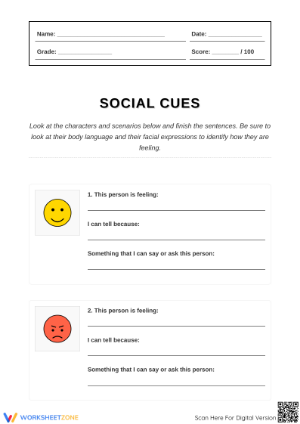
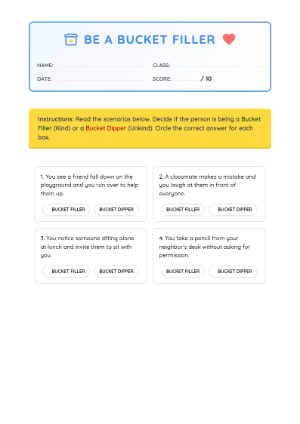
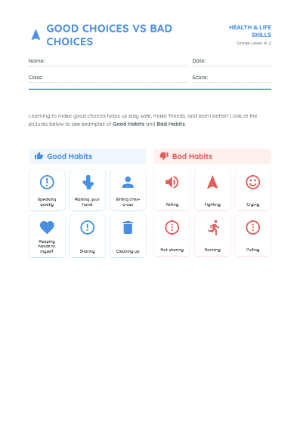
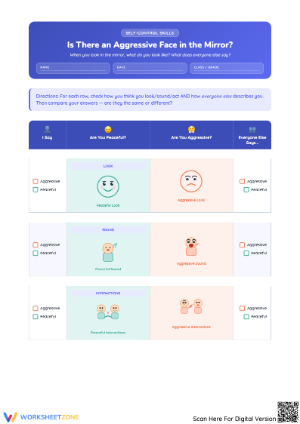
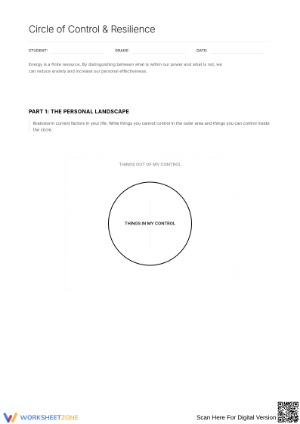
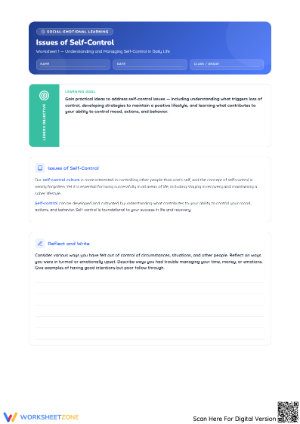
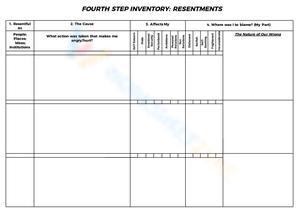
Behavior worksheets for 10th grade give teachers structured tools for some of the hardest instructional work in secondary education: helping fifteen- and sixteen-year-olds build genuine self-awareness rather than simply comply with classroom rules. At this stage, students are cognitively capable of real metacognition — they can trace a behavior back to a trigger, analyze their own thought patterns, and reason through consequences — but that capacity doesn't activate automatically. These worksheets create the conditions for it.
The Specific Skills These Worksheets Target
The set covers five skill areas, each mapped to something students in this grade are actively navigating:
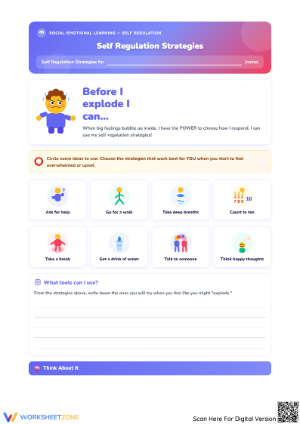
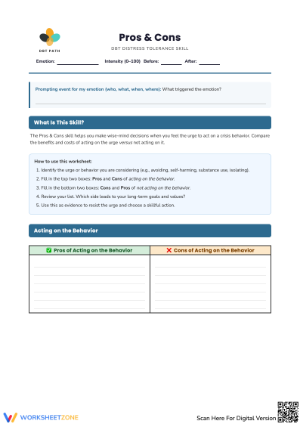
- Trigger identification and self-regulation — Students work backward from a behavioral incident to identify the physical and cognitive sequence that preceded it: what the situation was, what they felt in their body first, what thought followed. This is not a standard "how did you feel" reflection; it asks students to trace causation, not just name an emotion.
- Habit analysis using cue-routine-reward mapping — Teenagers engage more seriously when the framing is behavioral psychology rather than behavioral correction. These exercises ask students to identify the cue that initiates a habit, the routine it produces, and the short-term reward sustaining it — then propose a specific substitution for the routine while keeping the cue and reward intact.
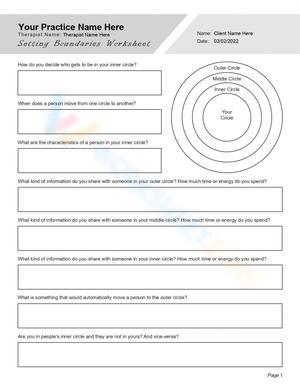
- Conflict scenario analysis — Scenarios include peer disputes that originated on social media and carried into class, group project breakdowns near the end of a grading period, and moments involving perceived disrespect from an adult. Students annotate each scenario, identify the decision point, and explain their reasoning in writing.
- Restorative reflection prompts — Students identify who was specifically affected by their behavior, what underlying need or emotion drove the action, and what a concrete repair looks like. These prompts require named people and described actions — not general statements of regret.
- Goal-behavior alignment — Students state a specific personal or academic goal and trace how a recent pattern of behavior either supports or contradicts it. A student writing out the connection between chronic tardiness and a stated goal of earning a scholarship does analytical work that a teacher-delivered consequence cannot replicate.
Resistance Patterns Teachers Should Anticipate and Address
The most consistent engagement failure with behavioral self-reflection at this age is surface compliance rather than outright refusal. A student writes "I got angry and walked out" on every line — technically answering, never analyzing. This happens because open-ended prompts allow event narration to satisfy the apparent requirement. These worksheets counter that by embedding specificity directly into the question structure: instead of "What happened?" the prompt reads "What were you thinking in the moment just before you acted?" That constraint redirects students from narrating an event to observing their own cognition.
A second pattern worth naming: consistent externalization. "I reacted because she was being disrespectful" is a complete sentence, and the student who writes it believes they've fully answered the question. Each worksheet follows that type of response with a built-in redirection — "What choices did you have available, regardless of what the other person did?" — that acknowledges the other party's behavior without permitting the student to stop at attribution. Students who skip that follow-up entirely are telling you something. That's the conversation that needs to happen next.
Fitting These Worksheets Into Your Week
These resources work differently depending on context. Teachers who keep them on hand for post-incident reflection find the restorative prompts valuable in that role, but using them exclusively as a disciplinary measure causes students to code them as a consequence — which produces performative responses rather than genuine reflection. A more sustainable structure is ten minutes at the start of Monday advisory, one worksheet per week, no grade attached. Students who encounter this as a consistent routine rather than a punitive assignment engage at a qualitatively different level.
Behavior worksheets for 10th grade also fit naturally into PBIS Tier 2 check-in/check-out programs. A student meeting daily with a counselor or mentor can work through one targeted worksheet per week as part of that structured conversation — the written component gives both the student and the adult something concrete to respond to rather than relying entirely on verbal disclosure, which many teenagers avoid. At the Tier 1 level, the habit-mapping and goal-alignment worksheets support the full student population as part of a shared SEL curriculum.
Standard Alignment
These worksheets align with CASEL's core SEL competency framework, specifically the Self-Management (SM) and Responsible Decision-Making (RDM) domains. CASEL's SM competencies include impulse control, emotional regulation under stress, and goal-setting persistence — the trigger-identification and habit-mapping worksheets address each of those directly. The RDM domain encompasses evaluating consequences, recognizing ethical responsibilities, and reflecting on the impact of personal choices, which the restorative and goal-alignment worksheets target in structured form.
In classroom terms, behavior worksheets for 10th grade belong in advisory periods, dedicated SEL blocks, or small-group counseling settings where the instructional focus is explicitly developmental. Teachers building a Tier 1 PBIS curriculum will find the set useful as a universal tool appropriate for the full student population — not only for students already receiving targeted behavioral support.
Adjusting the Worksheets for Different Learners
Behavior worksheets for 10th grade work across a wider ability range than most content-area materials because every student has direct access to the subject matter — their own experience. For students with IEPs centered on behavioral goals, two modifications tend to help most: sentence starters ("One thing I noticed about my reaction was...") and the option to respond verbally to a trusted adult who records the response. Both adjustments shift the cognitive effort onto the behavioral reflection rather than onto writing production.
For students who move through prompts quickly and produce consistently thin responses, the differentiation runs the other direction. Rather than adding more questions, ask them to compare two incidents — one where they managed their reaction effectively and one where they didn't — and identify specifically what was different. That comparative structure demands analysis rather than description and generates responses that are genuinely informative rather than performed.
Frequently Asked Questions
Can these worksheets replace a direct conversation, or do they work best alongside one?
Alongside. The worksheet gets a student to articulate their thinking before the adult responds — which changes the quality of that exchange considerably. A teacher who reads a restorative reflection before sitting down with a student already knows where the student is externalizing blame, where they went deeper, and where the gaps are. The written work functions as preparation for a more precise conversation, not a substitute for it.
How should teachers approach grading these?
A completion grade is appropriate for most uses — assessed on whether the student engaged fully with the prompt, not on whether their conclusions match what the teacher hoped they'd conclude. Some teachers use a simple three-column rubric: incomplete, partially addressed, fully addressed. Students who sense their personal reflection is being evaluated for correctness produce responses calibrated to teacher expectations rather than honest introspection, which defeats the purpose entirely.
What's the right response when a student refuses to complete a worksheet at all?
First, distinguish between a student who is genuinely dysregulated — not yet capable of reflective thinking because they're still in an acute stress response — and a student who has decided the activity is beneath them. The first student needs time before the worksheet serves any purpose; attempting it too soon produces nothing useful. The second student is usually responding to how the activity was introduced. Framing it as the kind of behavior mapping used by athletes and executives tends to shift the calculus faster than framing it as a required reflection exercise.
Are these appropriate for students with trauma histories?
Self-reflection prompts that ask about the emotional drivers of behavior can surface material connected to prior adverse experiences rather than the present classroom incident — and that's worth knowing before using these in a trauma-affected classroom. Practical safeguards include giving students explicit permission to pass on specific prompts, ensuring the setting is private enough that written disclosure doesn't feel coerced, and looping in the school counselor when a student's responses indicate something beyond routine behavioral reflection. The content of each worksheet is appropriate for this age group; the context and manner of administration matter considerably.