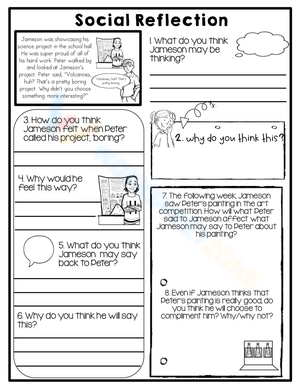
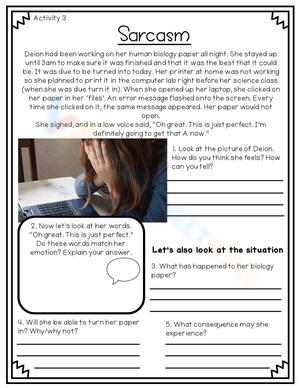
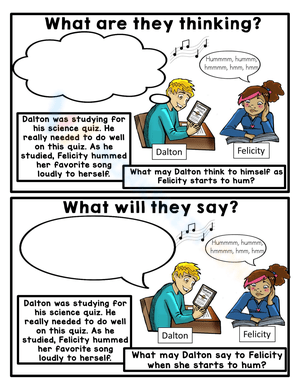
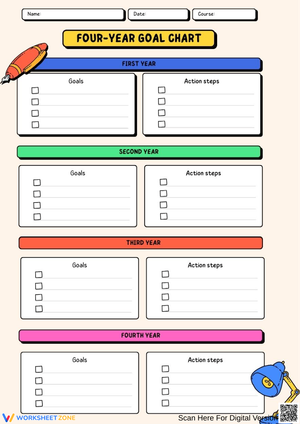
These social skills for teens worksheets pdf for 10th grade give counselors, advisory teachers, and health instructors printable activities that treat students like the near-adults they are — centered on realistic peer situations, not elementary-style prompts about sharing and taking turns. Each worksheet pairs a brief scenario with structured reflection tasks: students read a situation, analyze the choices available, identify what's driving someone's reaction, and write or discuss a better response. The result is a set that fits inside a 15-minute advisory block as comfortably as a full SEL lesson.
Skills Each Worksheet Targets
The collection covers six skill areas that consistently show up as high-need in 10th grade — not because these students lack capability, but because the social demands of sophomore year are genuinely more complex than most adults remember. Partner projects, group chats, asking a teacher to revisit a grade, navigating a falling-out with a friend, and speaking in front of a class all require distinct communication moves that students rarely get explicit practice on.
- Active listening: students mark which listening behaviors appear in a scenario, then rewrite a dismissive response as an attentive one.
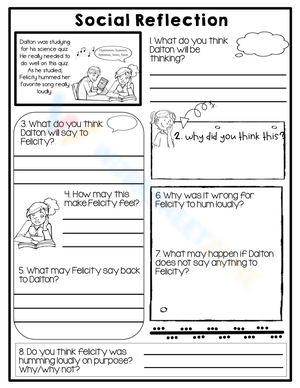
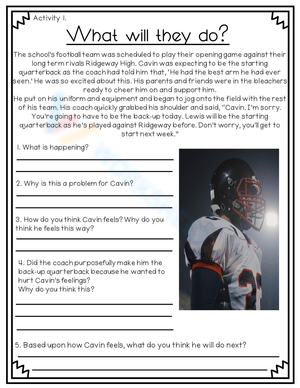
- Empathy and perspective-taking: students identify what a second character is feeling before deciding how to respond — especially useful before literature discussions or restorative conversations.
- Self-advocacy: students draft what they would say to a teacher after missing a deadline or misunderstanding directions, then evaluate their own tone and word choice.
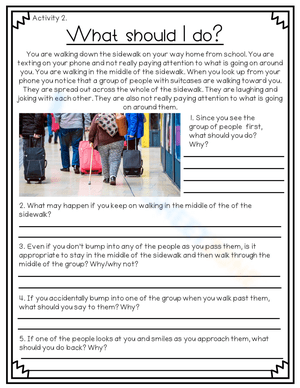
- Setting limits: students distinguish between firm, respectful refusals and responses that either cave under pressure or escalate the situation.
- Conflict resolution: students name the core issue in a dispute, separate it from the emotional reaction, and write a proposed next step using specific language.
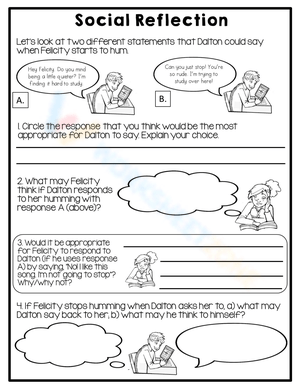
- Digital tone: students compare two text message exchanges and annotate where tone breaks down — a task that lands with particular weight for students who have lived through exactly that kind of misread.
Why This Format Works for 10th Graders
Tenth graders are at a developmental point where they can analyze social situations with surprising nuance — but only when they slow down enough to do it. Most social decisions happen fast, under peer observation, and with real emotional stakes. A worksheet creates a low-stakes rehearsal space where students can work through a situation without an audience watching them get it wrong. That's distinct from role-play, and distinct from whole-class discussion where the loudest voice shapes the conclusion. The written format gives quieter students a private space to process before they're asked to speak.
Cognitive load research supports this sequence: when students externalize their thinking onto paper before a discussion, working memory is freed up for reasoning rather than just recall. In practice, students who complete a worksheet before a pair-share argue their positions more specifically — "I think option B works because she's already upset and option A sounds like you're dismissing her" — rather than offering one-word answers about which response they liked.
Student Errors Worth Watching For and Correcting
The most persistent mistake on conflict-resolution worksheets is students selecting the response that sounds most mature in print rather than the one that would actually work in the moment. A student might circle "I understand you're upset, and I'd like to talk when you're ready" because it reads like what an adult would say — not because they've thought through what the other person actually needs. That gap between performing maturity and exercising real social judgment is where most of the instructional work happens, and it's worth naming directly before sending students into the activity.
On empathy worksheets, a second pattern appears reliably: students write what the character should feel rather than what the text evidence suggests the character does feel. This shows up especially in scenarios involving social media conflict or friend group dynamics, where students import their own norms about how people are "supposed to" react. Asking "Where in the scenario does it say she felt that way?" — and waiting for students to look back at the text — is usually enough to redirect this without turning it into a lecture about projection.
Working These Worksheets Into Your Planning Without Losing Instructional Time
When teachers look for social skills for teens worksheets pdf for 10th grade, they usually need resources that fit inside constrained time rather than require a full period to justify. The most effective use pattern is a three-part sequence: independent completion (3–5 minutes), structured partner talk (3–4 minutes), and a brief whole-group close (2–3 minutes) where one or two students read a rewritten response aloud. That's 10 minutes total. Teachers who try to run all three phases plus an extended debrief in 20 minutes consistently lose the closing — so it helps to decide in advance whether the whole-group share is essential or optional for that day's skill.
Advisory teachers who use these regularly often build a weekly rhythm: one worksheet Monday to introduce a skill, brief peer-share Wednesday after students have had time to notice the behavior in real life, and a short reflection Friday. That distributed pattern does more for retention than a single long lesson would. Counselors running small groups often use the same worksheet across two sessions — independent work the first day, role-play the second — so students can rehearse the response they wrote rather than only theorizing about it.
Standard Alignment
These worksheets align to the CASEL Social-Emotional Learning framework, specifically the competencies of Social Awareness, Relationship Skills, and Responsible Decision-Making. At the 10th grade level, CASEL describes Social Awareness as the ability to take the perspective of others and recognize situational context — which maps directly to the empathy and perspective-taking tasks in this set. Many states that have adopted secondary SEL standards, including Illinois, California, and Washington, reference CASEL competencies in their frameworks, making these worksheets compatible with district SEL pacing guides without modification.
Differentiating These Worksheets Across Ability Levels
For students who need additional support — whether through an IEP, a behavior intervention plan, or a language acquisition goal — the written response sections shift to sentence stems. "I felt __ when __ because __" gives a student the structure to access the social thinking without the added cognitive demand of generating sentence syntax from scratch. The skill practice stays intact; only the production load changes. For students who have clearly mastered a skill, the activity extends by asking them to rewrite the scenario from the other character's point of view, which integrates empathy and conflict reasoning simultaneously rather than practicing each in isolation.
In general education classes where social skills for teens worksheets pdf for 10th grade are used as part of a health or life-skills unit, the discussion component usually carries more instructional weight than the written task itself. Letting students make a case for which response is strongest — and defend that position — generates the kind of peer reasoning that transfers more durably than a circled correct answer. The worksheet anchors the conversation; the conversation is where the learning compounds.
Frequently Asked Questions
These worksheets look short. Do students actually engage with them?
Tenth graders respond to brevity when the scenario is specific enough to hold attention. A worksheet that runs three pages gets skimmed; one that gives a tight, grounded situation and asks for two or three deliberate written moves earns genuine engagement. The framing matters as much as the content: if students sense they're being corrected for social failures, they disengage quickly. When the activity is introduced as a performance tool — something that helps with teamwork, presentations, teacher communication, and interviews — participation improves noticeably, particularly among students who don't see themselves as needing a "social skills lesson."
Can a non-specialist teacher facilitate these without counseling training?
Yes. The worksheets are written so that any teacher running an advisory, health, or life-skills block can facilitate them without specialized background. The scenarios carry most of the structure. The teacher's main job is keeping the discussion focused on communication strategies rather than letting students drift into debating the characters' personal choices, which is the direction conversations reliably tend to go.
How often should a class return to the same skill?
Spaced retrieval applies here more than raw frequency. Rather than spending three consecutive days on active listening, it's more effective to address the skill once, return to it two weeks later in a new scenario, and reference it briefly a third time when it surfaces naturally in class. That distributed pattern builds the habit of noticing when a skill is relevant — which is the actual goal, not completing the worksheet correctly once and moving on.
Do these work for students with social communication goals on their IEPs?
Social skills for teens worksheets pdf for 10th grade are frequently used in exactly that context. They work best alongside IEP social communication goals when the target behavior is named explicitly before the student begins — "today we're practicing what to say when you want to enter a conversation that's already started" — and when the same worksheet format repeats across sessions so students can track their own progress rather than reorienting to a new structure each time.












 Interactive Worksheet Maker
 Quiz Maker
 Word Search Maker
 Crossword Puzzle Maker
 Word Scramble Generator
 Sentence Scramble Generator
 Handwriting Worksheet Generator
 Name Tracing Generator
 Fill In The Blank Generator