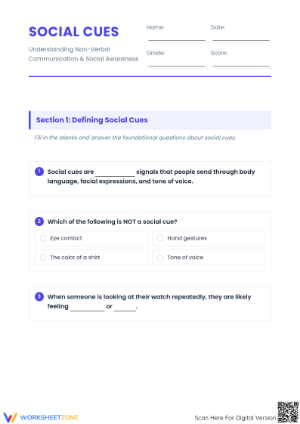
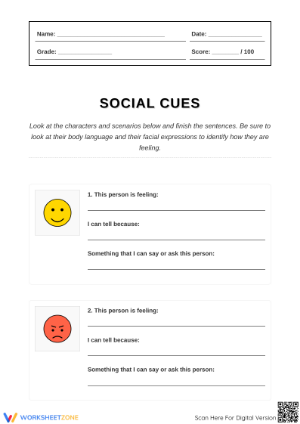
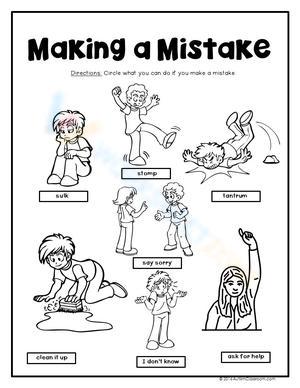
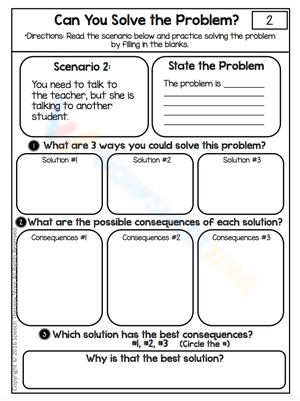
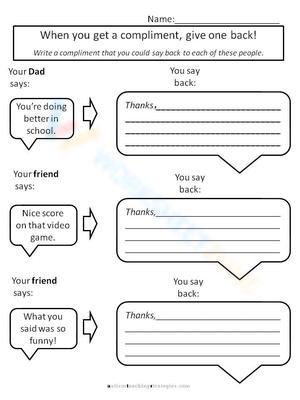
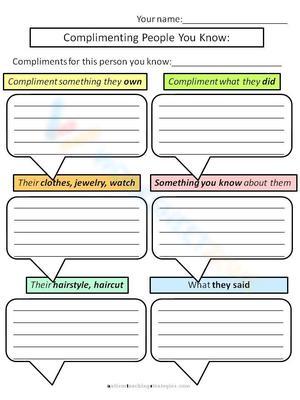
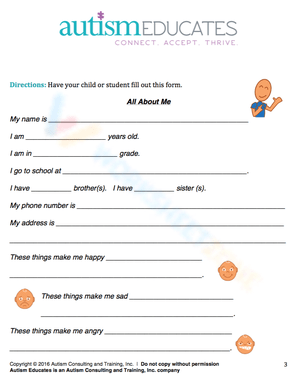
These 10th grade social skills for autism worksheets pdf give teachers print-ready materials organized around the specific communication demands of high school — not generic social scripts borrowed from elementary programs. Each worksheet addresses a skill students are navigating right now: entering a group project that has already started, reading whether a classmate's silence signals boredom or distraction, asking for clarification without drawing unwanted attention, or calibrating the tone of a text to a peer. The set works in resource rooms, counseling groups, inclusive classes, and one-to-one support with minimal prep.
The Specific Skills Targeted
Every worksheet isolates a discrete, nameable social skill rather than clustering loosely under "communication." That specificity matters at Grade 10 because students know when materials treat them as younger than they are — and they disengage accordingly.
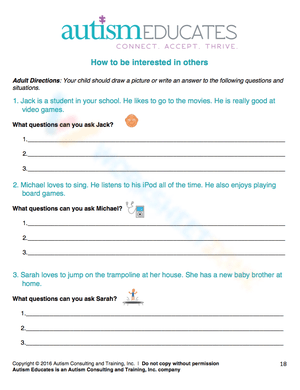
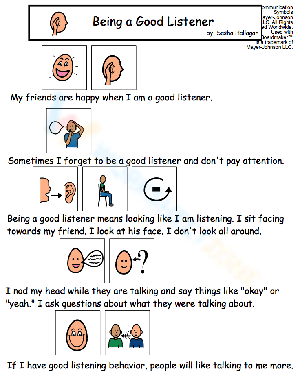
- Conversation structure: opening exchanges, maintaining a topic past the first response, reading signals that someone wants to end the conversation, and exiting without abruptness
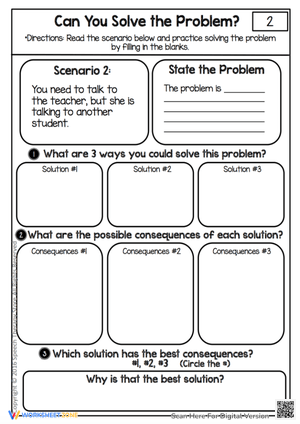
- Perspective-taking: short written scenarios where students identify what each person in the exchange likely thinks or needs — not only how they feel
- Self-advocacy: scripts for requesting accommodations, asking a teacher to repeat directions, and flagging confusion before a deadline becomes a crisis
- Boundary awareness: distinguishing personal from public topics, recognizing physical proximity shifts, and pushing back respectfully
- Digital communication: tone in texts and group chats, response timing, and what counts as school-appropriate online behavior
- Workplace and community readiness: greeting unfamiliar adults, joining an existing group conversation, and receiving corrective feedback without shutting down
Why Explicit Instruction Works at This Age
Autistic teens in 10th grade often carry a patchwork of social rules picked up implicitly — some reliable, some not. The hidden rules multiply in high school: cafeteria hierarchies, irony-heavy peer humor, the expectations of work-based learning placements, and the social weight of group project dynamics all demand new interpretive moves. Guidance from the IRIS Center, the Organization for Autism Research, and the CDC consistently points to explicit teaching — not mere social exposure — as the mechanism that produces durable learning. Worksheets built on that principle show students the rule, explain why it works, and then move to structured application in that order.
The format also reduces cognitive load during initial learning. When a student is trying to internalize a new social pattern — detecting when a peer has stopped being interested in a topic, for instance — asking them to simultaneously manage a live conversation and self-monitor is too much at once. A worksheet lets them practice the interpretive move in a low-stakes, pause-and-reread environment before it needs to happen in real time. The separation is the point.
Common Misconceptions to Watch For and Correct
The most consistent pattern in student work on perspective-taking tasks is what might be called behavioral accuracy without inferential depth. A student circles the right answer — "ask the person if they want to change the subject" — but explains their choice by citing a memorized rule rather than reading the specific signals in that scenario. That distinction matters because a rule-based justification breaks down when the scenario shifts even slightly. Watching how students explain their choices, not just what they circle, tells teachers where actual understanding ends and pattern-matching begins.
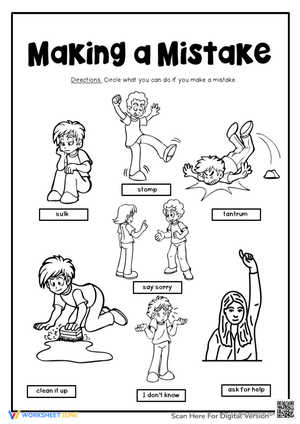
Self-advocacy prompts surface a separate issue. Students drafting scripts tend to land at one of two extremes: over-apologetic phrasing that undercuts the message ("Sorry, I know this is probably obvious, but could you maybe possibly...") or bluntness that reads as confrontational regardless of intent. The rewrite tasks in these worksheets surface that calibration problem directly. Students who read a perfectly reasonable script will still mark it "too harsh" because they default to minimizing — and naming that tendency out loud is often more instructive than any individual correction.
Building These Worksheets Into Your Lesson Plans
Any well-designed 10th grade social skills for autism worksheets pdf resource is built for quick deployment, and that brevity is worth protecting in practice. A focused 15 to 20 minute block produces better results than stretching practice across a long period. Open with a specific target skill — not "communication" but "how to enter a group conversation already in progress" — model one example, let students work through the core section of the worksheet, and close with a short verbal or written practice round. That rhythm repeats cleanly, and students settle into it faster after the first few sessions.
In small groups, one worksheet becomes a discussion tool. Students compare answers, notice that two people read the same scenario differently, and then practice the language aloud — which is where retention actually happens. In one-to-one support, the same page slows down into a teacher think-aloud with student response, suited for students who need substantial modeling before attempting anything independently. A step that consistently improves carryover: after completing a worksheet, ask the student to name one specific moment in the coming day where the target skill applies. That bridge from paper to setting is small to add and meaningfully changes whether learning stays in the room or travels with the student.
Friday review blocks and Monday warm-ups are both natural homes for a single worksheet, particularly when teachers want a consistent routine without dedicating full class periods. The printable format makes it easy to pull one worksheet for an advisory period, a counseling check-in, or the last ten minutes of a support block.
Differentiating These Worksheets Across Ability Levels
Among Grade 10 students with autism, communication profiles vary considerably — some students write fluently but struggle with open-ended social inference; others read tone accurately but find written expression effortful. These worksheets support meaningful adjustment without changing the age level of the content or the complexity of the core scenario.
- Replace open-response prompts with three-choice options for students who freeze at a blank line — return to open response once the target skill is more established
- Add a simple tone scale (1 = too distant, 3 = appropriate, 5 = too intense) so students can rate sample scripts before rewriting them
- Provide sentence starters — This response makes the other person feel... because... — to structure reasoning without dictating the content
- Offer role-play cards after the written portion for students who demonstrate understanding best through action rather than writing
- Trim scenario length for students with high processing demands: core information only, stripping extra context while keeping the question intact
The target is not task completion. It is building communication patterns that transfer to the hallway, the group project table, the job shadow site. Every adjustment should serve that transfer, not just make the page easier to finish.
Standard Alignment
These worksheets connect to the CASEL SEL framework across all five competency domains: self-awareness, self-management, social awareness, relationship skills, and responsible decision-making. For IEP planning, the skill areas map directly to communication and social skills goals under IDEA, which requires transition planning to begin no later than age 16 — meaning Grade 10 is exactly where that groundwork should be building. The conversation and self-advocacy worksheets also support speaking and listening standards across multiple state ELA frameworks, making them defensible in inclusive English or advisory settings without a separate curricular justification. The 10th grade social skills for autism worksheets pdf format makes it straightforward to attach completed worksheets as evidence of progress toward IEP communication goals without additional documentation steps.
Frequently Asked Questions
Which skill areas should teachers prioritize first?
Self-advocacy and conversation management create the most immediate friction when underdeveloped — students who cannot request clarification or exit a conversation without going silent tend to accumulate avoidance patterns that compound across the school year. Boundary awareness and digital communication follow closely because both carry social consequences that are difficult to reverse once they occur. Starting with self-advocacy is practical because it also supports academic performance, not only social functioning.
How do teachers keep these materials from feeling juvenile at the high school level?
The scenarios need to sound like actual Grade 10 life — a group chat that misfired, feedback delivered in a tone that read as personal criticism, a peer standing too close at a locker. Anything that sounds like it belongs in a middle school health class will lose the room fast. Language should be direct, visual design should be clean rather than decorated, and the worksheet should never ask a student to illustrate or color.
Can the same worksheet serve both a resource room pull-out and an inclusive class?
Yes, with intentional framing on the teacher's part. In a resource room, the worksheet is the explicit instruction. In an inclusive class, the same worksheet functions as structured SEL practice that benefits many students while giving autistic learners the direct teaching layer they need. The content does not need to change — the surrounding discussion and modeling do.
Does the printable format offer any advantage over a digital version for this population?
For many autistic students, a fixed-layout printed page reduces visual processing demands that digital environments introduce: no shifting layouts, no notifications, no navigation decisions. Students can annotate directly, return to earlier sections without scrolling, and bring the same page to a follow-up session as a reference without any login step. Teachers evaluating 10th grade social skills for autism worksheets pdf options often find that consistency of format matters as much as quality of content — the predictability of the medium supports the learning, not just the message.












 Interactive Worksheet Maker
 Quiz Maker
 Word Search Maker
 Crossword Puzzle Maker
 Word Scramble Generator
 Sentence Scramble Generator
 Handwriting Worksheet Generator
 Name Tracing Generator
 Fill In The Blank Generator