


























Views
Downloads
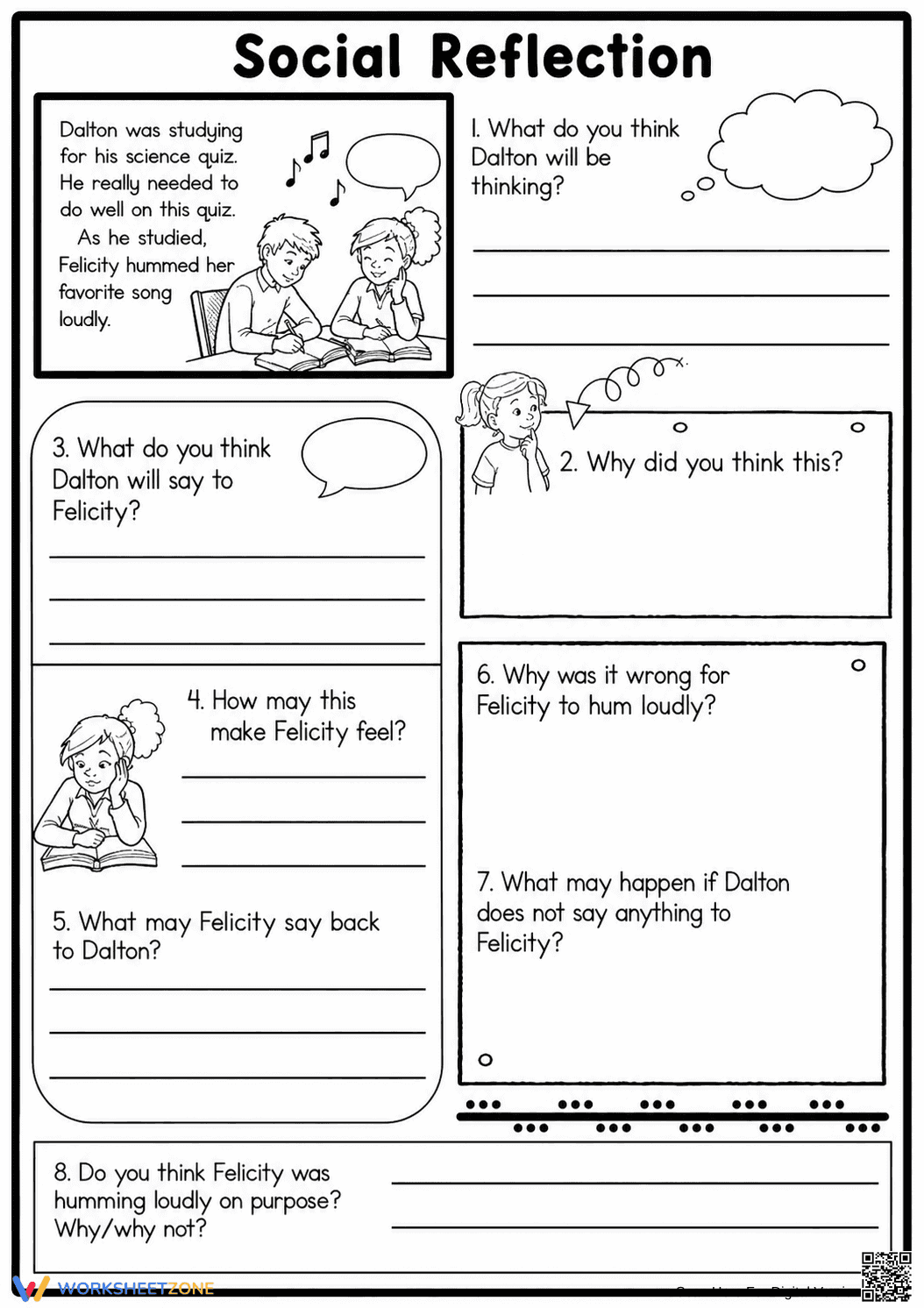

Social Reflection Worksheet | Grade 9 Printable
Paste this activity's link or code into your existing LMS (Google Classroom, Canvas, Teams, Schoology, Moodle, etc.).
Students can open and work on the activity right away, with no student login required.
You'll still be able to track student progress and results from your teacher account.
This Grade 9 social reflection worksheet helps students build essential perspective-taking and empathy skills. By analyzing a relatable peer conflict scenario, students practice inferring characters' thoughts, feelings, and motivations to determine appropriate conflict resolution strategies.
At a Glance
- Grade: 9 · Subject: Social Skills
- Standard:
CCSS.ELA-LITERACY.RL.9-10.1— Make inferences and cite evidence from a text scenario- Skill Focus: Perspective-Taking & Empathy
- Format: 1 page · 8 problems · PDF
- Best For: Independent practice or advisory
- Time: 15–20 minutes
This single-page resource features a brief, relatable scenario about two students, Dalton and Felicity, navigating a minor distraction while studying. It includes eight open-ended questions with dedicated writing space, prompting students to analyze the situation from both characters' viewpoints, predict potential dialogue, and evaluate the consequences of different reactions.
- Print (1 min): Easily print the single-page PDF for the entire class.
- Distribute (1 min): Hand out the worksheet as a bell-ringer, advisory activity, or sub-plan task.
- Review (5 mins): Facilitate a quick class discussion to share diverse viewpoints and conflict resolution strategies.
With under two minutes of teacher setup required, this print-and-go resource is perfect for busy educators needing a meaningful, zero-prep social-emotional learning activity.
Aligned to CCSS.ELA-LITERACY.RL.9-10.1, this worksheet requires students to cite strong and thorough textual evidence to support analysis of what the text says explicitly as well as inferences drawn from the text. It also supports collaborative discussion standards by providing a foundation for peer dialogue. Both standard codes can be copied directly into lesson plans, IEP goals, or district curriculum mapping tools.
Use this worksheet as a standalone activity during a homeroom or advisory period to spark conversations about peer respect and communication. Alternatively, assign it as a targeted intervention for students working on specific social-emotional IEP goals. While students work, observe their written responses as a formative assessment of their ability to accurately identify and articulate others' emotions. Expected completion time is 15 to 20 minutes.
This resource is designed for Grade 9 students, particularly those benefiting from explicit social skills instruction or teen behavior activities. It serves as an excellent tool for school counselors, special education teachers, and advisory leaders. Pair this worksheet with role-playing exercises or direct instruction on active listening to reinforce the concepts.
Integrating structured social-emotional learning tasks into the daily curriculum significantly improves students' interpersonal skills, overall well-being, and the general classroom climate. By actively practicing perspective-taking and empathy through relatable scenarios, high school students learn to navigate complex peer conflicts much more effectively. This targeted worksheet directly aligns with the rigorous expectations of CCSS.ELA-LITERACY.RL.9-10.1, specifically challenging students to make logical inferences and cite strong textual evidence from a realistic text scenario to support their conclusions. Developing these critical analytical skills not only boosts academic reading comprehension but also fosters profound personal growth. According to a comprehensive RAND AIRS 2024 report, consistent and meaningful engagement with scenario-based social reflection activities directly enhances adolescents' emotional regulation capabilities, builds lasting resilience, and substantially reduces disruptive behavioral incidents in diverse secondary school settings. Ultimately, providing students with these essential tools empowers them to build healthier relationships and succeed inside and outside the modern educational environment.


