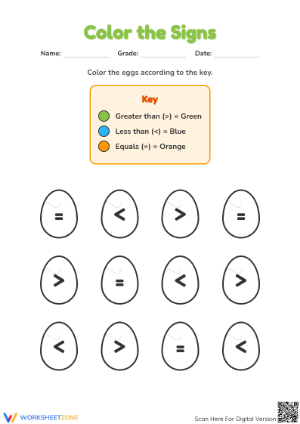
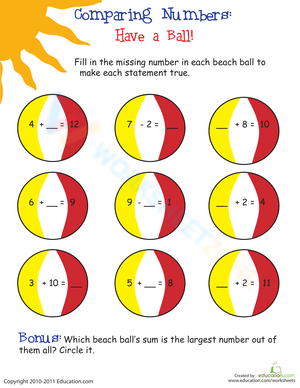
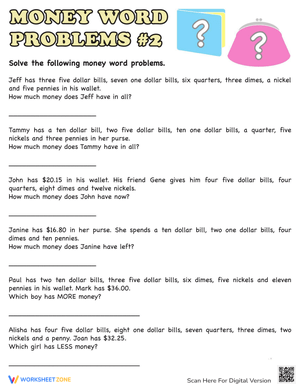
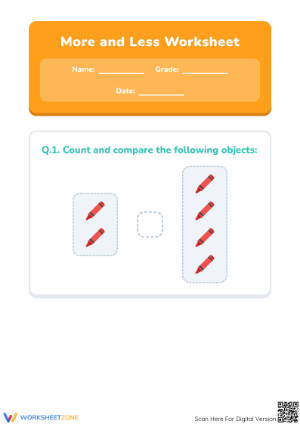
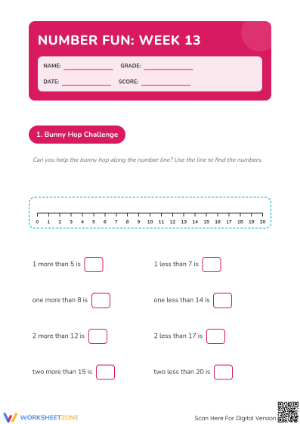
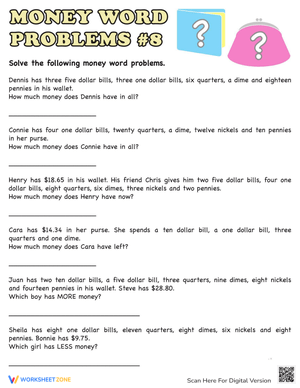
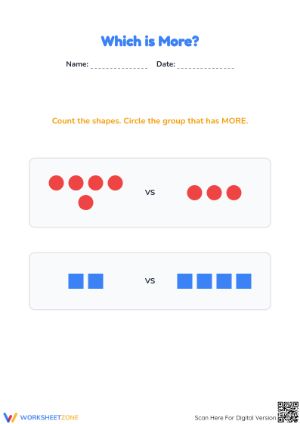
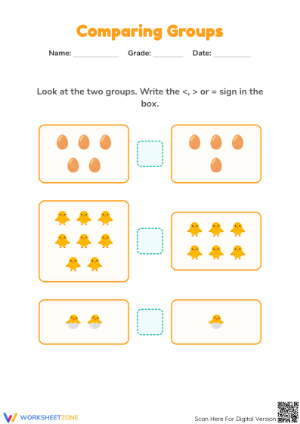
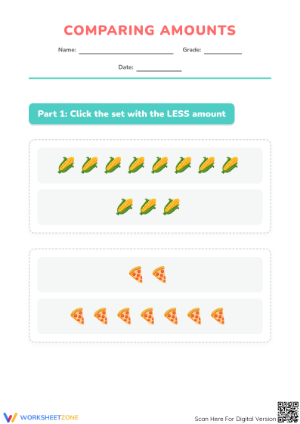
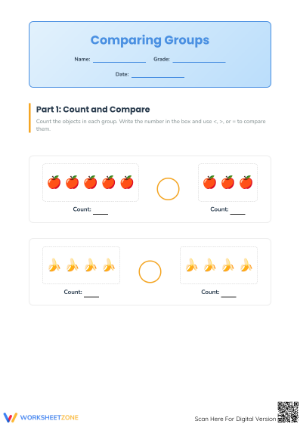
These 1st grade comparison printable worksheets give teachers a ready path from counting concrete objects to writing comparison symbols — a sequence that mirrors how Grade 1 number sense actually develops, not how adults assume it does. The set covers quantities within 100, multiple visual formats, and symbol notation so teachers can move students from recognizing "more" and "fewer" to recording those relationships with >, <, and =.
The Specific Skills Each Worksheet Builds
Comparison work in Grade 1 spans more ground than recognizing which pile is bigger. Each worksheet in the set targets one of these distinct tasks, which lets teachers assign the exact practice a group needs on a given day:
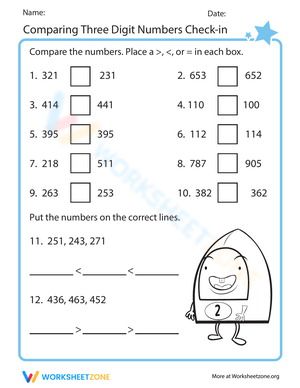
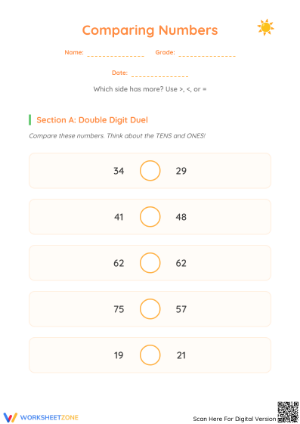
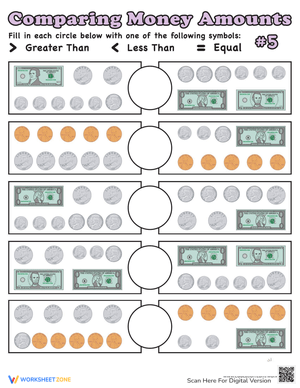
- Comparing numbers within 100: Students examine two numerals, determine the relationship, and write the correct symbol between them.
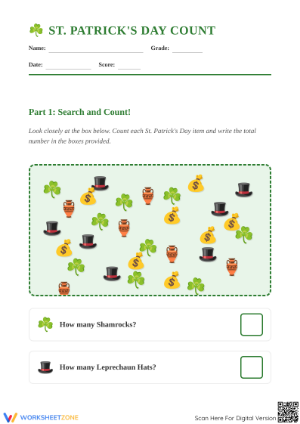
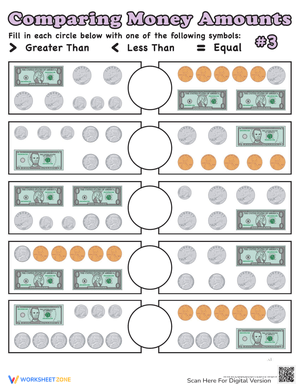
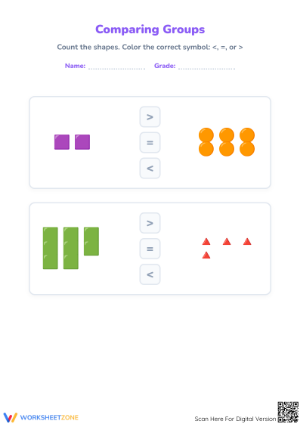
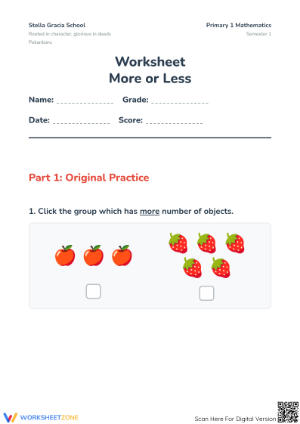
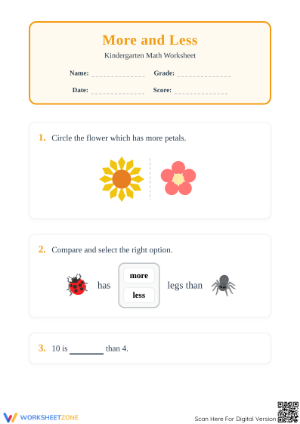
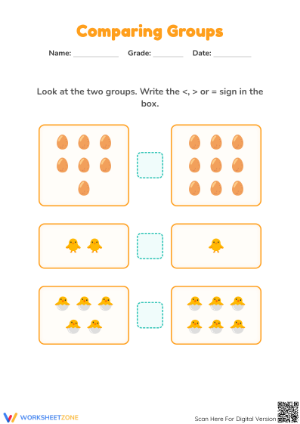
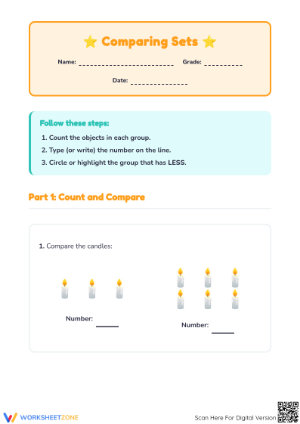
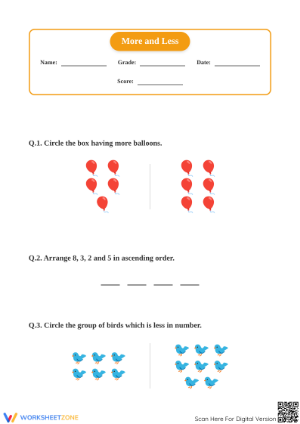
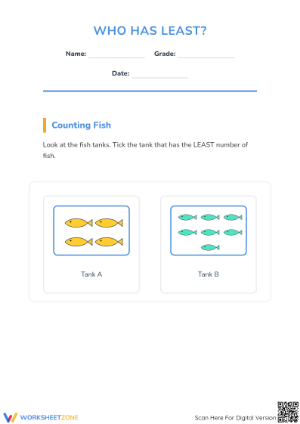
- Counting and comparing picture sets: Dot arrays, tally marks, and grouped objects require a counting step before committing to a symbol, which is where many students' actual understanding lives early in the unit.
- Ten-frame comparisons: Partially filled ten frames let students see quantity at a glance and bridge the gap between counting and recognizing number size as an abstract concept.
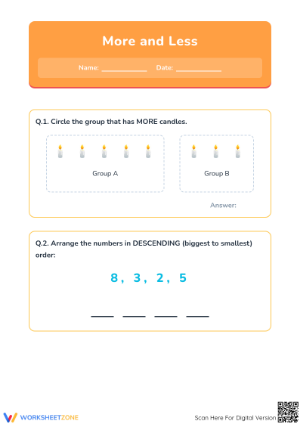
- Ordering sequences: Students arrange three or four numbers from least to greatest or greatest to least, which requires holding multiple comparisons in mind simultaneously.
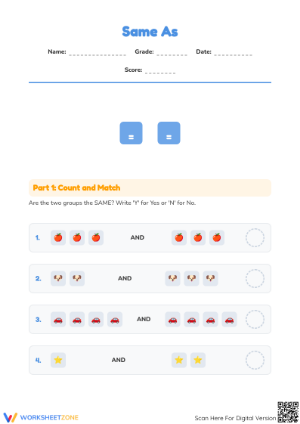
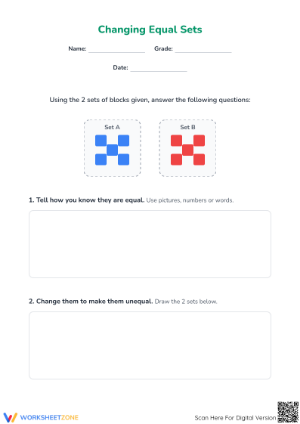
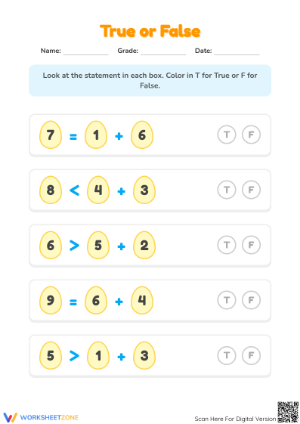
- Equal groups: Students identify when two sets or numbers match exactly — consistently harder than teachers expect because first graders tend to read the equal sign as "here comes an answer" rather than "same amount."
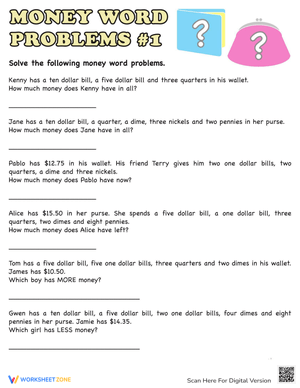
- Short comparison word problems: Students extract two quantities from a brief context, compare them, and record a comparison sentence with a symbol.
Transfer between formats is not automatic. A student who confidently writes 45 < 72 may still count scattered picture sets incorrectly when the objects are not lined up in rows. Using 1st grade comparison printable worksheets that span multiple formats helps surface those gaps before a unit assessment rather than after.
Errors Students Make That These Worksheets Help You Catch
The most persistent error involves place value, not symbols. When comparing 47 and 52, many students look at the ones digits first: they see 7 and 2, decide that 7 is greater, and write 47 > 52. They are applying a real comparison strategy — just to the wrong column. A similar pattern appears when students compare a two-digit number and a single-digit number, such as 38 and 9. Some students write 9 > 38 because 9 looks like the larger numeral on the page.
Symbol reversal is common but frequently misdiagnosed. When a student writes 24 > 31 instead of 24 < 31, the instinct is to reteach the symbol. Often, though, the student understood the comparison — they wrote the sign backward. Having students circle the larger quantity before placing the symbol interrupts the rush, gives teachers a visible reasoning trail, and makes it easier to distinguish a conceptual error from a notational one.
A third pattern worth watching: students who read 73 as "seven-three" rather than seventy-three sometimes compare digit values independently and reach inconsistent conclusions about which number is greater. Worksheets that include a ten-frame or base-ten drawing alongside the numeral give those students an anchor back to actual quantity when written notation alone is not enough.
Fitting These Worksheets Into Normal Classroom Routines
The most practical entry point is the ten minutes after morning meeting when students need a low-stakes math warm-up that does not require teacher setup or verbal directions. A picture-comparison worksheet with four to six problems settles students into math without the friction of learning new instructions. Running that same block on Monday before whole-group instruction establishes the week's comparison vocabulary before symbolic notation enters the picture.
After a direct instruction mini-lesson on >, <, and =, assigning three to five numeral-comparison problems as an immediate independent check tells teachers within minutes which students grasped the concept and which need a different approach before the lesson continues. That formative read is faster to collect from a brief worksheet than from a center activity or a whole-class discussion where quieter students can stay hidden.
Math centers are another reliable fit. Pairing a comparison worksheet with base-ten blocks or a classroom number line lets students use the manipulative and then record their thinking. Slipping the worksheet into a dry-erase sleeve allows the same problems to be reused across rotations — worth doing for any worksheet where the work involves circling or underlining rather than filling in multiple separate blanks.
Standard Alignment
These worksheets address CCSS.MATH.CONTENT.1.NBT.B.3, which requires first-grade students to compare two two-digit numbers based on the meanings of the tens and ones digits and record the results using >, =, and <. In classroom terms, this standard lands in the middle of the Grade 1 number sequence — students need a working grasp of place value before this standard is accessible, and comparison fluency is what makes addition and subtraction estimation approachable later in the year. Worksheets that build from picture-based comparisons toward numeral comparisons directly support the conceptual progression the standard assumes rather than jumping students directly to symbol notation.
Adjusting the Worksheets for a Range of Learners
Students still consolidating number sense do best with worksheets that include a visual anchor on every problem — a ten frame, a picture set, or a base-ten drawing alongside the numeral. That visual lets students count or subitize rather than holding the full number concept in working memory while simultaneously managing symbol notation. Without that support structure, students who are shaky on place value will guess at symbols and produce completed-looking work that tells teachers nothing useful about actual understanding.
Students who have already internalized comparison within 20 are ready for pages that move directly to two-digit numerals, ordering sequences of three or four numbers, and problems that require a written explanation. One honest limitation worth naming: the word-problem format frustrates students who are strong with numbers but weak readers, because the bottleneck shifts from math to decoding. For those students, substituting additional numeral comparison rows keeps the mathematical focus intact without the reading demand.
For a mixed-ability class, rotating formats across the week — picture sets on Monday, numeral comparisons on Wednesday, ordering and short word problems on Friday — gives every student multiple entry points into the same skill and shows teachers where the concept breaks down for individual students. A set of 1st grade comparison printable worksheets built with that variety already included removes the planning work of finding separate resources for each instructional day.
Frequently Asked Questions
What number range should Grade 1 comparison worksheets cover?
The CCSS standard targets two-digit numbers, so worksheets covering comparisons within 100 match Grade 1 expectations. Starting with comparisons within 20 makes sense early in the year when students are still consolidating place value understanding. Moving to the full range of two-digit numbers by mid-year aligns with how most Grade 1 pacing guides sequence number and operations work.
How do I help students who consistently reverse the > and < symbols?
Separate the comparison step from the notation step. Have students circle the greater quantity, say the comparison aloud using "greater than" or "less than," and write the symbol last. When notation is the final step rather than the first, students who understand the concept make the reversal less often. If the reversal continues, the issue is usually that the student is copying the symbol from memory rather than reasoning about quantity each time through.
Can these worksheets work for students who are still operating within numbers to 20?
Any set of 1st grade comparison printable worksheets worth using in a real classroom includes pages that limit quantities to 20 or fewer. Those worksheets are the right starting point for students who still need picture support and for any small-group reteach work earlier in the school year. Mixing within-20 pages and within-100 pages in the same center also lets teachers differentiate quietly without running completely separate rotations for different groups.
Is there a way to use these worksheets for assessment rather than just practice?
A five- to eight-problem numeral comparison worksheet completed independently, without manipulatives, gives a usable snapshot of where a student is with symbol notation. It is not a full diagnostic, but it tells teachers whether a student has moved past guessing — which is exactly the information needed before deciding whether to continue a unit or return to concrete comparison work with physical objects.













 Interactive Worksheet Maker
 Quiz Maker
 Word Search Maker
 Crossword Puzzle Maker
 Word Scramble Generator
 Sentence Scramble Generator
 Handwriting Worksheet Generator
 Name Tracing Generator
 Fill In The Blank Generator