


























Views
Downloads



Printable Same As Comparing Quantities Worksheet | Grade K
Paste this activity's link or code into your existing LMS (Google Classroom, Canvas, Teams, Schoology, Moodle, etc.).
Students can open and work on the activity right away, with no student login required.
You'll still be able to track student progress and results from your teacher account.
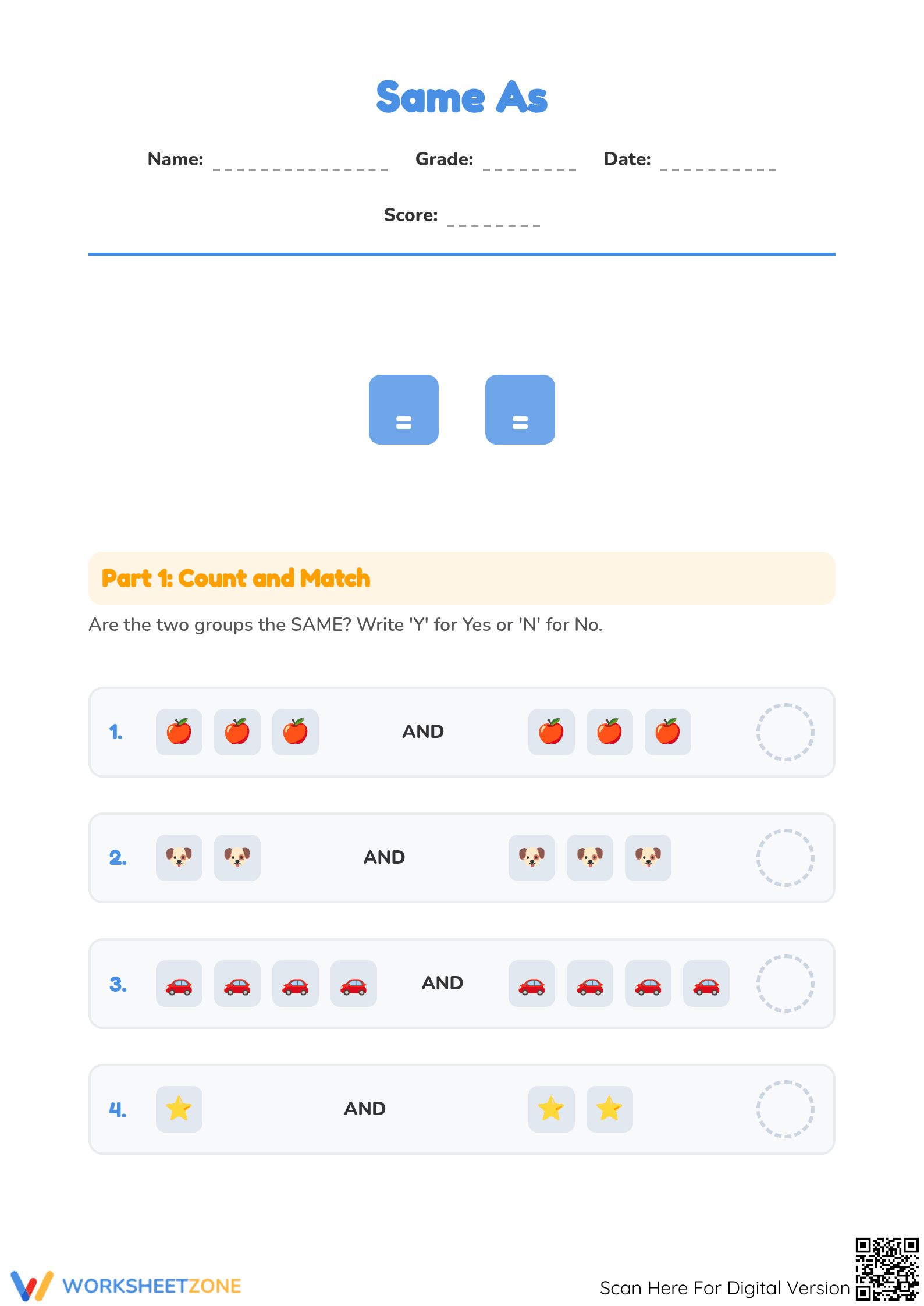
This Kindergarten counting and comparison worksheet provides focused practice for students learning to identify equal sets. By engaging with visual representations of common objects, learners strengthen their understanding of cardinality and one-to-one correspondence. The activity ensures students can accurately count two distinct groups and determine if they contain the same amount, a critical early numeracy milestone.
At a Glance
- Grade: Kindergarten · Subject: Math
- Standard:
CCSS.MATH.CONTENT.K.CC.C.6— Identify if the number of objects in one group is equal to another group- Skill Focus: Comparing Quantities
- Format: 4 pages · 16 problems · Answer key included · PDF
- Best For: Early numeracy counting and comparison practice
- Time: 15–20 minutes
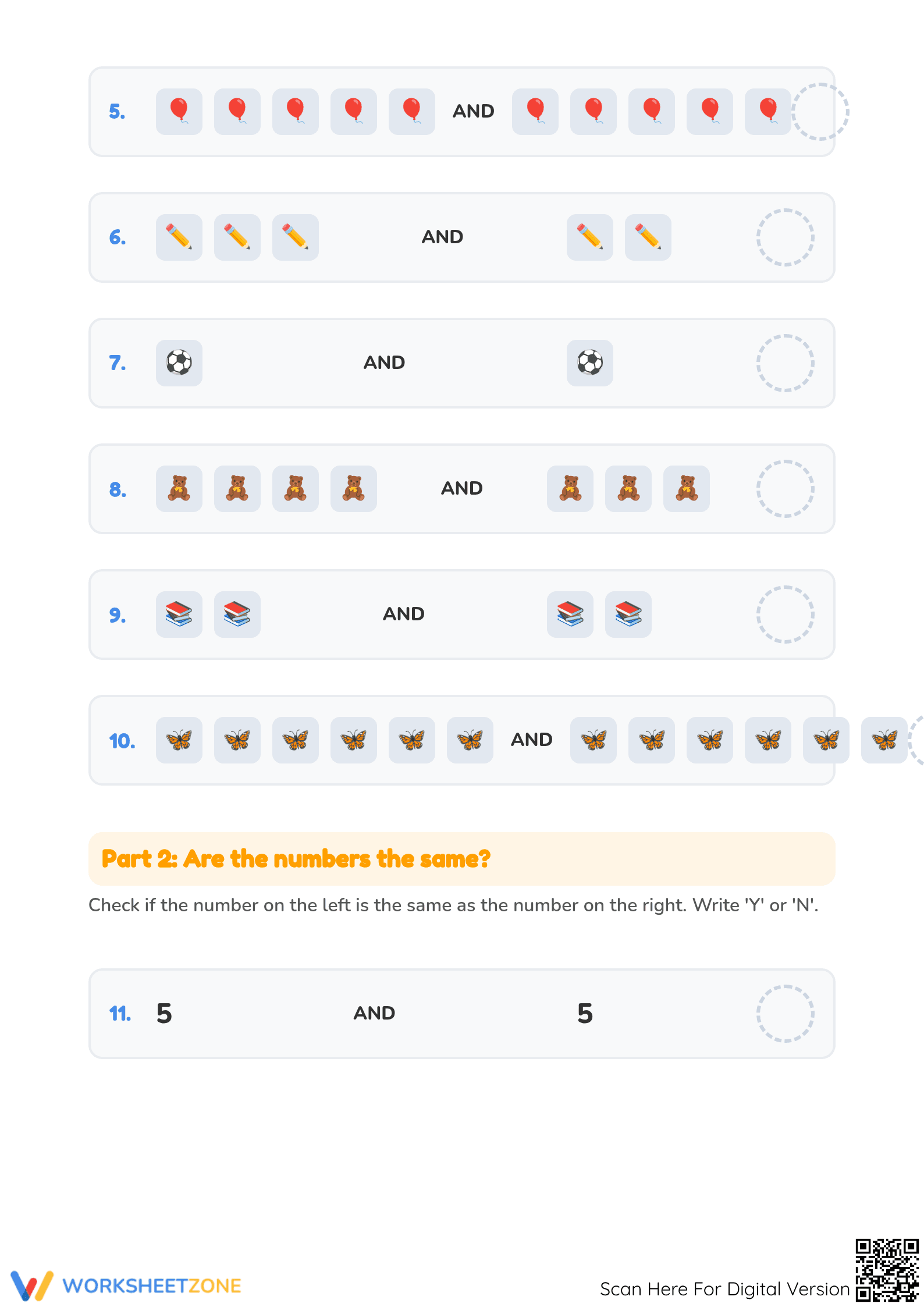
What's Inside: This comprehensive four-page resource features sixteen independent tasks designed to build confidence in mathematical comparisons. Each task presents a target box of objects and two choice boxes, requiring students to count and select the matching quantity. The worksheet includes friendly illustrations like insects and animals to maintain engagement, along with a full answer key for quick checking.
Skill Progression:
- Guided Practice: The first page uses small sets (under 5) to establish the counting-and-matching logic with high visual clarity.
- Supported Practice: Middle pages introduce slightly larger sets and more complex arrangements to challenge subitizing skills.
- Independent Practice: The final tasks require sustained attention to detail, ensuring students can generalize the concept of equality across different object types.
Standards Alignment: This resource is explicitly aligned to `CCSS.MATH.CONTENT.K.CC.C.6`, which requires students to identify whether the number of objects in one group is greater than, less than, or equal to the number of objects in another group. It specifically targets the 'equal to' aspect of the standard. This standard code can be copied directly into lesson plans, IEP goals, or district curriculum mapping tools.
How to Use It: Deploy this worksheet during the independent practice portion of a lesson on quantity comparison. It works effectively as a formative assessment to check if students are counting accurately or just guessing based on visual density. Teachers should observe students as they count to ensure they are touching each object once, which takes approximately fifteen to twenty minutes for most Kindergarten learners.
Who It's For: This activity is designed for Kindergarten students but serves as an excellent intervention tool for first graders who need to solidify their number sense. It pairs naturally with physical manipulatives like counting cubes or bear counters. For students who struggle, providing a physical set to match the target box before they look at the options offers a necessary scaffold.
The standard CCSS.MATH.CONTENT.K.CC.C.6 requires students to identify whether the number of objects in one group is greater than, less than, or equal to the number of objects in another group. This specific worksheet focuses on the 'equal to' or 'same as' concept through visual matching tasks. Research from the RAND AIRS 2024 report emphasizes that early exposure to one-to-one correspondence and quantity comparison is a significant predictor of future mathematical achievement. By utilizing discrete objects like butterflies and snails, the resource helps students move from simple rote counting to cardinality and comparative logic. These skills form the baseline for algebraic thinking and numerical fluency. Educators can use these sixteen focused tasks to pinpoint specific misconceptions in student counting strategies. The visual nature of the prompts ensures that learners are engaging with mathematical concepts in a concrete and developmentally appropriate manner that supports long-term retention of core numeracy skills.


