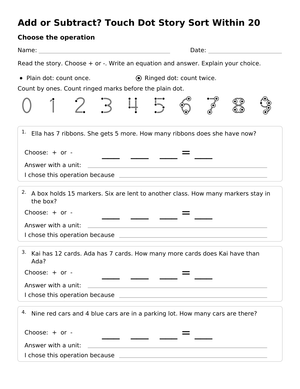
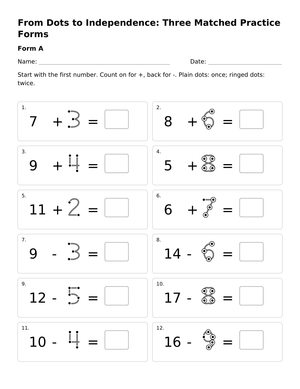
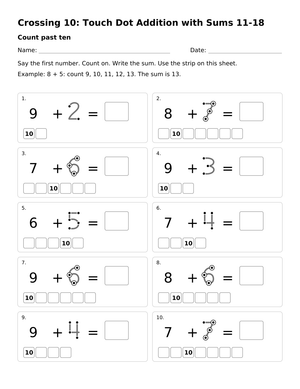
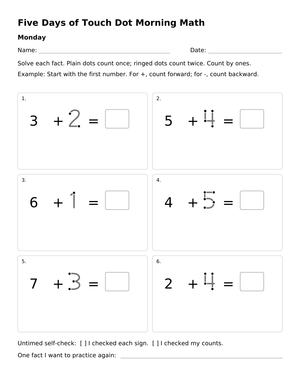
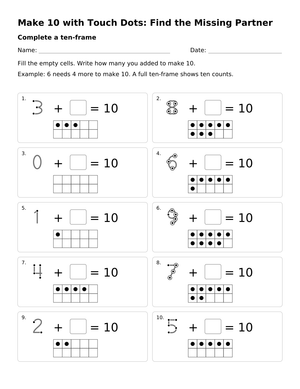
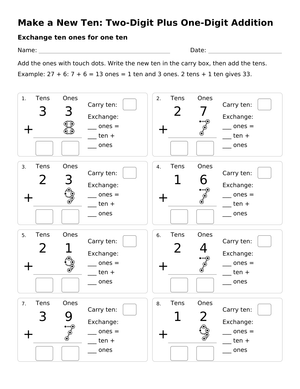
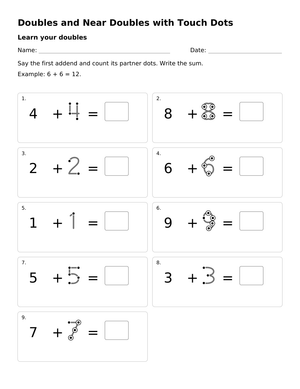
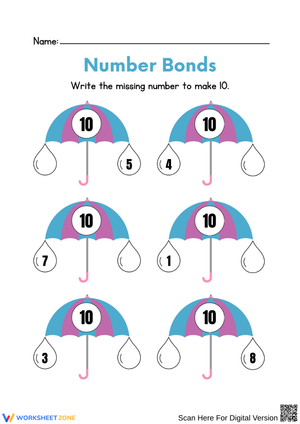
The others math worksheets for 1st grade in this collection address the domains that get squeezed out when the arithmetic block runs long — telling time, coin identification, non-standard measurement, introductory geometry, and simple data interpretation. Each worksheet targets one of these skills with visual, low-text tasks that most first graders handle independently after a single model. The PDF format matters here because clocks print to the right proportion and measurement lines hold their length, which is not guaranteed when teachers pull images from general word-processing files.
Skills These Worksheets Build
The set spans five non-arithmetic domains that the Common Core places in Grade 1 but that rarely receive the same daily repetition as addition and subtraction facts. Each worksheet stays inside one domain, which keeps cognitive load manageable and lets teachers isolate a specific gap without pulling out a full unit.
- Telling time — drawing clock hands to the hour and half-hour, matching analog displays to written times, and distinguishing the hour hand from the minute hand on a fully drawn clock face
- Coin recognition — identifying pennies, nickels, dimes, and quarters by appearance and relative value, without calculating totals
- Non-standard measurement — measuring printed objects by counting paper clip or cube units, recording the result, and comparing the lengths of two objects
- Geometry and equal shares — naming two-dimensional shapes, recognizing basic three-dimensional solids, and partitioning circles and rectangles into halves and fourths
- Data and graphs — recording tally marks, reading simple picture graphs, and answering comparative questions about the data
Frequent Errors Worth Watching For and Addressing
The most persistent time-telling error is hand confusion. On a clock showing 6:30, a student who has learned the hour hand correctly will still sometimes report "the big hand is on the 6, so it's 6:00" — fixating on which hand points more dramatically rather than which hand is shorter. Blank-face problems, where students draw both hands themselves rather than read a pre-drawn clock, surface this confusion in ways that multiple-choice formats cannot.
In measurement, the typical procedural error is leaving gaps between non-standard units. A student counting five paper clips that are spaced unevenly ends up with a measurement that doesn't match anyone else at the table. When this shows up at a center, it is worth pausing the group for two minutes to demonstrate tight alignment on a projected worksheet rather than correcting every student one at a time.
Coin recognition produces a reliable mix-up between nickels and pennies. The nickel is physically larger, which contradicts the intuition that bigger means more valuable. Even with detailed coin illustrations, some students need to hold the actual coins alongside the paper before visual identification clicks — a detail worth noting before assigning these worksheets as independent work for the first time.
The fractions tasks generate a different category of error. Students who successfully partition a shape into two pieces do not always make them equal. A rectangle divided into one large and one small section still registers as "two pieces" for a child who hasn't yet internalized what "equal" requires. Asking students to color only one half and then asking whether the remaining section is also one half uncovers this gap in about thirty seconds.
Building These Worksheets Into the Lesson Week
Morning work is the most reliable entry point for these domains. A clock-reading or coin-identification worksheet set out before the bell activates mathematical thinking that isn't tied to the arithmetic lesson coming later — and the familiar low-text format keeps morning transitions smooth.
Math centers are where others math worksheets for 1st grade do their most targeted work. Set up one station around measurement: print the worksheet, place a small bag of real paper clips at the station, and students measure printed objects using the physical clips before writing the count. A second station works well with a geometry worksheet inside a dry-erase sleeve, so students trace equal-share partitions repeatedly without consuming extra paper. A data station connects directly to classroom life: run a quick morning vote, post the results on the board, and have students fill in the matching tally chart worksheet independently.
The eight minutes before afternoon pickup and the ten-minute block on Friday before lunch are both well-suited to a short mixed-review worksheet that samples two domains at once. These brief, low-pressure sessions build retention over time without requiring full lesson planning.
Standard Alignment
The time worksheets address 1.MD.B.3, which requires students to tell and write time in hours and half-hours using both analog and digital clocks. The measurement worksheets cover 1.MD.A.1 and 1.MD.A.2 — ordering objects by length and expressing length in non-standard units. The data worksheets align to 1.MD.C.4, asking students to organize, represent, and interpret data with up to three categories. Geometry and equal-shares work falls under 1.G.A.1 and 1.G.A.3, covering shape attributes and partitioning into equal shares. Coin recognition is not a formal Common Core standard at Grade 1, but it appears in most state supplemental frameworks and in NCTM's guidance for connecting number sense to real-world context — making it a practical inclusion at this level.
Adjusting These Worksheets for a Range of Learners
For students who need additional support, pair others math worksheets for 1st grade with physical objects before expecting written responses. A student who cannot identify a dime on paper will often name it immediately when holding the actual coin. For clock worksheets, a small geared practice clock at the student's seat — one where turning the minute hand also moves the hour hand proportionally — closes the gap that static printed images leave open.
Students who move through the material quickly can extend without a separate worksheet. On a coin-identification page, ask them to write the total value of a pictured group of coins in the margin. On a measurement page, ask them to write a comparison sentence ("The crayon is 3 clips longer than the eraser"). Both extensions stay on the same paper and require no additional teacher preparation.
The data worksheets carry the most language demand in the set because of comparative vocabulary — more, fewer, least. For English language learners and students with limited academic language exposure, a brief vocabulary preview before the worksheet keeps the mathematical task accessible rather than turning it into a reading comprehension exercise.
Frequently Asked Questions
What domains do these worksheets cover?
The set covers five areas: telling time to the hour and half-hour, identifying coins by appearance and relative value, measuring objects with non-standard units, recognizing and partitioning geometric shapes, and reading and recording simple data in tally charts and picture graphs.
When during the year should I introduce each domain?
Time-telling and coin recognition work well early in the year because they connect to daily routines students already notice. Measurement and data worksheets fit naturally in the middle of the year once students have enough classroom vocabulary to discuss comparison. Geometry and equal shares often land in spring, when fractions vocabulary — halves, fourths — is already showing up in read-alouds and science lessons.
Are mixed-review worksheets appropriate for first graders?
Mixed-review worksheets work best as spaced review after each domain has received dedicated instruction — not as a first exposure. Used too early, they split a student's attention before either skill is stable. Used four to six weeks after initial instruction, they function as genuine retrieval practice and help teachers spot which domains have slipped.
Can these be used for small-group reteaching?
Yes. A single clock or measurement worksheet gives a small group a shared, concrete focus point, and the teacher can watch each student's process rather than just the final answer. The others math worksheets for 1st grade format prints consistently, so every student in the group works from an identical page — clock proportions, printed measurement lines, and coin images all hold their scale from one copy to the next.













 Interactive Worksheet Maker
 Quiz Maker
 Word Search Maker
 Crossword Puzzle Maker
 Word Scramble Generator
 Sentence Scramble Generator
 Handwriting Worksheet Generator
 Name Tracing Generator
 Fill In The Blank Generator