


























Views
Downloads
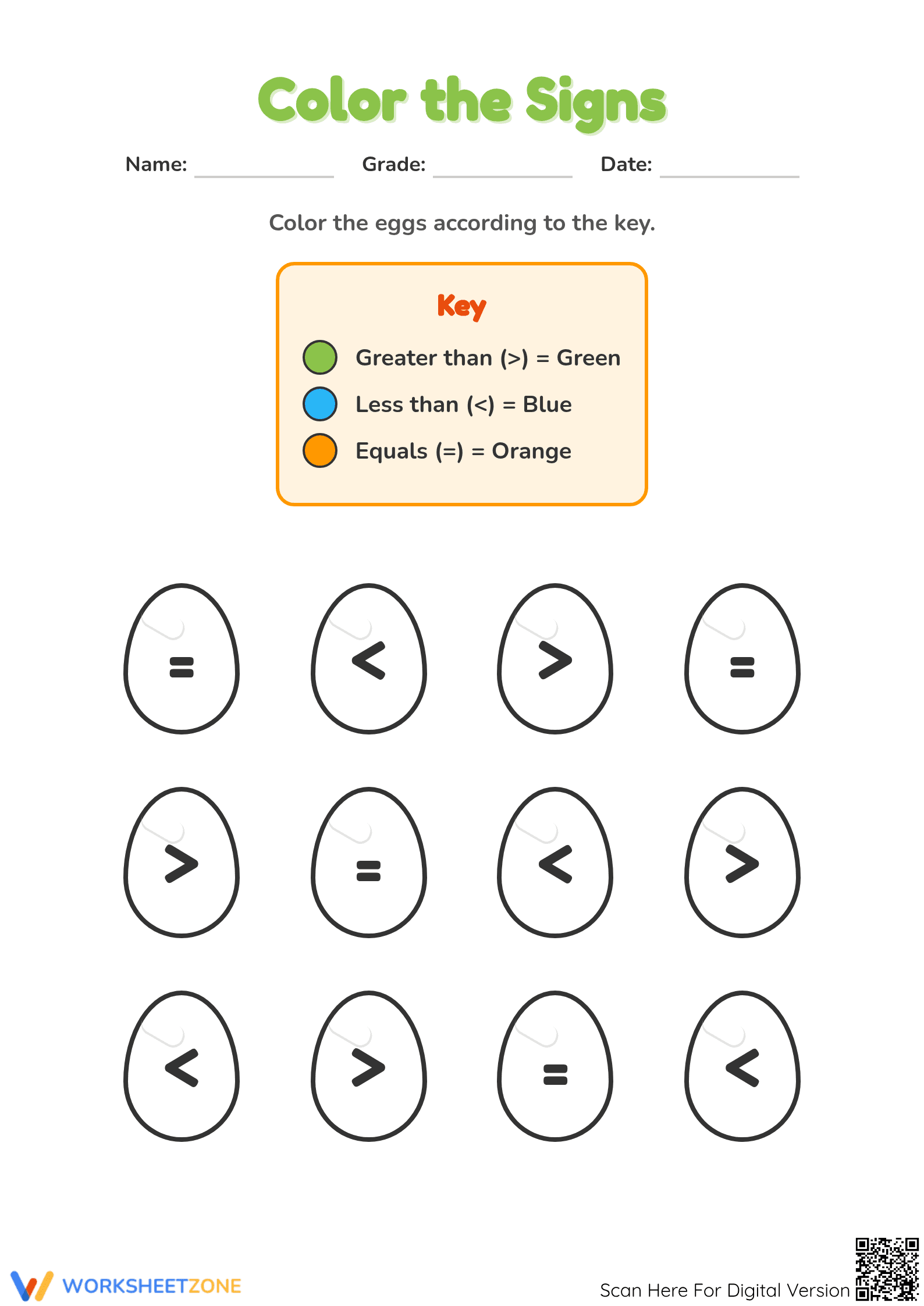


Printable Greater Than Less Than Symbols Math Worksheet
Paste this activity's link or code into your existing LMS (Google Classroom, Canvas, Teams, Schoology, Moodle, etc.).
Students can open and work on the activity right away, with no student login required.
You'll still be able to track student progress and results from your teacher account.
Master the foundational language of mathematical comparison with this engaging coloring activity. This worksheet helps students distinguish between greater than, less than, and equal signs through visual recognition and reinforcement. By associating colors with specific symbols, young learners build the muscle memory needed for more complex algebraic thinking and numerical comparisons in later grades.
At a Glance
- Grade: Grade 1 · Subject: Math
- Standard:
1.NBT.B.3— Compare numbers using the symbols >, =, and <- Skill Focus: Symbol Recognition
- Format: 2 pages · 16 problems · Answer key included · PDF
- Best For: Early finishers or morning work
- Time: 10–15 minutes
This resource contains two pages featuring sixteen egg-shaped illustrations, each housing a comparison operator. A clear, color-coded key at the top of the first page guides students to color the greater than sign green, the less than sign blue, and the equals sign orange. The package includes a comprehensive answer key to allow for quick teacher review or student self-correction.
Zero-Prep Workflow
- Print (1 min): Download the two-page PDF and print copies for your small group or entire class.
- Distribute (30 sec): Hand out the sheets along with green, blue, and orange crayons or colored pencils.
- Review (1 min): Use the provided answer key to scan student work for accuracy in symbol identification.
Total prep time is under three minutes, making this an ideal sub plan or transition activity during busy instructional blocks.
Standards Alignment
The primary standard addressed is CCSS.MATH.CONTENT.1.NBT.B.3, which requires students to compare numbers and record the results using the symbols `>`, `=`, and `<`. While this worksheet focuses on the symbolic representation rather than comparing specific digits, it serves as an essential prerequisite for fulfilling the standard's requirement. This standard code can be copied directly into lesson plans, IEP goals, or district curriculum mapping tools.
How to Use It
Introduce this worksheet during the guided practice phase of a lesson on comparison. Before asking students to compare actual numbers, ensure they can fluently name and recognize the symbols. Alternatively, use it as a formative assessment at the end of a unit. Observe whether students can correctly apply the key without constant redirection, as this indicates mastery of the symbolic language.
Who It's For
This activity is designed for Kindergarten and Grade 1 students who are being introduced to the concepts of more and less. It is also highly effective for English Language Learners (ELLs) and students with IEPs who benefit from multisensory, color-coded reinforcements of abstract mathematical concepts.
Mathematical fluency relies heavily on the student's ability to decode symbols accurately before applying them to logical operations. According to Fisher & Frey (2014) in their research on gradual release of responsibility, providing structured, low-stakes opportunities for symbol recognition—such as this color-coded comparison activity—bridges the gap between conceptual understanding and procedural fluency. This worksheet addresses the 1.NBT.B.3 standard by isolating the comparison operators, allowing students to focus on the visual form of the greater than, less than, and equals signs. By removing the cognitive load of calculating numerical values, the activity ensures that students internalize the meaning of the signs themselves. This foundational step is critical for preventing common reversals and misconceptions that often occur when students begin comparing multi-digit numbers. The research-backed approach of using visual cues significantly improves retention and retrieval for early learners in diverse classroom settings.


