


























Views
Downloads

Grade K More or Less Comparison: Essential No-Prep Math Worksheet
Paste this activity's link or code into your existing LMS (Google Classroom, Canvas, Teams, Schoology, Moodle, etc.).
Students can open and work on the activity right away, with no student login required.
You'll still be able to track student progress and results from your teacher account.
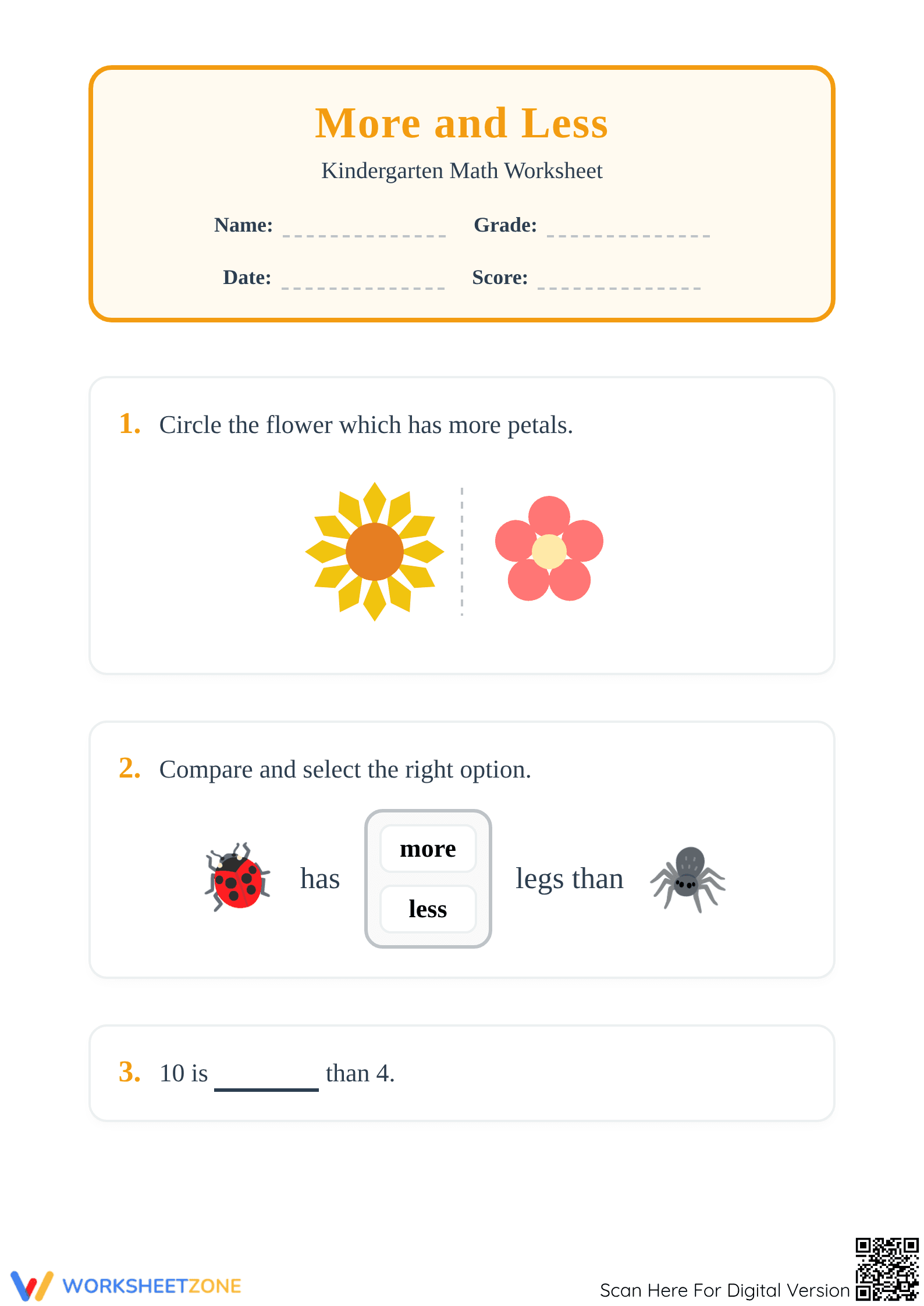
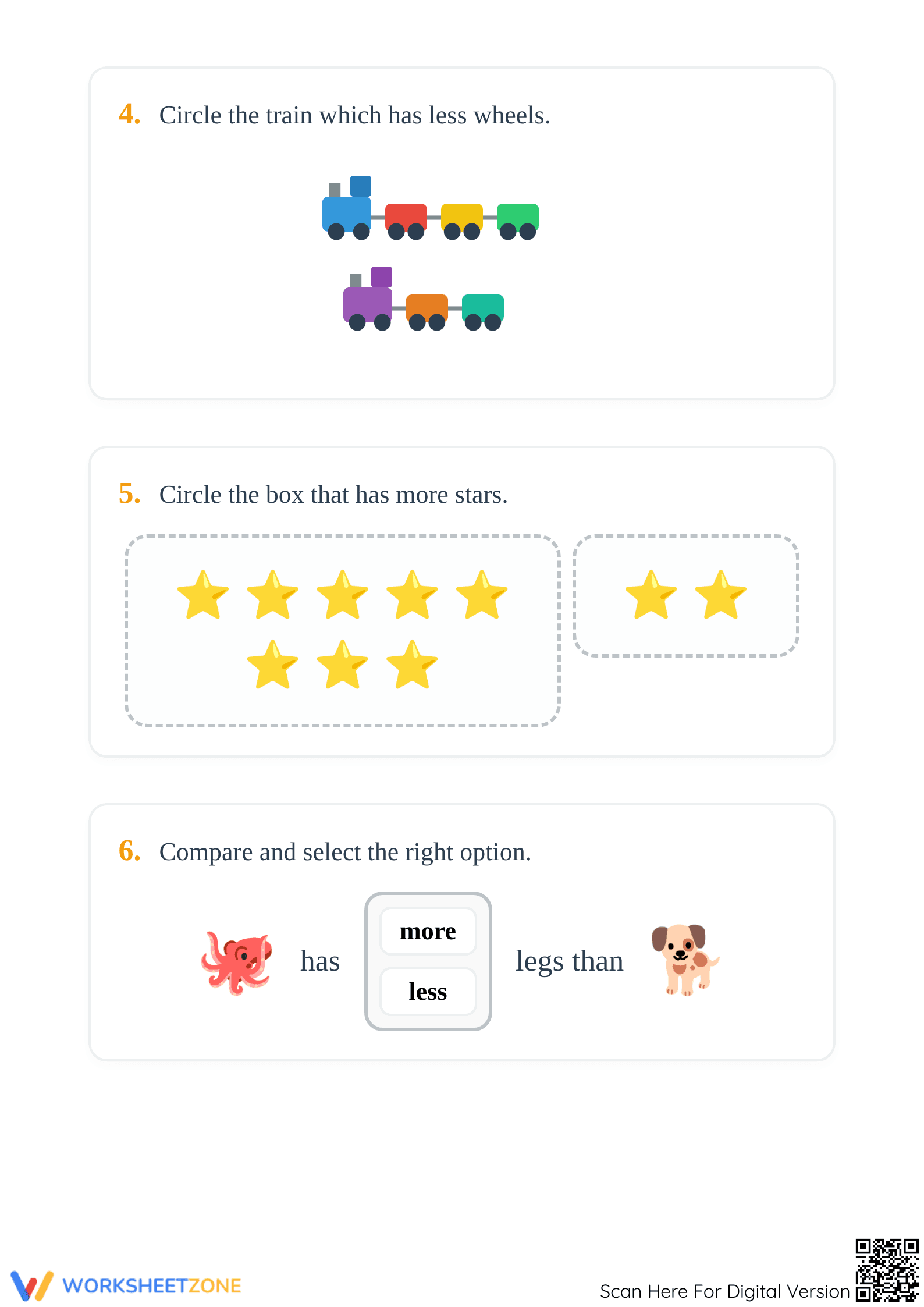
This Kindergarten more or less worksheet helps young learners master the fundamental concept of numerical comparison through engaging visual tasks. Students analyze sets of objects—from flower petals to animal legs—to identify which group is greater or smaller in quantity. It provides a solid foundation for understanding quantity and number relationships.
At a Glance
- Grade: Kindergarten · Subject: Math
- Standard:
CCSS.MATH.CONTENT.K.CC.C.6— Identify whether the number of objects in one group is greater or less than another- Skill Focus: Visual and Numerical Comparison
- Format: 3 pages · 8 problems · Answer key included · PDF
- Best For: Independent practice and early math centers
- Time: 15–20 minutes
What's Inside
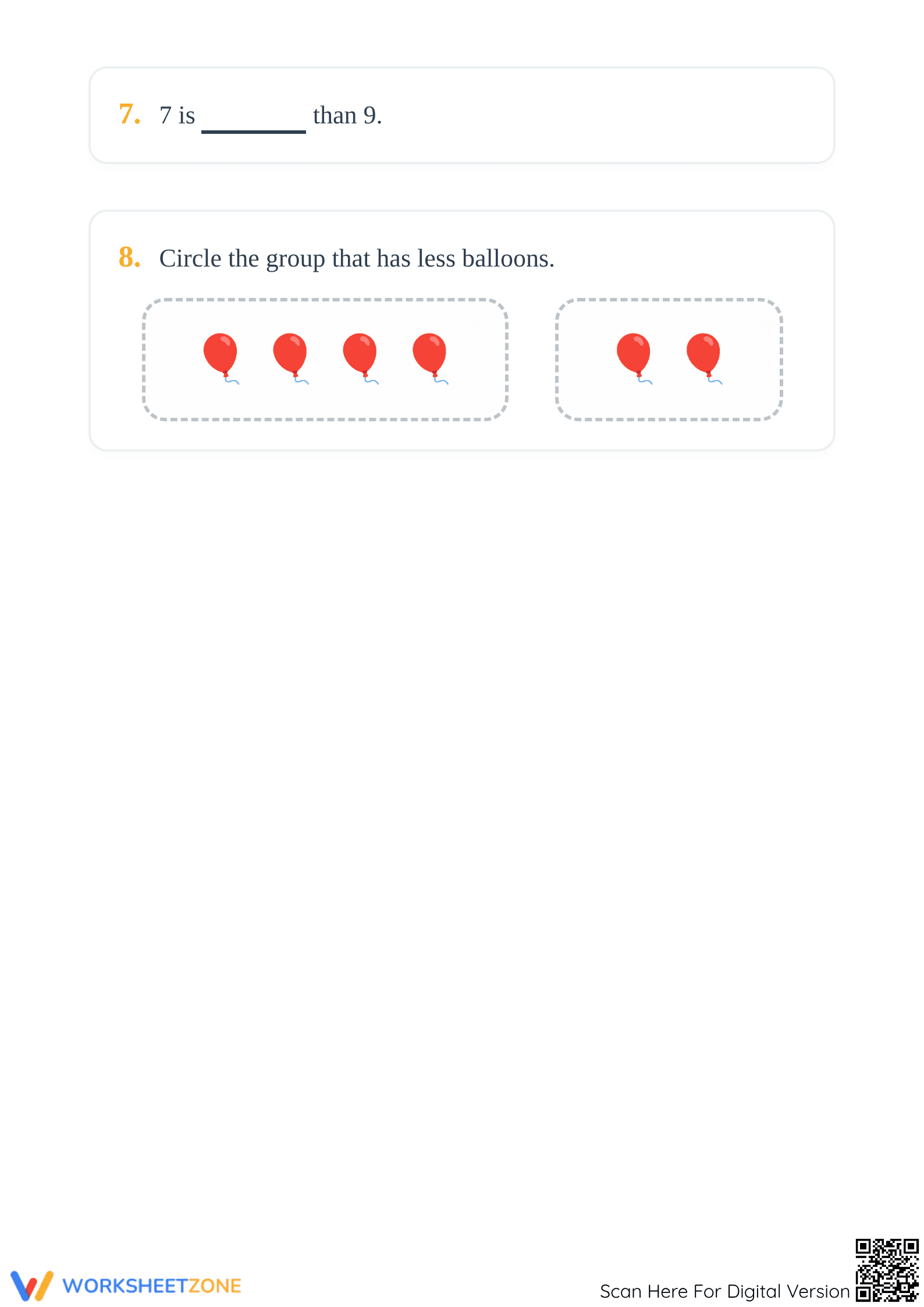
This comprehensive 3-page PDF includes 8 structured comparison tasks that transition from concrete visual sets to abstract numerical comparisons. The first page focuses on counting petals and comparing insect legs, while subsequent pages introduce train wheels, stars, and direct comparisons of numbers like 7 and 9. A full answer key is included for rapid grading.
Zero-Prep Workflow
First, print the 3-page document (30 seconds). Second, distribute the worksheets to students and provide a brief verbal overview of the words "more" and "less" (1 minute). Finally, review the answers using the included key (5 minutes). Total teacher preparation time is under two minutes, making it an ideal choice for emergency sub plans or last-minute math centers.
Standards Alignment
This activity is primarily aligned to CCSS.MATH.CONTENT.K.CC.C.6, requiring students to identify if a group's object count is greater or less than another. It also supports CCSS.MATH.CONTENT.K.CC.C.7 for comparing numerals. Both standard codes can be copied directly into lesson plans, IEP goals, or district curriculum mapping tools.
How to Use It
Use this worksheet during the "You Do" phase of a gradual release model following a lesson on counting and quantity. It works effectively as an exit ticket to gauge which students are confusing the terms "more" and "less." Teachers should observe if students are counting every object individually or using subitizing skills for smaller sets like the flowers or balloons.
Who It's For
This resource is tailored for Kindergarten students but serves as an excellent remedial tool for First Grade learners who need to reinforce their number sense. It naturally pairs with a physical manipulative activity, such as using counting cubes or bear counters, to bridge the gap between concrete objects and paper-and-pencil tasks.
Early mathematical development relies on the ability to compare quantities, a skill that serves as the bedrock for all future arithmetic. According to a RAND AIRS 2024 analysis, students who master comparison concepts in Kindergarten show significantly higher proficiency in addition and subtraction logic. This worksheet specifically targets the CCSS.MATH.CONTENT.K.CC.C.6 standard, requiring students to count objects and evaluate their relative size. By moving from high-interest visuals like ladybugs and stars to written numerals, the tasks encourage the cognitive shift from perceptual counting to abstract comparison. This structured approach mirrors the recommendations found in recent ScienceDirect TpT Analysis papers, which emphasize the importance of visual scaffolding in early numeracy resources. Teachers can integrate this printable to ensure students meet national benchmarks for numerical ordering and quantity relationships.


