


























Views
Downloads



Printable Comparing Sets Less Worksheet | Kindergarten Math
Paste this activity's link or code into your existing LMS (Google Classroom, Canvas, Teams, Schoology, Moodle, etc.).
Students can open and work on the activity right away, with no student login required.
You'll still be able to track student progress and results from your teacher account.
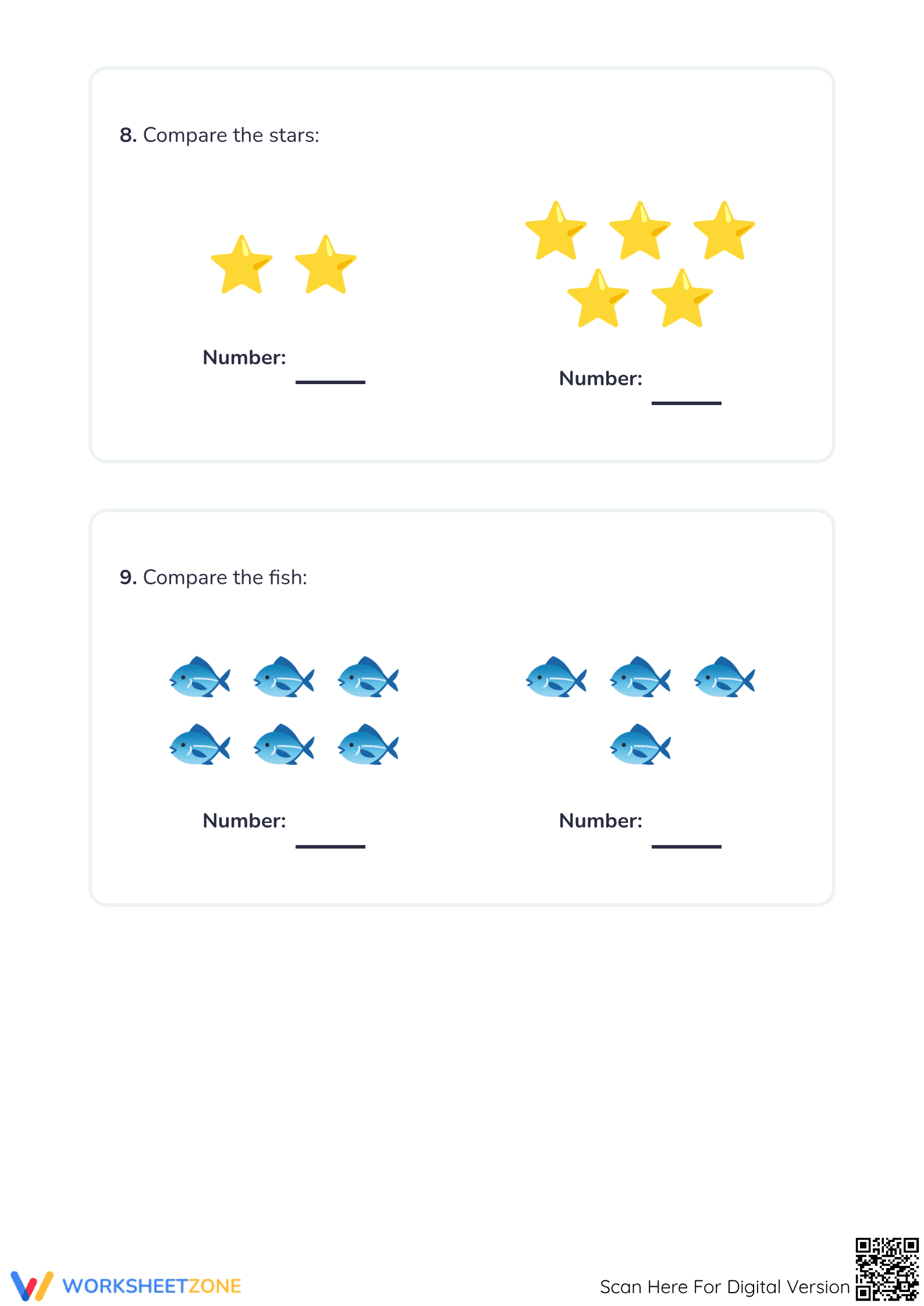
This Kindergarten comparison worksheet helps young learners master the concept of identifying the smaller of two groups. By counting objects and selecting the set with fewer items, students build foundational number sense. This essential math resource transforms abstract concepts into concrete, visual exercises that are easy for early learners to understand.
At a Glance
- Grade: K · Subject: Math
- Standard:
CCSS.MATH.CONTENT.K.CC.C.6— Identify whether the number of objects in one group is less than another- Skill Focus: Comparing sets (less)
- Format: 5 pages · 9 problems · Answer key included · PDF
- Best For: Early finishers, independent math center, or sub plan
- Time: 15–20 minutes
This 5-page PDF contains nine comparison tasks featuring engaging black-and-white illustrations of familiar objects like planes and stars. Each page provides ample white space to prevent visual overwhelm. The clear "Tick the set" instruction simplifies the objective, while the included five-page answer key allows for rapid grading or student self-correction.
Zero-Prep Workflow
- Step 1: Print — Select the specific pages needed for your math block (30 seconds).
- Step 2: Distribute — Hand out worksheets during independent practice or math centers (30 seconds).
- Step 3: Review — Use the answer key for a quick visual audit of student progress (30 seconds).
This streamlined process makes it an ideal choice for emergency sub plans or last-minute instructional gaps where teacher time is at a premium.
Standards Alignment
The worksheet is aligned to `CCSS.MATH.CONTENT.K.CC.C.6`, requiring students to identify if a group's count is less than another. These exercises target the "less" component, ensuring students develop vocabulary needed for future operations. Both standard codes can be copied directly into lesson plans, IEP goals, or district curriculum mapping tools, providing a seamless link between daily classroom practice and state-level accountability requirements.
How to Use It
Use this worksheet during the independent practice phase of a lesson on quantity. After modeling how to count each set, assign one page as a quick check for understanding. It serves as an excellent formative assessment tool; observe if students use one-to-one correspondence while counting. Expect most Kindergarten students to complete two pages in approximately 10 minutes, making it a perfect transition activity between direct instruction and small group work.
Who It's For
This resource is tailored for Preschool, Kindergarten, and Grade 1 students developing early numeracy. It provides necessary scaffolding for English Language Learners through high-visual support and minimal text. It pairs naturally with physical manipulatives, such as counting bears or snap cubes, allowing students to build the sets before marking their answers on the paper for a multi-sensory experience.
Research from RAND AIRS 2024 emphasizes that early exposure to comparative magnitude—the ability to discern which of two sets is "more" or "less"—is one of the strongest predictors of later mathematical achievement. This worksheet implements these findings by using discrete object sets that require active counting, which reinforces the cardinal principle. Unlike abstract numerical comparisons, visual sets provide the concrete scaffolding necessary for learners in the pre-operational stage of development. By focusing specifically on the "less" attribute, this resource prevents the common cognitive bias where students only attend to larger quantities. Educators can utilize this structured practice to bridge the gap between rote counting and true numerical reasoning, ensuring that students meet CCSS.MATH.CONTENT.K.CC.C.6 benchmarks with high accuracy. This evidence-based approach to number sense development provides a reliable foundation for future work with the "less than" symbol and subtraction concepts.


