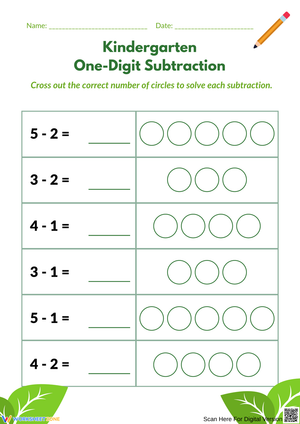
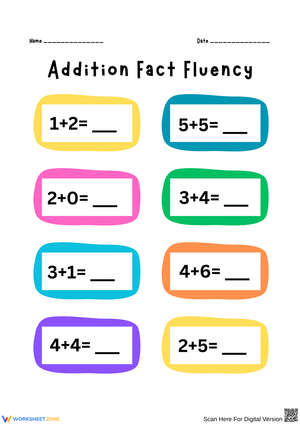
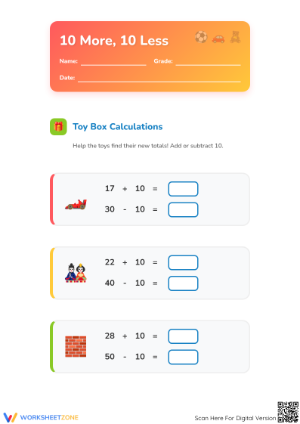
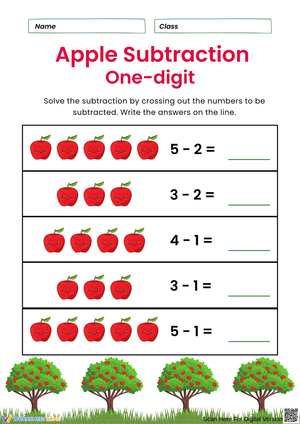
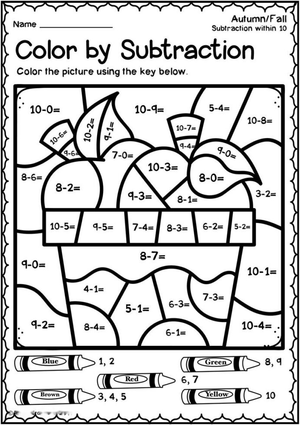
These subtraction pdf worksheets for 1st grade cover the three strategies first graders actually need — counting back, ten-frame modeling, and fact family relationships — in formats that move students from marking up pictures to writing equations without visual support. The set is organized so teachers can pull individual worksheets by strategy or by number range, rather than working through a fixed sequence that may not match where a class currently sits.
Skills Covered Across the Set
Each worksheet isolates one strategy or representation. The formats include:
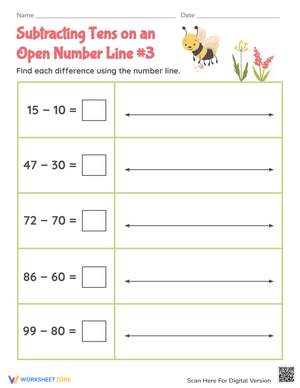
- Counting-back number line worksheets: Students mark a starting point, draw leftward jumps, and record the difference — a physical sequence that anchors directionality before they internalize the abstract.
- Ten-frame worksheets: A partially filled frame prompts students to record how many dots are missing, connecting the visual directly to a subtraction equation.
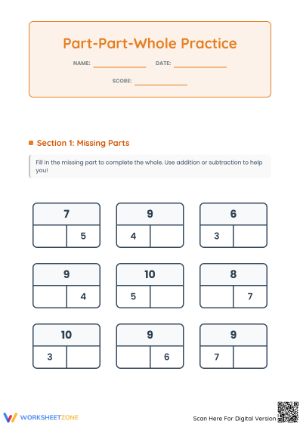
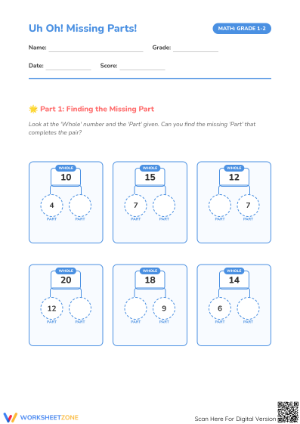
- Fact family worksheets: Students receive a number bond — such as 6, 8, and 14 — and write all four related equations, making the inverse relationship between addition and subtraction explicit rather than implied.
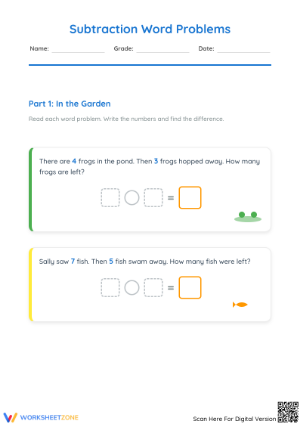
- Word problem worksheets: Two-sentence scenarios with single-digit unknowns. Students underline key numbers, circle the action word, and write the equation before solving — an annotation step built into the format itself.
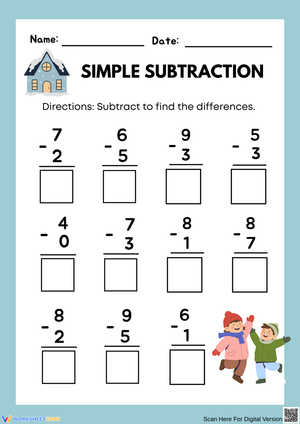
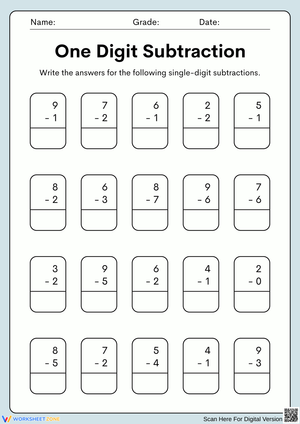
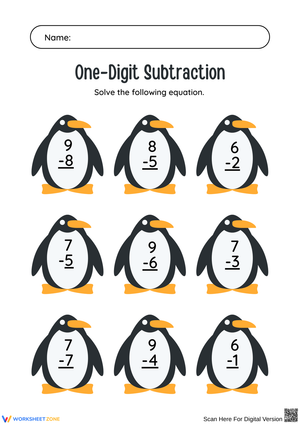
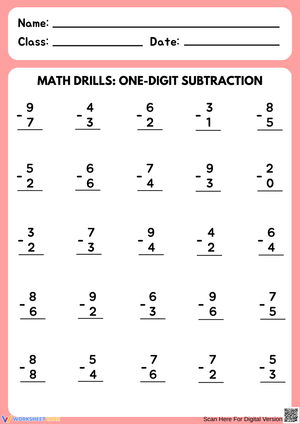
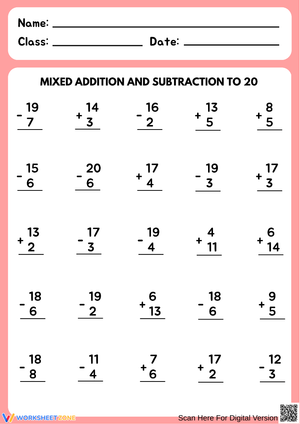
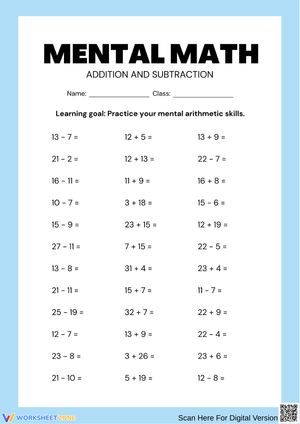
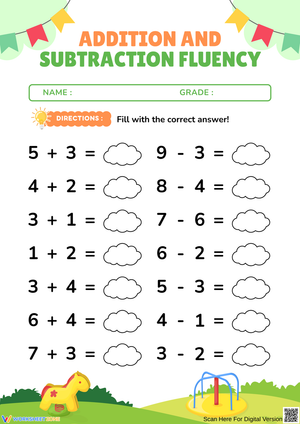
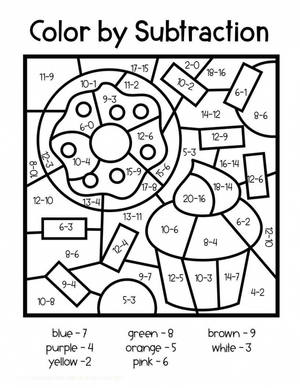
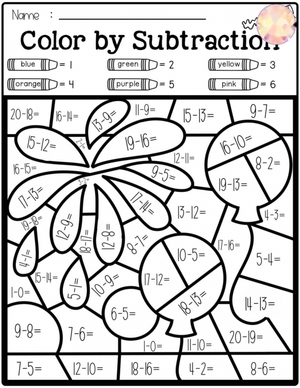
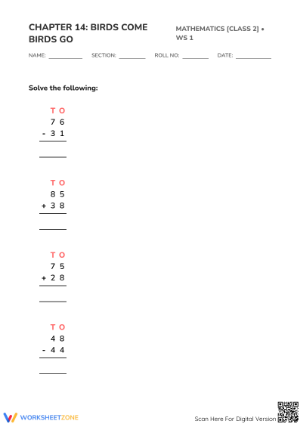
- Equation practice worksheets: Horizontal and vertical problems within 10 and within 20, for building fluency with the standard written format.
Where Students Predictably Go Wrong
The most consistent error in first-grade subtraction is an off-by-one counting mistake that looks like this: a student solving 8 - 3 counts "8, 7, 6" and writes 6. They've counted back three numbers, but they've counted the minuend itself as step one, so they're always one short of the correct answer. This pattern appears in roughly half the class during initial instruction. Naming it explicitly — before students complete a full worksheet independently — prevents them from practicing the wrong procedure until it's entrenched.
Number-line direction is a second reliable stumbling block. Because addition travels right and students learn it first, they occasionally hop right when subtracting, effectively adding instead. Each number-line worksheet in this set prints a small leftward arrow above the line as a directional anchor — useful to point out during whole-group instruction before releasing students to work on their own.
A subtler error surfaces in fact family work. Students fill in all four equations correctly — 6 + 8 = 14, 8 + 6 = 14, 14 - 6 = 8, 14 - 8 = 6 — but when asked the isolated fact 14 - 6 without the number bond visible, they reconstruct from scratch rather than retrieve. The procedure has been learned; the relationship has not. That gap is worth a brief discussion rather than just a check mark.
Fitting These Worksheets Into Your Weekly Math Block
Daily ten-minute practice distributed across the week outperforms one long subtraction session. Counting-back worksheets work well at the start of math block — students arrive from morning meeting already in a counting-sequence mindset, and the worksheet activates that before moving into new instruction. Ten-frame worksheets fit naturally midweek, when students benefit from a concrete visual anchor after a few days of more abstract number work. Fact family and word problem worksheets belong toward the end of the week, when students have enough accumulated practice to connect strategies across formats.
These subtraction pdf worksheets for 1st grade also integrate cleanly into a math-centers rotation. Independent groups work on review worksheets — one group reviewing within 10, another within 20 — while the teacher pulls a small group for targeted instruction. Because each worksheet carries a single, clear task, students in the independent centers rarely need to interrupt the small-group table with procedural questions.
Standard Alignment
The worksheets address CCSS 1.OA.C.6, which requires first graders to add and subtract within 20 and demonstrate fluency for subtraction within 10. In classroom terms, this standard sits at the center of first-grade math because it bridges the counting skills students arrive with and the algebraic reasoning they'll need in second grade. Fluency within 10 — which the standard specifically calls for — isn't about speed alone; it means students produce accurate answers without rebuilding the problem from scratch each time. These subtraction pdf worksheets for 1st grade build that fluency by presenting the same number ranges across different problem types, so students encounter the facts in varied contexts rather than cycling through one format until they've memorized the presentation instead of the math.
Tiering the Set for Different Skill Levels
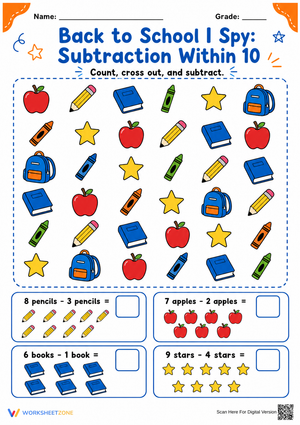
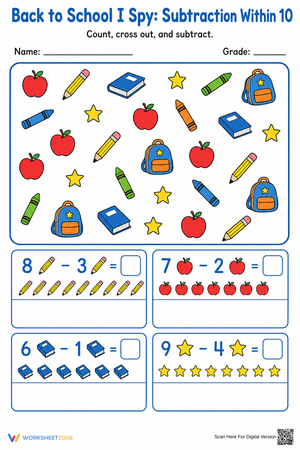
For students who haven't secured subtraction within 5, start with the ten-frame and picture-based worksheets. Those formats give students something to mark up before they write any equation, so the work remains productive rather than stalling at a blank problem. Students who show consistent accuracy within 10 move to the within-20 worksheets and the word problem set, which require more working memory because the numbers are larger and the operation isn't signaled by a picture.
For students who finish early and accurately, the fact family worksheets offer a quick extension: ask them to generate a fourth fact family on the back using numbers they choose themselves. Selecting a valid number bond is a higher-demand task than completing a given one. It takes thirty seconds to assign and produces a clearer picture of genuine understanding than a completed worksheet alone can show.
Frequently Asked Questions
Should students use manipulatives alongside the worksheets?
During initial instruction, yes. Having students model a problem with snap cubes or counters before recording the equation gives them a concrete referent for what the numbers represent. Once students reliably reach correct answers with manipulatives in hand, the worksheets alone are sufficient for practice and fluency building.
How do these worksheets fit alongside a published curriculum that already covers subtraction?
They work as supplemental practice rather than replacement material. If your curriculum introduces counting back in week three, pull the counting-back worksheet for that week's independent work or center rotation. Because each worksheet targets a single strategy, matching individual worksheets to an existing curriculum sequence is straightforward.
What does consistent accuracy tell me about where to go next?
It tells you the student is ready for a harder number range or a more abstract format. Move them to the next difficulty tier, or introduce the fact family worksheet as the following day's warm-up. These subtraction pdf worksheets for 1st grade produce actionable information: consistent accuracy means move the student up; consistent errors mean identify the specific mistake before assigning more of the same problem type.













 Interactive Worksheet Maker
 Quiz Maker
 Word Search Maker
 Crossword Puzzle Maker
 Word Scramble Generator
 Sentence Scramble Generator
 Handwriting Worksheet Generator
 Name Tracing Generator
 Fill In The Blank Generator