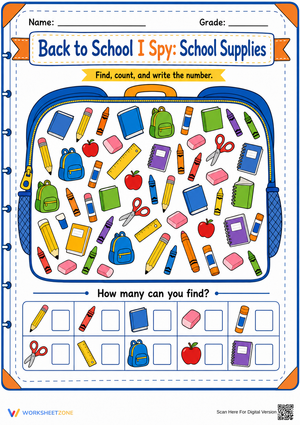
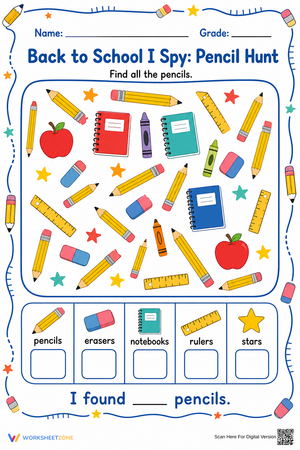
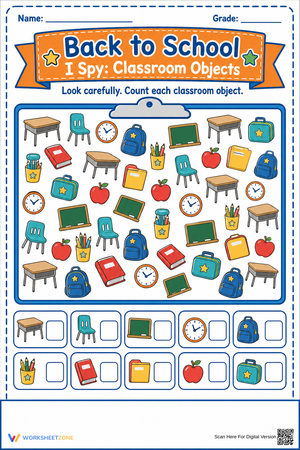
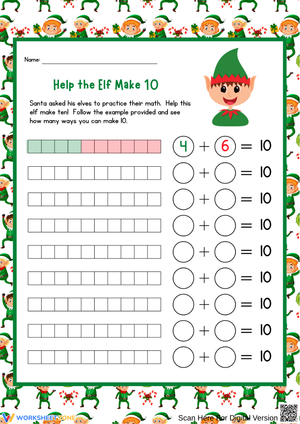
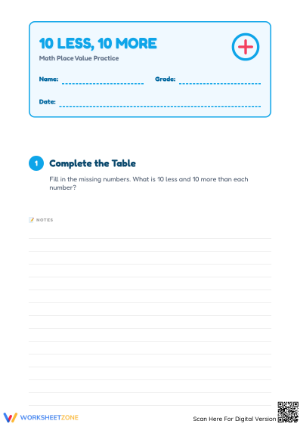
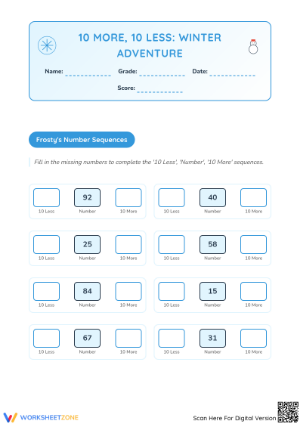
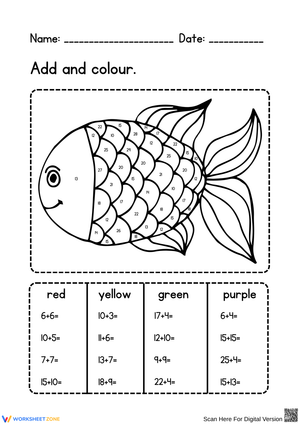
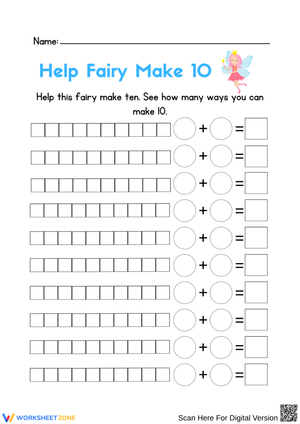
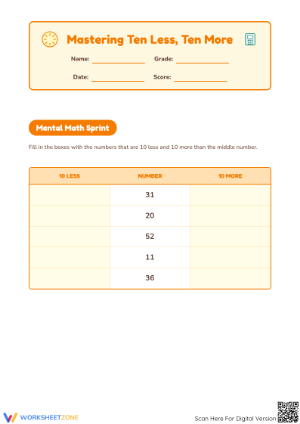
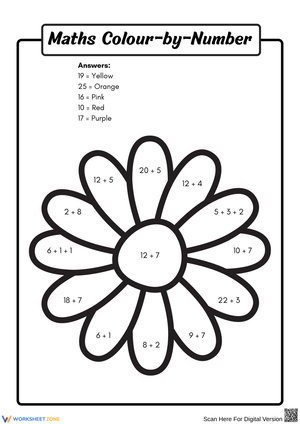
These 1st grade counting worksheets resources give teachers a print-and-go set of targeted practice materials covering the skills that define first-grade number sense: reading and writing numerals to 120, navigating the 120 chart, skip counting by twos, fives, and tens, and using counting-on as a bridge to early addition. Each worksheet targets one discrete skill, which makes it easy to drop into a math center, a five-minute warm-up, or a small-group pull-out session without rebuilding your lesson plan around it.
Skills These Worksheets Build
The set moves through four skill areas that span the full first-grade math year, from early-year numerals-within-30 work through spring's push to 120.
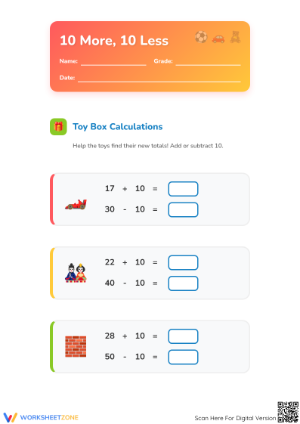
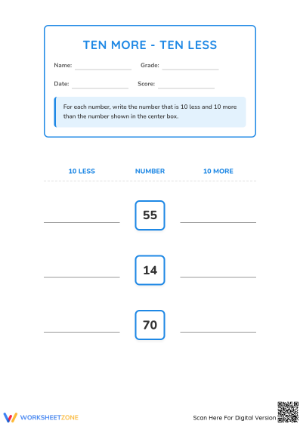
- 120 chart navigation: Students fill in missing numerals, identify patterns within rows and columns, and answer "ten more" and "ten less" prompts using the chart. Regular chart work shifts students from treating it as a lookup tool to using it as a reasoning tool.
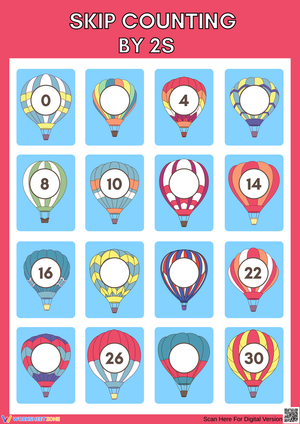
- Skip counting sequences: Worksheets ask students to complete sequences by twos, fives, and tens — sometimes starting from zero, sometimes from a mid-sequence number like 14 or 35. Starting a skip count at a non-zero entry point reveals whether students understand the underlying pattern or have only memorized the standard recitation.
- Counting on from a given number: Students see a starting number — often in the forties or sixties — and write the next five or ten numbers in sequence. This dismantles the habit of restarting from one every time and builds the mental flexibility that early addition requires.
- Missing number sequences: Gaps appear before, after, and between known numbers, including crossings from one decade to the next. A prompt like 58, 59, ___, 61 tells you immediately whether a student grasps the structural reset at 60 or is estimating.
Counting Errors Worth Catching Early
The most consistent stumbling point is the decade crossing. A student who counts thirty-six, thirty-seven, thirty-eight, thirty-nine without hesitation will sometimes write "twenty" or "forty-ten" as the next number — not because they forgot the sequence, but because English number names don't signal the structural shift the way "sixty" does. Sixty sounds like six-tens; "thirty" does not sound like three-tens to a six-year-old working from sound alone. Worksheets that visually emphasize decade boundaries — a bolder rule between chart rows, a distinct background on the "zero ones" column — give students an anchor right where the cognitive demand spikes.
Digit reversal in the teens appears just as reliably. A student writes 41 when they mean 14 because the name "fourteen" places the four before the ten in speech, and left-to-right transcription follows that spoken order. Asking students to mark the tens digit and ones digit separately before writing the complete numeral — rather than writing first and checking after — interrupts this reversal before it sets into habit. Eleven and twelve need direct attention beyond regular sequence work; their names carry no base-ten information, and counting practice alone does not resolve that gap.
Standard Alignment
The worksheets in this 1st grade counting worksheets set address CCSS 1.NBT.A.1, which requires first graders to count to 120 starting from any number less than 120, read and write numerals in that range, and represent a quantity of objects with the corresponding numeral. The clause "starting from any number" carries real instructional weight — it rules out pure rote recitation and demands flexible sequence knowledge. In most first-grade pacing guides, counting extends to 30 in the opening unit, reaches 100 before winter break, and pushes to 120 in the spring. The worksheets distribute naturally across that arc rather than clustering in a single unit.
How to Work These Worksheets Into the Week
The 1st grade counting worksheets set fits particularly well as Monday morning work — a calm, focused re-entry to math after the weekend. A partial 120 chart or a missing-number sequence takes about six minutes to complete, which clears before the first lesson block without cutting into direct instruction time. For math centers, laminate the skip-counting worksheets and set them out with dry-erase markers. Students fill in the sequence, check it against a number line or a row of counting cubes, then wipe and reset for the next student. That one worksheet runs all week without consuming paper.
For intervention groups, pull a worksheet that isolates one specific decade crossing — the jump from 89 to 90, for instance — and work through it orally before anyone picks up a pencil. Hearing a peer say "eighty-nine, ninety" without hesitation often resolves the confusion faster than three days of written practice alone. Reserve the more demanding missing-number sequences for Friday review, when students have had a full week of exposure and the task functions as retrieval practice rather than first contact with the material.
Adjusting the Worksheets for a Range of Learners
Students not yet secure at 20 do well with worksheets that keep sequences within a single decade and pair the numerals with ten-frame visuals. For these students, covering the pre-printed numbers on a 120 chart and asking them to fill in just one row at a time reduces the scope without removing the structural context of the full chart. Students who have counting to 120 solid benefit from added constraints on the same worksheets: start the skip count from an odd number, count backward from 80, or work through the sequence with no reference chart available. Both groups can use the same worksheet; the adjustment shifts the cognitive load substantially without requiring a separate material.
A 1st grade counting worksheets that includes multiple sequence types — single-decade, cross-decade, skip-count by fives, skip-count by tens — gives teachers enough variety to match each worksheet to a student's current readiness level without building a second resource from scratch. For students who need reference support, attach a blank 120 chart; for students ready to work from memory, remove it.
Frequently Asked Questions
What counting milestones should first graders have solid before winter break?
By December, students should count forward and backward reliably within 30, read and write those numerals without consistent reversal, and complete simple missing-number sequences in that range. Skip counting by tens to 100 — introduced early in the year — should also be stable. If a student still restarts from one every time rather than counting on from a given number, that pattern is the intervention priority before the holiday break.
How do I use these worksheets as quick formative checks without grading every one?
Give students two minutes to complete a short sequence task at the start of a lesson, then circulate and mark errors with a small pencil dot rather than collecting papers. A scan of the room tells you whether the class needs a full reteach or whether two or three students need a brief pull-aside. This takes under five minutes of instructional time and often produces cleaner information than a graded quiz, because students don't stop to erase and second-guess — the errors you see are genuine errors.
Why do teen numbers remain difficult even after weeks of exposure?
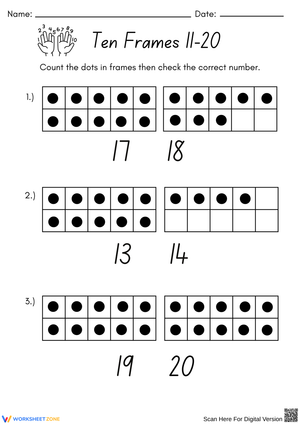
The naming structure in English actively works against students. "Fourteen" puts the ones name first and the ten name second — the reverse of how we read and write the numeral, where the tens digit appears on the left. Students who hear "four-teen" write the four first, producing 41. Adding more repetition of the name alone does not fix this because the mismatch is linguistic, not a memory gap. Worksheets that make the decomposition visible — 14 shown as 1 ten and 4 ones in both an equation and a ten-frame diagram — address the conceptual layer beneath the naming confusion, which is where the error actually originates.













 Interactive Worksheet Maker
 Quiz Maker
 Word Search Maker
 Crossword Puzzle Maker
 Word Scramble Generator
 Sentence Scramble Generator
 Handwriting Worksheet Generator
 Name Tracing Generator
 Fill In The Blank Generator