


























Views
Downloads

Comparing Groups Worksheet | Essential Kindergarten Math
Paste this activity's link or code into your existing LMS (Google Classroom, Canvas, Teams, Schoology, Moodle, etc.).
Students can open and work on the activity right away, with no student login required.
You'll still be able to track student progress and results from your teacher account.
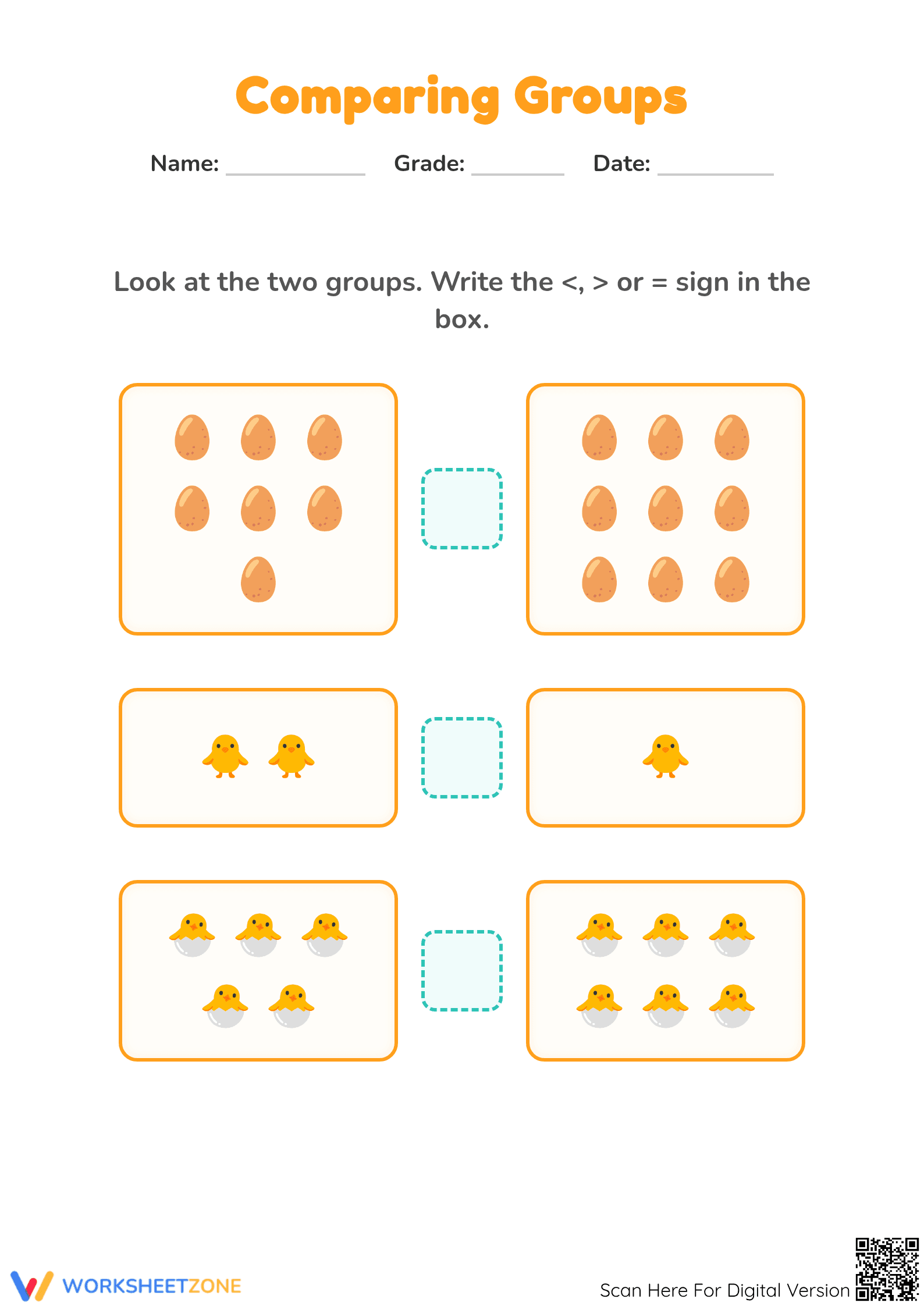
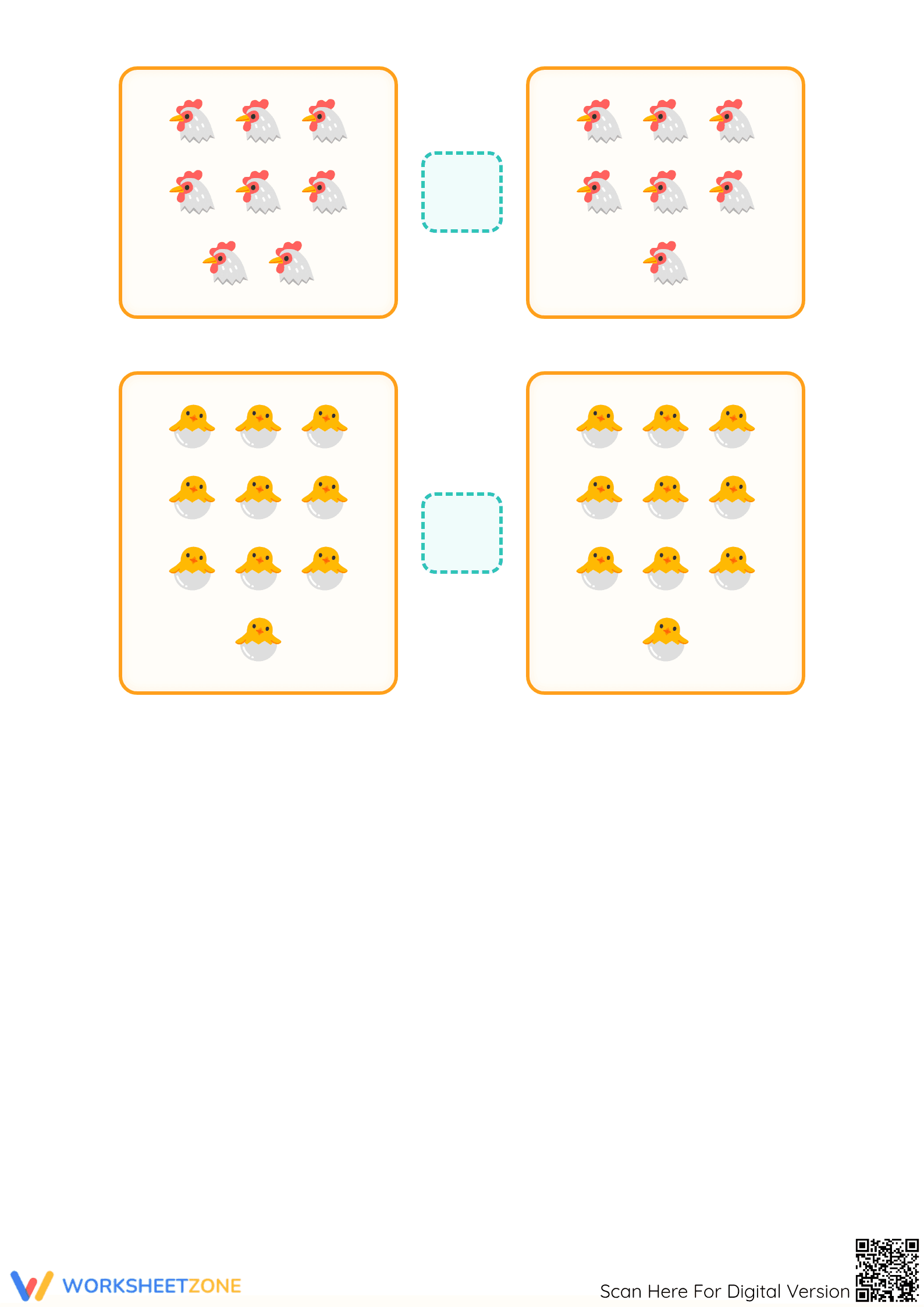
This printable comparing groups worksheet provides foundational practice for young learners mastering quantity relationships. Students observe visual sets of objects—including spring-themed eggs and chicks—and apply mathematical symbols to indicate greater than, less than, or equal to values. It is a perfect tool for bridging the gap between concrete counting and abstract algebraic reasoning in early elementary mathematics.
At a Glance
- Grade: K–1 · Subject: Math
- Standard:
CCSS.MATH.CONTENT.K.CC.C.6— Identify if object groups are greater than, less than, or equal to each other- Skill Focus: Comparing Quantities with Symbols
- Format: 2 pages · 5 problems · Answer key included · PDF
- Best For: Early finishers and morning work practice
- Time: 10–15 minutes
What's Inside
The packet includes two high-quality pages featuring five distinct comparison tasks. Each problem presents two framed groups of illustrations, such as chickens, eggs, and hatching chicks, with a central box for students to write the correct symbol (<, >, or =). The clean layout and engaging visuals minimize cognitive load, while the included full-color answer key allows for rapid grading or student self-correction.
Zero-Prep Workflow
Implementation is designed for maximum efficiency in busy classrooms. Teachers can move from discovery to distribution in under two minutes: simply print the two-page PDF and hand it to students. No additional manipulatives are required, as the visual groups are clearly structured for easy counting. Reviewing the finished work takes less than 60 seconds per student using the provided answer guide, making this an ideal sub plan.
Standards Alignment
This resource aligns directly with CCSS.MATH.CONTENT.K.CC.C.6, requiring students to identify whether the number of objects in one group is greater than, less than, or equal to the number of objects in another group. It also supports 1.NBT.B.3 by introducing the symbols used to compare two-digit numbers. Both standard codes can be copied directly into lesson plans, IEP goals, or district curriculum mapping tools.
How to Use It
Use this worksheet as a formative assessment after a whole-group lesson on comparison symbols. During the activity, observe if students are counting every object individually or using subitizing skills to recognize small groups quickly. It also serves as an excellent "Bridge to Abstract" activity, where students transition from counting physical objects to recording their findings with mathematical notation.
Who It's For
The worksheet is tailored for Kindergarten and Grade 1 students, particularly those who benefit from visual scaffolds. It is highly effective for English Language Learners (ELLs) because the mathematical symbols provide a universal language for demonstrating understanding without heavy text reliance. Pair this with a digital counting game or a physical sorting tray activity for a comprehensive math center rotation.
Effective early math instruction relies on the transition from perceptual to conceptual comparison. Research from the NAEP highlights that students who develop a strong grasp of quantity relationships, specifically CCSS.MATH.CONTENT.K.CC.C.6, in Kindergarten are significantly better prepared for the complexities of base-ten operations in later grades. This worksheet facilitates that development by requiring students to count and then evaluate the magnitude of sets relative to one another. By using familiar icons like eggs and chicks, the cognitive load is redirected toward the primary task of mathematical evaluation. Fisher & Frey (2014) emphasize that such focused practice, when coupled with immediate feedback via an answer key, solidifies the "You Do" phase of gradual release. This resource serves as a high-utility guide for ensuring students meet early numeracy benchmarks while maintaining engagement through seasonal themes. The structured comparison boxes reinforce the symbolic representation required for standardized testing environments.


