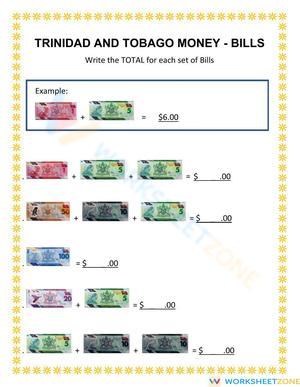
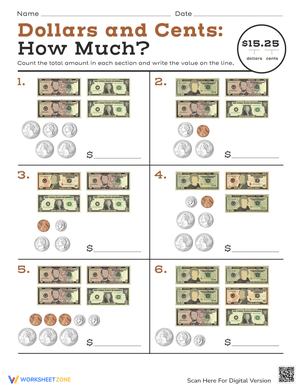
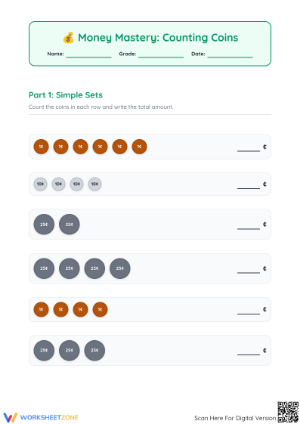
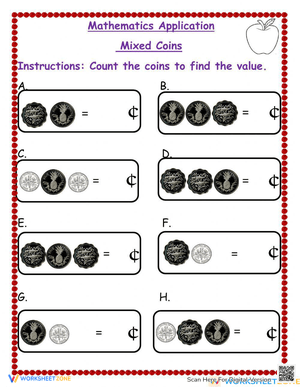
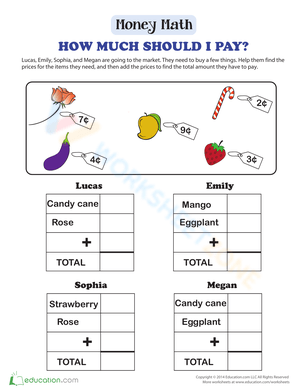
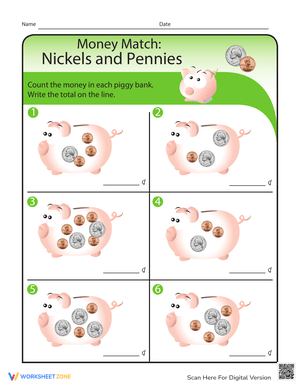
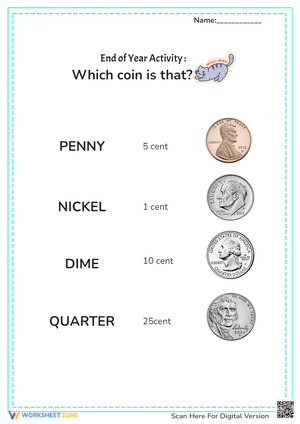
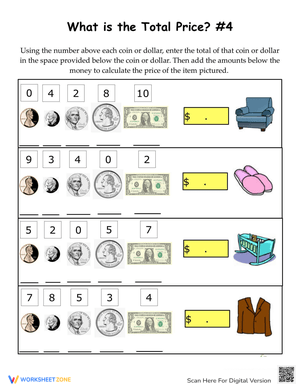
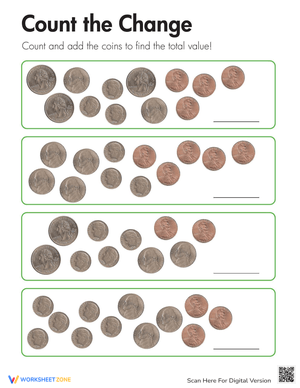
These money pdf worksheets for 1st grade give teachers a focused set of coin-recognition and counting activities built for the specific developmental stage where first graders are: they can count objects reliably, they understand that numbers represent quantities, but they haven't yet grasped that a thin dime outranks a chunky nickel in value. Each worksheet targets that gap directly.
The Specific Coin Skills Covered
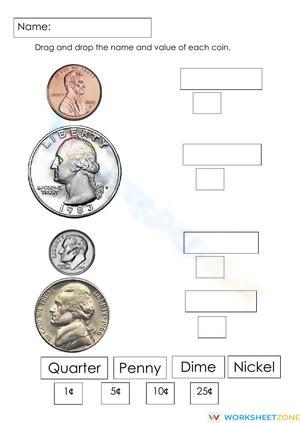
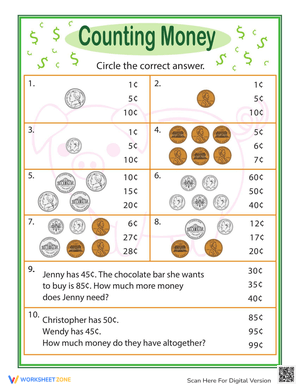
The set moves through three connected areas. The first group of worksheets asks students to name and match coins using both the obverse and reverse — so they see Roosevelt on the dime's front alongside the torch on its back, not just one image they've memorized. The second group ties names to values: students mark the cent amount next to each coin, trace the ¢ symbol, and write the value in a blank. The third group introduces skip counting with like coins — rows of nickels counted by fives, rows of dimes by tens — before any mixed-coin work appears.
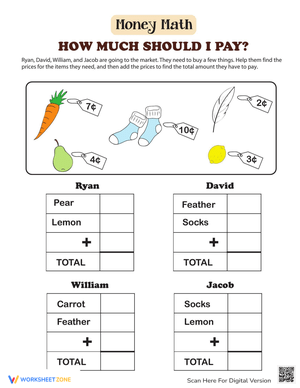
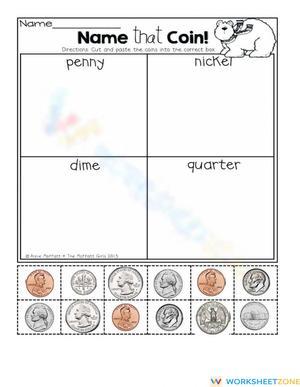
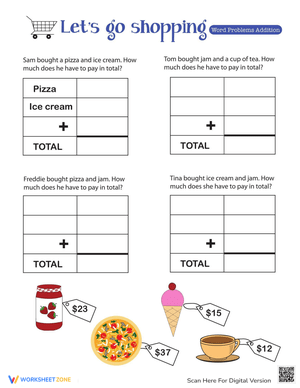
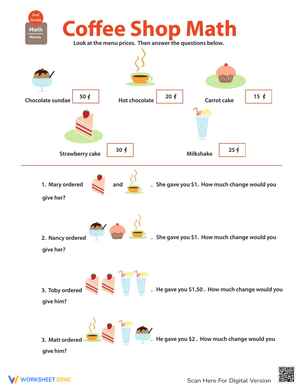
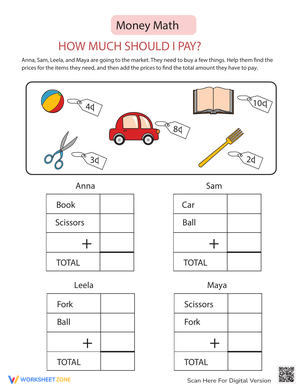
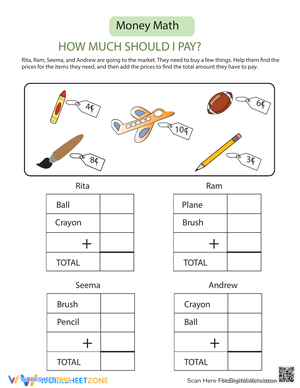
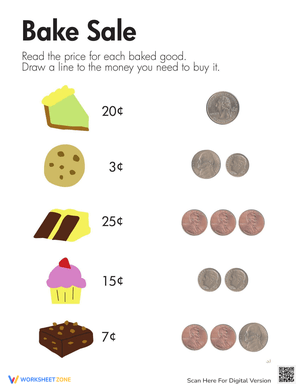
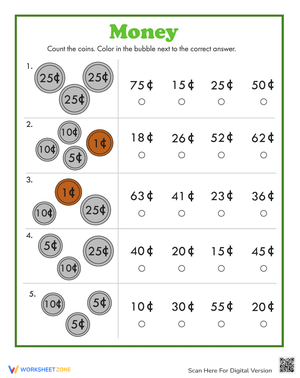
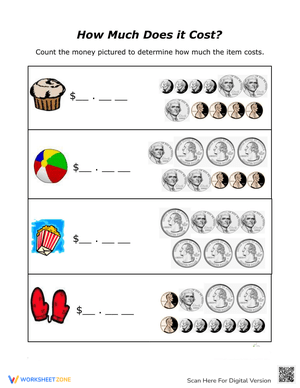
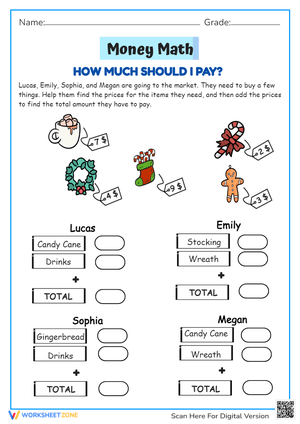
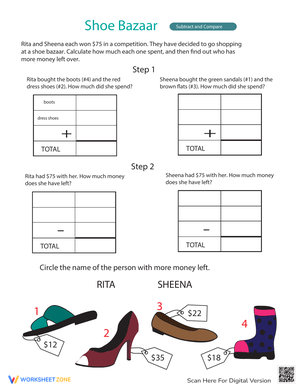
Two activity formats repeat across worksheets: cut-and-paste sorting, where students clip coins and place them into labeled containers by name or value, and simple shopping scenarios, where items carry price tags under 50¢ and students circle the coins that make the correct amount. Both formats give teachers something to read quickly — a misplaced coin in the sorting activity or a wrong circle in the shopping scenario tells you exactly which concept needs more work.
Frequent Student Errors Worth Watching For
The dime causes more trouble than any other coin. Its small size contradicts everything first graders know about quantity — bigger things should be worth more. Students who correctly say a nickel is worth 5¢ will still, in the same lesson, insist the dime must be worth less because it's smaller. Expect this. The fix isn't just repetition; it's direct, repeated comparison. Placing a dime and a nickel side-by-side on a worksheet and asking students which one buys more — before supplying the answer — forces the cognitive conflict into the open where it can be addressed.
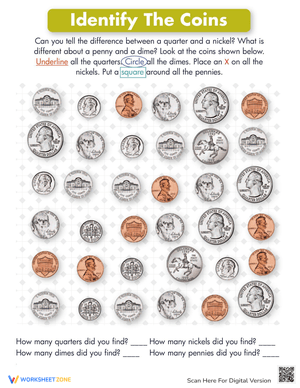
The nickel-quarter confusion runs a close second. Both are silver, both feel substantial in a small hand, and first graders frequently swap them on identification exercises. Students learn to distinguish them most reliably through edge texture — the quarter's milled rim versus the nickel's smooth edge — rather than through portrait memorization alone. Worksheets that print both coins at true relative scale help, but pairing any written exercise with a real coin in hand is what actually closes the gap.
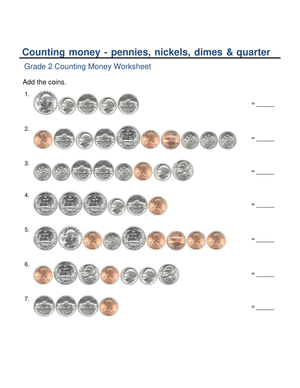
A third error pattern appears during skip counting: students count every coin by ones regardless of denomination. A student given eight nickels counts to 8 instead of 40. This tells you the student hasn't yet connected the skip-counting procedure to the coin's face value. It's a distinct skill from identifying the coin, and it needs separate, deliberate practice rather than more identification work.
How to Build These Worksheets Into Your Lesson Plans
These worksheets fit well into the 8–10 minutes of warm-up time at the start of a math block, particularly after you've introduced a coin and spent one day on concrete manipulation. The sequence that works: handle real coins first, name them aloud as a group, then move to the worksheet as written consolidation. Sending students straight to paper before they've held the coin delays the physical-to-abstract connection the worksheet is trying to build.
The cut-and-paste sorting worksheets also work as a Friday review station — students rotate through in pairs, and the partner-checking that happens naturally catches errors before you have to find them yourself. For the shopping scenario worksheets, give each student a small container of plastic coins and have them count out the purchase amount on their desk before writing anything on paper. That physical step prevents the most common careless error: circling coins that add up to something close but not exact.
If your school runs morning meeting, a simple classroom economy fits here: assign penny or nickel values to certain routines and let students accumulate and count their coins each week. The money pdf worksheets for 1st grade in this set serve as the written record of what students have been doing with their hands all week, reinforcing the same skills through a different mode.
Standard Alignment
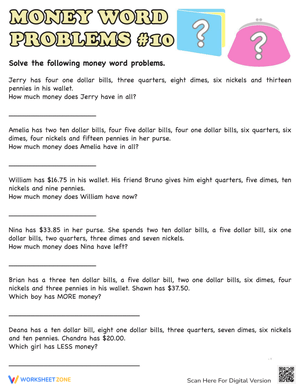
The formal Common Core standard for money — 2.MD.C.8 — sits in Grade 2, where students solve word problems involving dollar bills, quarters, dimes, nickels, and pennies. Grade 1 builds the necessary prior knowledge: coin names, coin values, and skip-counting fluency with 5s and 10s, which fall under the 1.NBT and 1.OA number sense domains. Districts that introduce money formally in first grade are front-loading the conceptual groundwork so that 2.MD.C.8 instruction in second grade can move quickly past identification into the harder work of combining denominations and making change. These worksheets target exactly that preparatory layer — students arrive at second grade already knowing what a dime is and why it's worth 10¢.
Adapting These Worksheets for a Range of First-Grade Learners
Students who are still solidifying one-to-one correspondence do better with identification worksheets before any value or counting work appears. Limit them to penny and nickel first — two coins, a clear value difference, no size-value paradox to navigate. The cut-and-paste format gives these students something physical to do when the abstract value concept isn't landing through visual practice alone.
Students who move quickly through identification and value can push into skip-counting worksheets earlier, and then into mixed-coin counting before the rest of the class gets there. For those students, the shopping scenario worksheets with two or three coins required per purchase — rather than one — provide a meaningful challenge without requiring entirely different materials. Having them write the total amount and draw the correct coins from memory, rather than circling from a printed set, raises the demand further without leaving the same worksheet behind.
Frequently Asked Questions
Why does the dime trip students up more than the other coins?
Size-to-value mapping is the culprit. First graders arrive in math class having spent years learning that bigger means more. The dime breaks that rule, and no amount of telling fixes it — students need to experience the contradiction directly. The most effective approach is repeated side-by-side comparison: hold a dime next to a nickel, count out what each one buys in a simple shopping scenario, and do it across multiple sessions rather than one. Worksheets that print the dime and nickel at accurate relative size and ask students to circle the one worth more make the conflict visible on paper and create a retrievable memory hook.
Is it too early to introduce quarters in first grade?
No — but sequence matters. Students who encounter all four coins simultaneously tend to conflate the three silver ones. Introduce the penny first (one cent, copper, unambiguous), then the nickel (five cents, larger silver coin, smooth edge), then the dime (ten cents, smallest silver coin, ridged edge), and let students reach solid identification before the quarter enters the picture. These money pdf worksheets for 1st grade are ordered to follow that progression, so teachers who work through the set from the beginning don't need to build a separate introduction sequence.
How do I use physical coins alongside these worksheets without losing control of the classroom?
Keep the coin supply contained. A small cup with no more than 10–12 coins per student prevents the rolling-coin-on-the-floor problem. For identification work, students place one real coin on top of its matching printed image — the physical overlay makes the comparison unavoidable without requiring students to hold ideas in working memory while they look back and forth. For counting work, have students sort their coins onto a piece of dark construction paper before recording on the worksheet; the contrast makes coins easier to see and harder to misplace, and it keeps the manipulative use purposeful rather than distracting.
What if some students finish well before the rest of the class?
The money pdf worksheets for 1st grade in this set top out at skip counting with like coins and single-item shopping scenarios under 50¢. Students who clear those tasks quickly are developmentally ready for mixed-coin counting, which is second-grade territory. Rather than rushing into that, most teachers find it more productive to have those students complete the shopping scenarios using the fewest possible coins — that problem-solving constraint fits the same worksheet without changing the content and keeps fast finishers genuinely thinking rather than waiting.













 Interactive Worksheet Maker
 Quiz Maker
 Word Search Maker
 Crossword Puzzle Maker
 Word Scramble Generator
 Sentence Scramble Generator
 Handwriting Worksheet Generator
 Name Tracing Generator
 Fill In The Blank Generator