


























Views
Downloads



Printable Measuring Insects Worksheet | Grade 1 Math
Paste this activity's link or code into your existing LMS (Google Classroom, Canvas, Teams, Schoology, Moodle, etc.).
Students can open and work on the activity right away, with no student login required.
You'll still be able to track student progress and results from your teacher account.
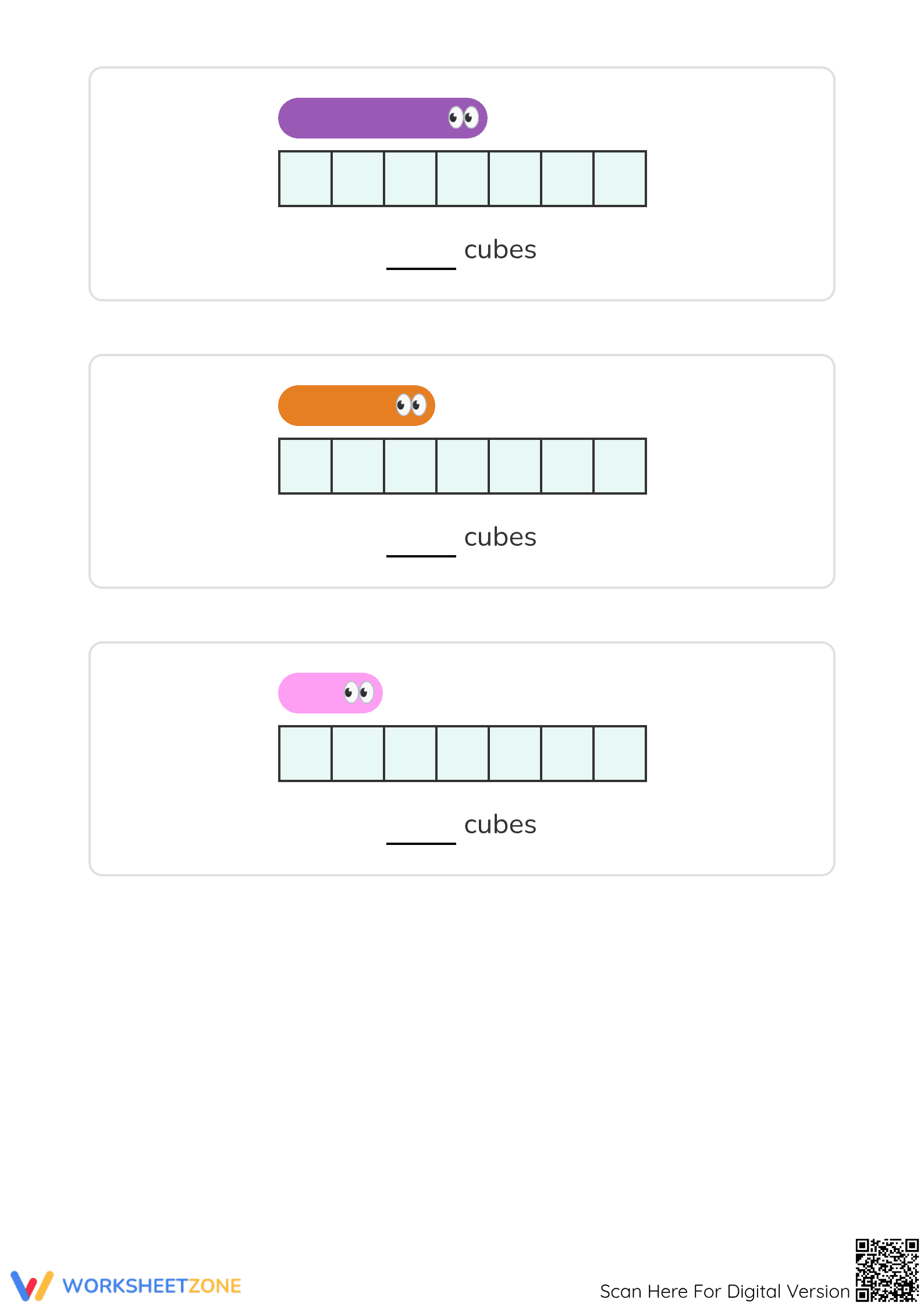
Teach measurement concepts with this engaging set of worksheets. Students will measure various insects using non-standard units like cubes and units to develop spatial awareness and counting skills. This resource provides a practical way for young learners to understand length and comparison through hands-on visual estimation and precise counting. By using familiar objects like bugs, the activity removes the intimidation of formal rulers while building the foundational logic needed for later scientific observation.
At a Glance
- Grade: Kindergarten · Subject: Math
- Standard:
CCSS.MATH.CONTENT.1.MD.A.2— Express length as a whole number of units by laying copies end to end- Skill Focus: Non-standard measurement
- Format: 5 pages · 20 problems · Answer key included · PDF
- Best For: Small group math centers or homework
- Time: 15–20 minutes
This comprehensive 5-page PDF contains 20 unique measurement tasks. Each page features a series of friendly insect illustrations alongside a row of measurement cubes. Students determine the length of each insect by counting the corresponding units. A complete answer key is provided for quick grading or student self-checking, ensuring that immediate feedback is possible even in busy classroom settings.
These worksheets are designed for a zero-prep classroom workflow. 1. Print the required pages in under 30 seconds. 2. Distribute to students for immediate individual practice. 3. Review answers as a class or individually in less than a minute using the included key. Total teacher preparation time is less than two minutes, making these ideal for sub plans, morning work, or quick transition activities between lessons.
This resource aligns with CCSS.MATH.CONTENT.1.MD.A.2: "Express the length of an object as a whole number of length units, by laying multiple copies of a shorter object end to end; understand that the length measurement of an object is the number of same-size length units that span it with no gaps or overlaps." Both standard codes can be copied directly into lesson plans, IEP goals, or district curriculum mapping tools to ensure administrative compliance.
Use these worksheets during the independent practice portion of a measurement lesson. They serve as an excellent formative assessment to see if students understand how to align objects with the start of a measurement scale and iterate units without gaps. Expected completion time is 15 to 20 minutes per sheet depending on student pace and familiarity with the counting-on method.
Designed for Kindergarten and Grade 1 students, these sheets are perfect for early learners developing foundational math skills. They can be naturally paired with a physical bin of counting cubes or a classroom insect theme. The large, clear visuals accommodate students with developing fine motor skills and those requiring high-contrast instructional materials.
According to the RAND AIRS 2024 report on elementary mathematics, the use of non-standard units like the cubes found in this CCSS.MATH.CONTENT.1.MD.A.2 worksheet is a critical precursor to formal measurement with rulers. By counting discrete units to determine length, students internalize the concept of iteration and the importance of standardizing a unit of measure. This Grade 1 math activity allows students to practice these abstract concepts through concrete visual representations of insects. Research from ScienceDirect TpT Analysis suggests that high-quality, focused practice sheets like these significantly improve retention of measurement vocabulary and procedural fluency in young learners. The clear layout and repetitive structure ensure that students can focus on the core math skill without being overwhelmed by complex instructions. Educators can use these metrics to track developmental milestones in early numerical reasoning and spatial cognition.


