


























Views
Downloads

Essential More or Less Worksheet — Grade K Printable
Paste this activity's link or code into your existing LMS (Google Classroom, Canvas, Teams, Schoology, Moodle, etc.).
Students can open and work on the activity right away, with no student login required.
You'll still be able to track student progress and results from your teacher account.
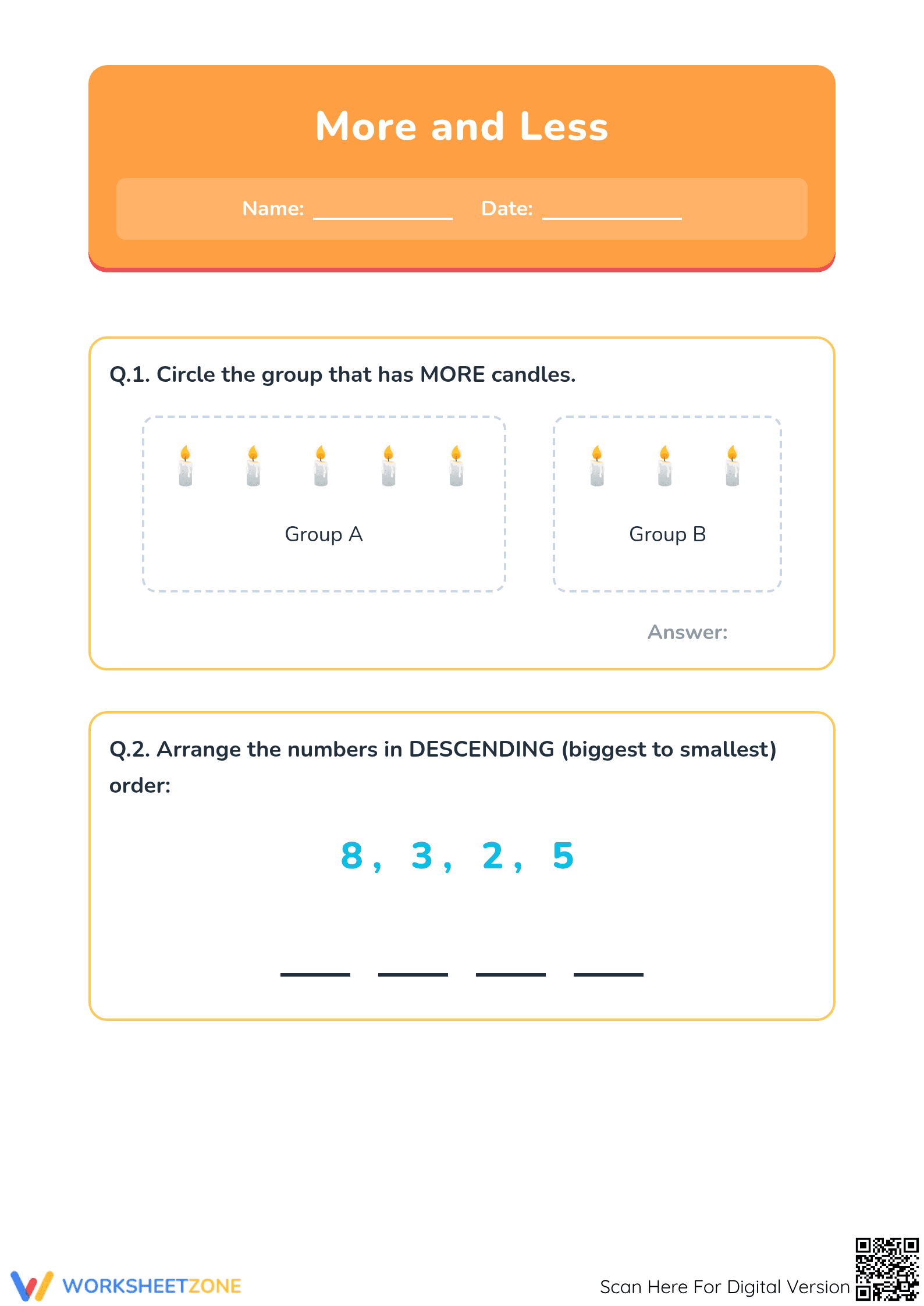
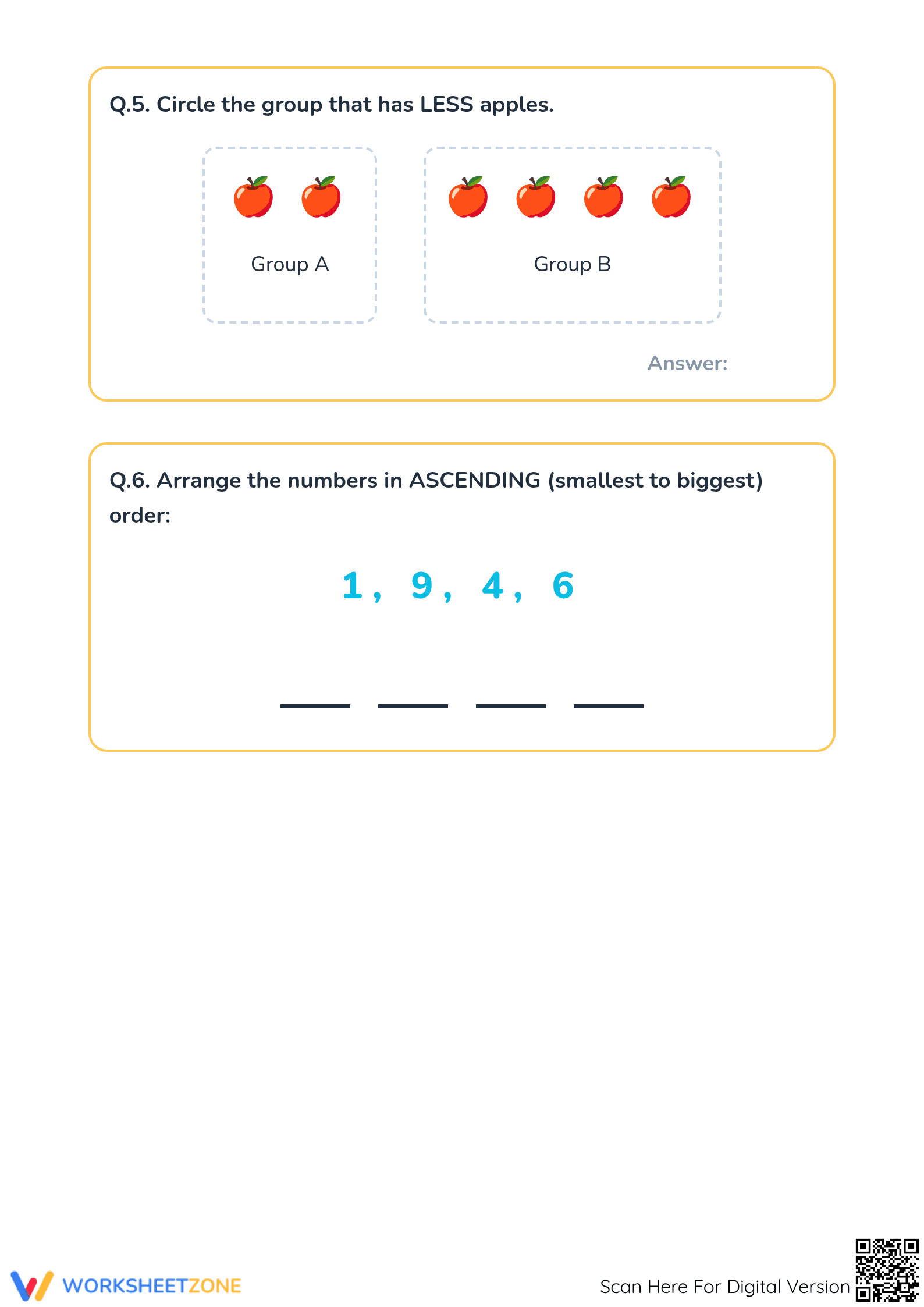
Students master quantitative comparison and numerical sequencing with this comprehensive Kindergarten Math worksheet. By evaluating groups of objects and ordering numerals from 1 to 10, learners bridge the gap between concrete counting and abstract number sense. This resource provides immediate practice with "more," "less," and "ascending/descending" terminology.
At a Glance
- Grade: Kindergarten · Subject: Math
- Standard:
K.CC.C.6— Identify if one group of objects is more or less than another- Skill Focus: Quantity comparison and numerical ordering
- Format: 3 pages · 6 problems · Answer key included · PDF
- Best For: Kindergarten math centers and independent practice
- Time: 15–20 minutes
What's Inside
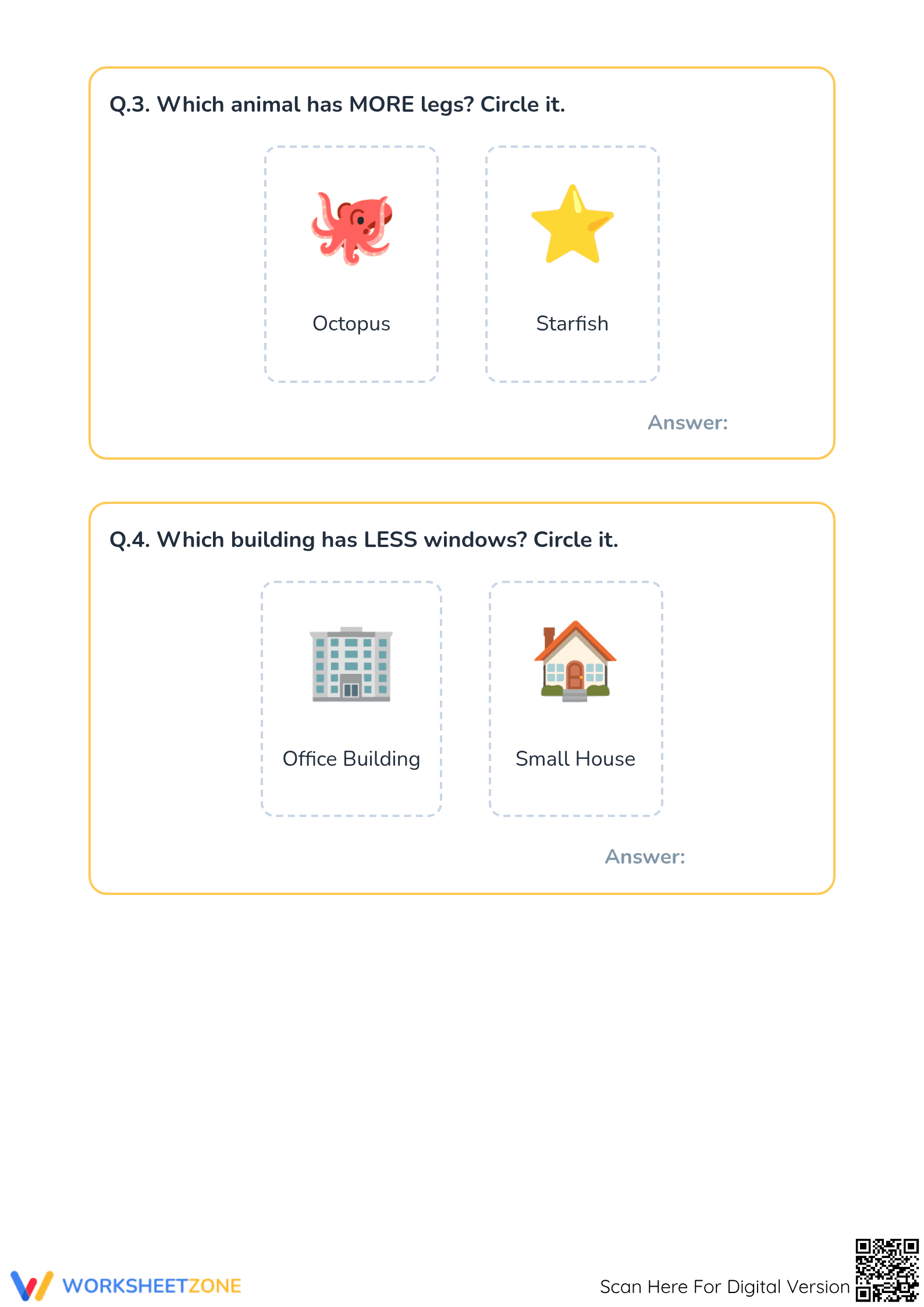
This 3-page printable features six distinct tasks that combine visual literacy with mathematical reasoning. Students interact with illustrated groups—including candles, animals, and fruit—to identify relative quantities. It also includes two dedicated sequencing challenges requiring students to arrange numerals in ascending and descending order. A complete answer key is provided for rapid grading or student self-check.
Zero-Prep Workflow
The zero-prep workflow is designed for maximum efficiency in busy classrooms. First, Print the 3-page PDF (under 10 seconds). Next, Distribute to students as an independent activity or morning work (under 30 seconds). Finally, Review using the included answer key to identify learners who struggle with comparison vocabulary (under 1 minute). Total teacher prep time is under 2 minutes, making this ideal for substitute plans.
Standards Alignment
This resource aligns primarily with K.CC.C.6: "Identify whether the number of objects in one group is greater than, less than, or equal to the number of objects in another group." It also supports K.CC.C.7 through numerical sequencing tasks that require comparing written numerals. Both standard codes can be copied directly into lesson plans, IEP goals, or district curriculum mapping tools.
How to Use It
Deploy this worksheet during the "You Do" phase of a gradual release model following a lesson on comparison symbols. It works effectively as a formative assessment tool; observe whether students count objects individually or use subitizing skills to determine "more" or "less" at a glance. Expect completion within a 15-to-20-minute window.
Who It's For
Designed for Kindergarten students developing early numeracy, this worksheet also supports Grade 1 RTI groups or Preschoolers ready for extension. It pairs naturally with a number line anchor chart or a "Comparing Sets" picture book to provide contextual support for students who are still mastering the difference between ascending and descending order.
This worksheet targets foundational comparison skills documented by Fisher & Frey (2014) as critical for developing mathematical fluency. By requiring students to pivot between visual group comparison (K.CC.C.6) and abstract numerical ordering, the resource strengthens the mental number line necessary for future operations. Research suggests that early mastery of "more" and "less" concepts is a primary predictor of long-term success in elementary arithmetic. This 6-task sequence provides the repeated, low-stakes exposure needed to internalize these concepts. The standard code K.CC.C.6 is explicitly addressed through varying contexts—from counting legs to candles—ensuring that students generalize the skill beyond a single object type. Educators can use this tool to quickly benchmark student readiness for Grade 1 comparison standards, ensuring that core deficiencies are remediated before moving to more complex algebraic thinking.


