Cursive c is one of the first letters worth teaching in a handwriting sequence, and a focused worksheet makes that introduction far easier to manage. This guide breaks down the stroke, shows where it fits in your scope and sequence, and gives you practical ways to use cursive c worksheets for introduction, intervention, and review with US elementary students.
Why Start Cursive With the Letter C
If you're mapping out a cursive scope and sequence this year, the lowercase c is one of the smartest places to begin. It's built from a single continuous curve, so students never lift the pencil mid-letter the way they do with crossbars or loops. That low-friction motion lets beginners feel early success before they hit trickier forms. Cursive c worksheets give you a focused, repeatable page for that first win, whether you're introducing the letter to a whole class or reteaching it in a small group.
The timing matters more than it used to. As of 2025, 25 US states require cursive handwriting instruction in public schools, and many teachers are being asked to teach a skill they were never formally taught themselves. Structured, sequential worksheets fill that gap. They model correct formation so you're not relying on personal handwriting habits to demonstrate the stroke at the board.
Breaking Down the Cursive C Stroke
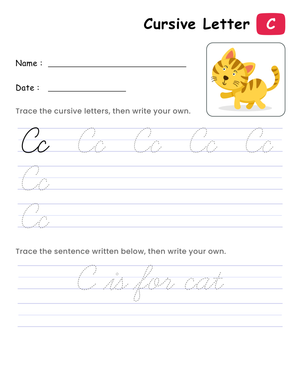
A clean cursive c has three parts worth naming for students: the entry stroke, the rounded body, and the exit connector. Start just below the midline, curve up and over to the top, then swing left and around in one smooth motion, closing near the baseline and pushing the exit stroke toward where the next letter will begin. Because it's one pass, the c rewards rhythm over precision, which is exactly why it's forgiving for young writers.
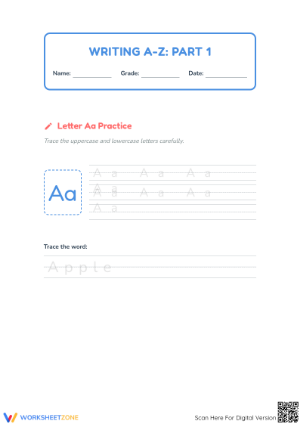
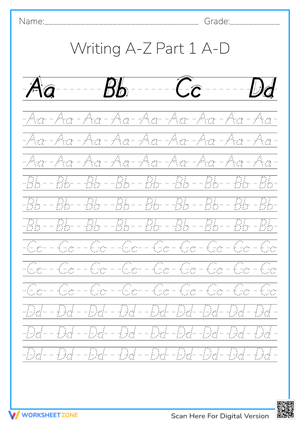
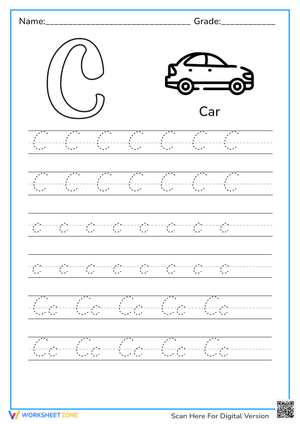
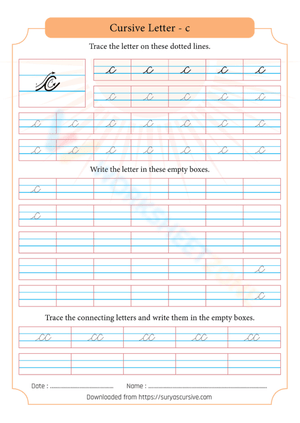
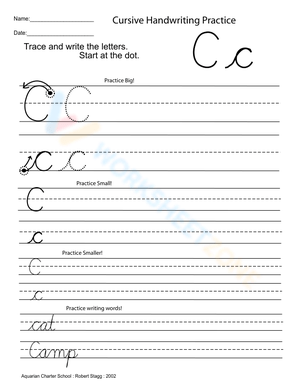
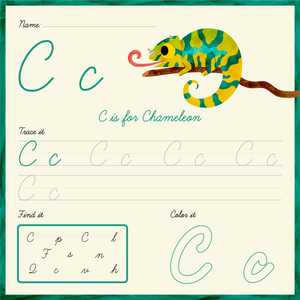
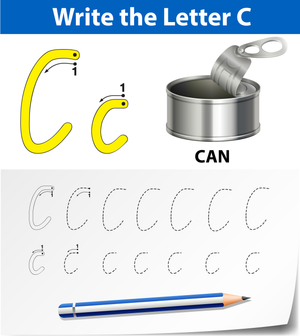
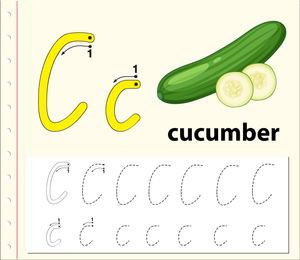
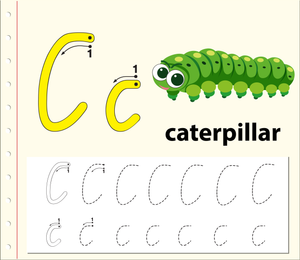
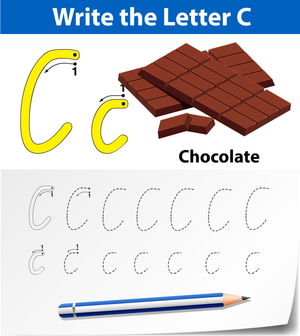
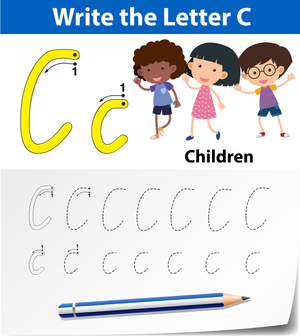
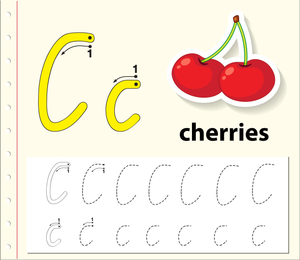
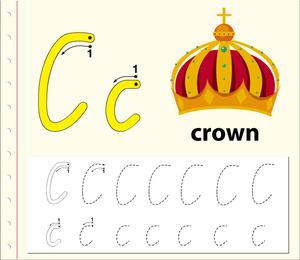
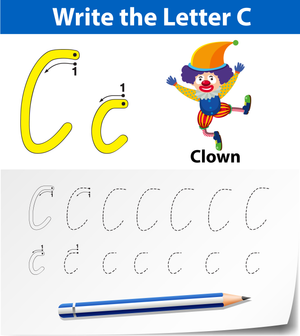
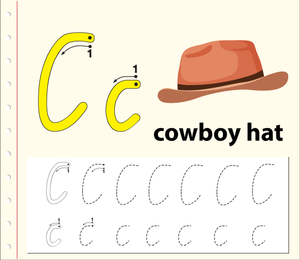
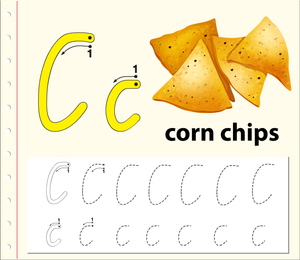
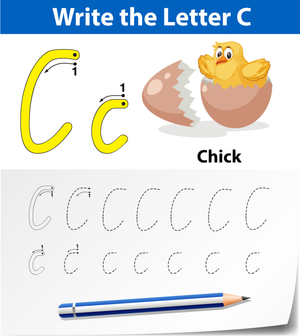
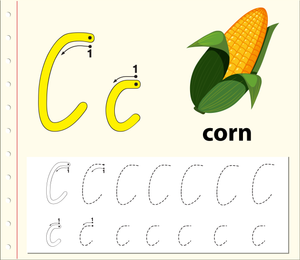
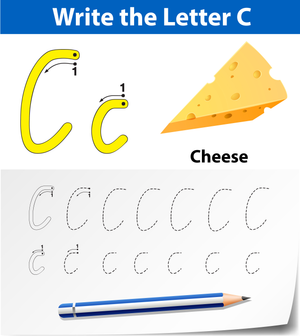
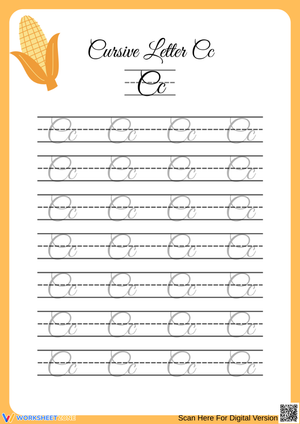
Good worksheets stack three kinds of rows so muscle memory builds in order: traced letters with directional arrows, guided letters with faded dots, and blank practice lines for independent writing. Working left to right across that gradient in a single session moves students from copying to producing without a jarring jump. I tell teachers to have students say the stroke path aloud on the first few tries, so the motor plan and the language lock in together.
Pacing matters as much as the path. Encourage a relaxed grip and a steady, unhurried curve rather than a fast scribble; speed comes after the shape is reliable. If a student's c looks pointed or lopsided, slow the motion down and return to a traced row before adding more independent writing.
How Cursive C Sets Up the Undercurve Family
Here's the payoff most letter-of-the-week plans miss: lowercase cursive c is the anchor of the undercurve family that also includes a, d, g, o, and q. Every one of those letters opens with the same up-and-over-then-around motion that c teaches in isolation. When students automate the c stroke first, you're not teaching five more letters from scratch — you're transferring one mastered motor pattern and adding a tail, an ascender, or a descender. Sequencing c before a and d, rather than marching alphabetically, can compress days of instruction and cut the reteaching you'd otherwise do letter by letter.
This is where isolated practice earns its place. Spending focused time on c isn't a detour; it's front-loading the mechanics for a quarter of the lowercase alphabet.
Fitting Cursive C Into Your Scope and Sequence
Cursive c rarely lives on its own for long, so it helps to know where it sits in the arc of a year. Most sequences group letters by shared strokes instead of the alphabet, and c leads the undercurve group. A practical order is to teach c, then a and d, then g, o, and q, so each new letter reuses a motion students already own. Worksheets that share a common baseline and letter size across the set keep that progression visually consistent for kids.
Because state requirements vary, check your district's expectations before you lock the sequence. With cursive mandated in 25 states as of 2025, some schools follow a specific published program while others leave pacing to teachers. Either way, a stack of single-letter pages like cursive c gives you the flexibility to slow down, loop back, or accelerate based on what you see in student writing.
What Cursive Practice Does Beyond Neat Letters
Cursive c drills can feel minor next to your core reading block, but the two connect more than teachers expect.
According to the Iowa Reading Research Center, cursive instruction is drawing renewed attention because handwriting supports reading and spelling, not just legibility. A 2020 study found cursive practice can improve spelling accuracy alongside writing fluency — evidence that isolated letter drills like cursive c work toward broader literacy goals, not just neat penmanship.
That's a useful framing for a skeptical colleague or administrator: time spent on formation isn't time taken from literacy, it's an investment in it.
Classroom Implementation
For a whole-class introduction, model the c three times under a document camera, narrate the stroke, then release students to a tracing row while you circulate. Keep the first session short — five to eight minutes of focused writing beats a full page of fatigued, sloppy repetitions. Watch for pencil grip and posture before you correct letter shape.
For small-group or one-on-one intervention, the same worksheet becomes a diagnostic. Sit beside a student, watch the direction of the curve, and catch reversals or clockwise motion in the moment. Fine motor demands are real here: a 2026 survey of early educators found 70% reported declining fine motor skills in incoming students, so plan for more repetition and shorter bursts than you might expect.
Differentiating and Reviewing Cursive C
Not every student needs the same page. For writers with fine motor delays, enlarge the letter, add more traced repetitions, and reduce the number of independent lines so the worksheet ends on accuracy rather than exhaustion. A raised or textured line can give kids who press too hard or drift off the baseline a physical cue to work against.
Cursive c worksheets also work well past the primary grades. In upper elementary, they're a quick remediation tool for students who missed cursive instruction or never solidified it. Because the c is low-stakes and fast, a single review row makes a painless warm-up before students tackle connected words or a paragraph copy task. Keep a small stack of these pages for early finishers and intervention blocks.
However you use them, resist rushing to connected script. Repetition on the isolated letter — often several short sessions rather than one long one — builds the automaticity students need before the c has to link smoothly into a word.
Frequently Asked Questions
1. When should teachers introduce cursive c relative to other letters?
Introduce c early, before its undercurve relatives a, d, g, o, and q. Its single continuous curve needs no lifted strokes, so it builds confidence and the exact motion those later letters reuse.
2. How many repetitions of cursive c do students need before connected words?
There's no fixed number, but plan for several short practice sessions rather than one marathon page. Most students need repeated exposure across days until the stroke is automatic and consistently sized before you move to connected script.
3. What common errors do students make with cursive c, and how do worksheets help?
The frequent mistakes are curving clockwise, starting too high, or not closing the body. Worksheets with directional arrows and faded guide dots make the correct path visible so students self-correct instead of grooving the wrong motion.
4. How can cursive c worksheets support students with handwriting difficulties?
Use enlarged letters, extra traced rows, and fewer independent lines. Shorter, more frequent bursts respect the fine motor limits many students bring, and one-on-one worksheet time lets you catch reversals as they happen.
5. Can cursive c worksheets be used for review in upper elementary?
Yes. They're an efficient remediation and warm-up tool for older students who missed or never mastered cursive, and a single review row is a quick, low-stakes way to reset formation before longer writing.