




























Views
Downloads
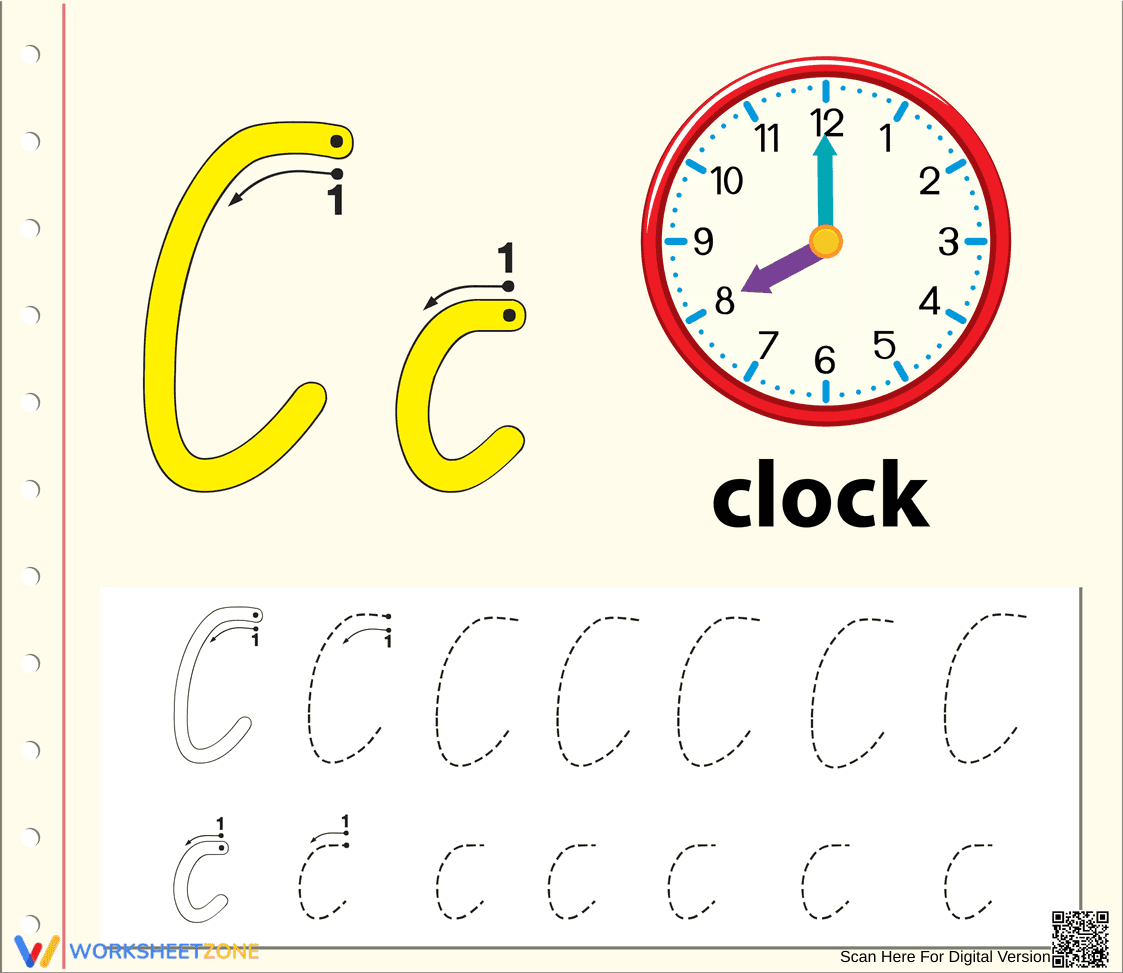

Cursive Letter C Tracing | Essential Kindergarten Worksheet

Paste this activity's link or code into your existing LMS (Google Classroom, Canvas, Teams, Schoology, Moodle, etc.).
Students can open and work on the activity right away, with no student login required.
You'll still be able to track student progress and results from your teacher account.
This Kindergarten cursive letter C worksheet provides students with 14 structured tracing opportunities to master uppercase and lowercase letter formation. By combining visual cues with repetitive motor practice, learners develop the muscle memory required for fluid handwriting. The inclusion of the word clock reinforces initial sound recognition and early vocabulary development.
At a Glance
- Grade: Kindergarten · Subject: English
- Standard:
CCSS.ELA-LITERACY.L.K.1.A— Print many upper- and lowercase letters correctly during writing tasks- Skill Focus: Cursive letter C formation
- Format: 1 page · 14 problems · Visual guides included · PDF
- Best For: Daily handwriting practice and literacy centers
- Time: 5–10 minutes
What's Inside
This single-page PDF features a large-scale model of both uppercase and lowercase cursive C at the top, complete with numbered directional arrows to guide stroke order. Below the instructional header, students find two rows of practice. The first row contains 7 uppercase C characters, while the second row provides 7 lowercase c characters. An illustration of a clock accompanies the text to provide a concrete anchor for the letter sound.
Zero-Prep Workflow
This resource is designed for immediate use with a total teacher prep time of under 2 minutes. First, print the required number of copies for your group (30 seconds). Second, distribute the sheets during your handwriting block or as a transition activity (30 seconds). Finally, perform a quick visual scan of student stroke direction to provide immediate corrective feedback (1 minute). It serves as an excellent sub-plan addition.
Standards Alignment
The primary focus is `CCSS.ELA-LITERACY.L.K.1.A`, which requires students to print many upper- and lowercase letters. While cursive is often introduced later, this worksheet provides early exposure to fluid letter connections. It also supports phonemic awareness by linking the letter shape to the /k/ sound in clock. This standard code can be copied directly into lesson plans, IEP goals, or district curriculum mapping tools.
How to Use It
Use this worksheet as a morning work activity to settle students as they enter the classroom. The familiar format allows for independent completion while the teacher handles attendance. Alternatively, place it in a literacy center inside a dry-erase pocket for reusable practice. Observe students to ensure they start at the 1 marker to prevent the development of inefficient writing habits. Completion typically takes 5 to 10 minutes.
Who It's For
This resource is tailored for Kindergarten students beginning their handwriting journey. It is particularly helpful for learners who need extra fine-motor support or those ready for an introduction to cursive styles. It pairs naturally with an alphabet anchor chart or a direct instruction lesson on the letter C. Home-school parents will find it useful for daily skill reinforcement.
According to Fisher & Frey (2014), the gradual release of responsibility begins with clear modeling, which this worksheet provides through its numbered stroke guides. Research indicates that explicit instruction in letter formation, such as the 14 tracing tasks provided here, significantly impacts later writing fluency and compositional quality. By focusing on the specific standard CCSS.ELA-LITERACY.L.K.1.A, this resource ensures that Kindergarten students build the foundational motor skills necessary for literacy. The integration of visual anchors like the clock helps bridge the gap between abstract letter shapes and concrete vocabulary. This systematic approach to handwriting is supported by the NAEP framework, which emphasizes the importance of legible writing as a prerequisite for effective communication. Educators can rely on this structured practice to meet early childhood literacy benchmarks efficiently and effectively.


