


























Views
Downloads

Cursive Uppercase D Worksheet | Essential Grade 2 Practice
Paste this activity's link or code into your existing LMS (Google Classroom, Canvas, Teams, Schoology, Moodle, etc.).
Students can open and work on the activity right away, with no student login required.
You'll still be able to track student progress and results from your teacher account.
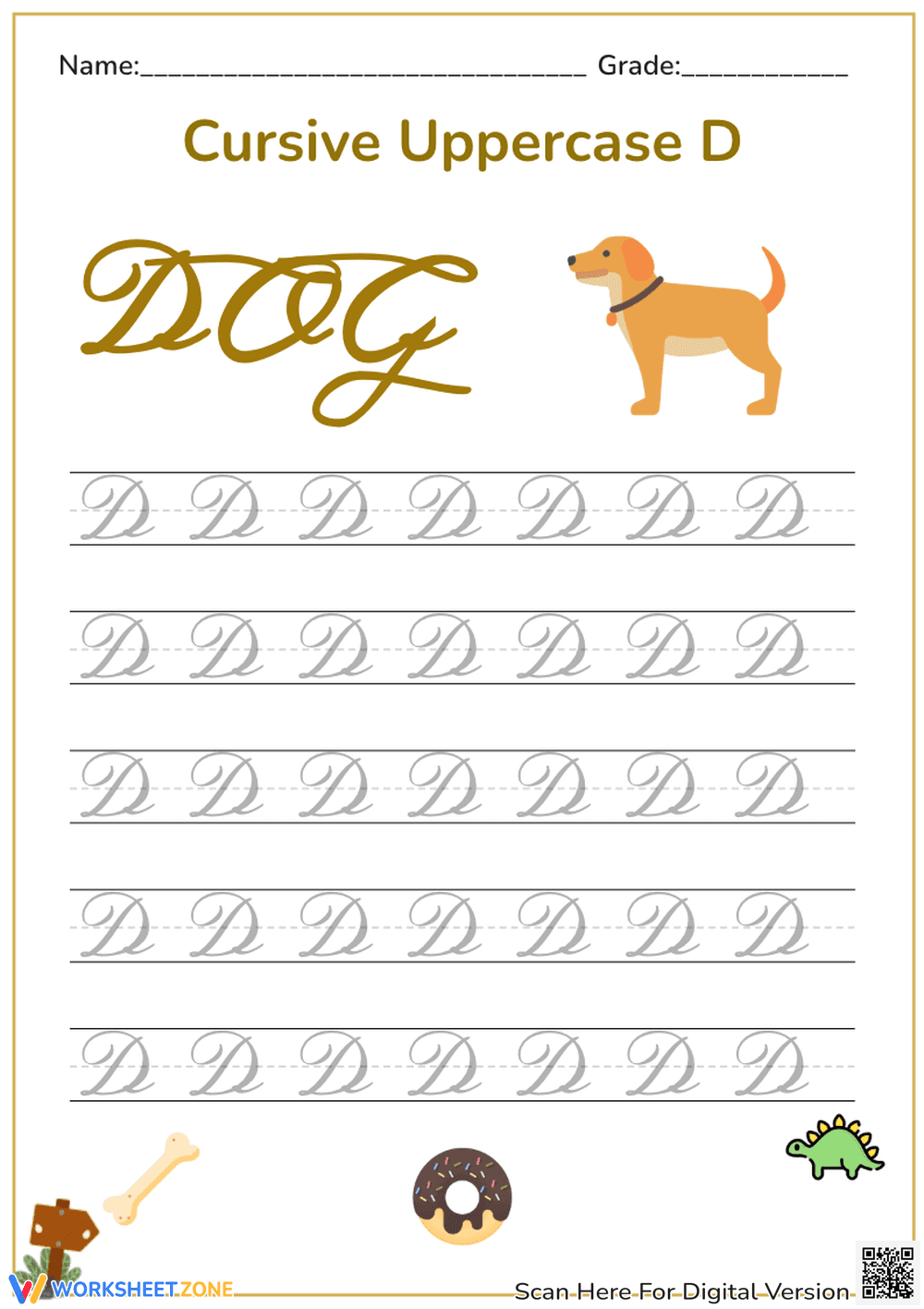
This Grade 2 cursive handwriting worksheet provides focused practice for mastering the uppercase letter D. Students develop fine motor control and letter-form consistency through repetitive tracing and word association. By the end of the session, learners will confidently transition from isolated letter formation to connecting the capital D in common words like "Dog."
At a Glance
At a Glance
- Grade: 2 · Subject: Handwriting
- Standard:
CCSS.ELA-LITERACY.L.2.1— Demonstrate command of standard English conventions when writing uppercase letters- Skill Focus: Cursive Uppercase D Formation
- Format: 1 page · 41 tasks · Answer key included · PDF
- Best For: Morning work or handwriting centers
- Time: 10–15 minutes
What's Inside
Inside this single-page PDF, you will find a clear, large-scale example of the word "DOG" in cursive to establish visual context. The worksheet features five dedicated rows of tracing guides, providing 40 individual opportunities to practice the uppercase D. The layout includes a standard three-line handwriting grid to help students maintain proper letter height and slant.
Skill Progression
- Guided Practice: Students trace the large-scale "DOG" header (1 task) to visualize the connection between the uppercase D and lowercase letters.
- Supported Practice: The first three rows provide 24 tracing opportunities with high-contrast dashed lines to stabilize hand movements.
- Independent Practice: The final two rows offer 16 additional letters for students to refine their stroke consistency and speed.
This structured approach follows the I Do, We Do, You Do model of instructional delivery.
Standards Alignment
This resource aligns with `CCSS.ELA-LITERACY.L.2.1`, which requires students to demonstrate command of the conventions of standard English grammar and usage when writing. While cursive is often a state-level requirement, this worksheet supports the foundational fine motor skills necessary for fluent written communication. This standard code can be copied directly into lesson plans, IEP goals, or district curriculum mapping tools.
How to Use It
Use this worksheet during the "You Do" phase of a handwriting lesson after demonstrating the stroke order on a whiteboard. It is also an excellent formative assessment tool; observe students to ensure they are starting the uppercase D at the top and following the correct loop direction. Expected completion time is approximately 12 minutes for most second-grade students.
Who It's For
This practice sheet is designed for Grade 2 students beginning their cursive journey, but it also serves Grade 1 students ready for enrichment. It is particularly helpful for students requiring occupational therapy support or extra fine motor practice. Pair this with a cursive alphabet anchor chart or a short reading passage about dogs to create a thematic literacy block.
Handwriting remains a critical component of literacy development, as evidenced by the Fisher & Frey (2014) framework for gradual release of responsibility. Research indicates that the physical act of forming letters in cursive engages different neural pathways than typing, which can improve word recognition and spelling retention. This worksheet specifically targets CCSS.ELA-LITERACY.L.2.1 by focusing on the uppercase D, a letter that requires precise looping and fluid motion. By providing 41 distinct tracing opportunities, the resource ensures that students move beyond simple recognition into automaticity. According to the RAND AIRS 2024 report on foundational skills, repetitive, high-quality tracing exercises are essential for students to achieve the handwriting fluency required for complex composition tasks in later grades. This printable PDF offers a structured, zero-prep solution for teachers looking to integrate consistent handwriting practice into their daily ELA routines without sacrificing instructional time.


