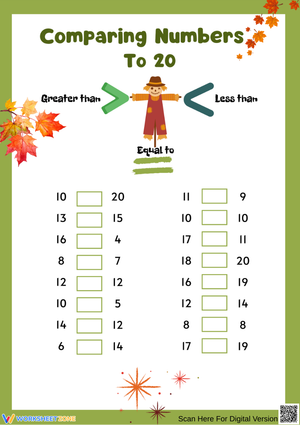
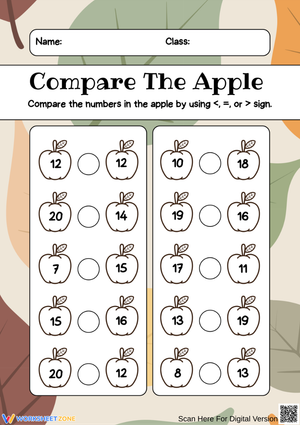
Every number from 11 to 20 has a tens digit of 1, so students cannot rely on digit count or place-value shortcuts they might use later with bigger numbers. They have to actually reason about the ones digit while understanding that the tens digit represents one full group of ten. This is exactly why comparing numbers 11-20 deserves its own dedicated block of instruction rather than being folded into a general comparing-numbers unit.
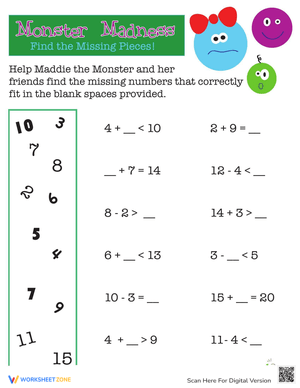
Worksheets built specifically around this 11-20 range give teachers a controlled space to isolate the skill: no distractions from different tens digits, just focused practice on reading the ones digit correctly and applying greater than, less than, and equal to language and symbols.
What CCSS 1.NBT.B.3 Asks Students To Do
CCSS.MATH.CONTENT.1.NBT.B.3 requires first graders to compare two two-digit numbers based on meanings of the tens and ones digits, recording the results of comparisons with the symbols greater than, less than, and equal to. For the 11-20 range specifically, this means students must understand that 1 ten stays constant across every number, and the ones digit is the only variable that determines order. A student who truly understands this standard can explain why 18 is greater than 13 by pointing to the ones place, not by guessing or counting up from memory.
A quick way to check for genuine place-value reasoning versus rote memorization is to ask a student to compare two numbers verbally without seeing them written down, such as 'sixteen and twelve.' Students who have only memorized number order from counting songs often hesitate or guess, while students with real place-value understanding can explain that 16 has 6 ones and 12 has 2 ones, so 16 is greater. This single check reveals more about mastery than a completed worksheet alone.
Concrete to Pictorial to Abstract: A Teaching Sequence
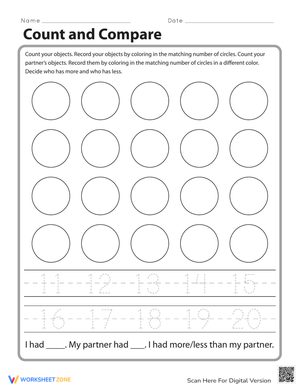
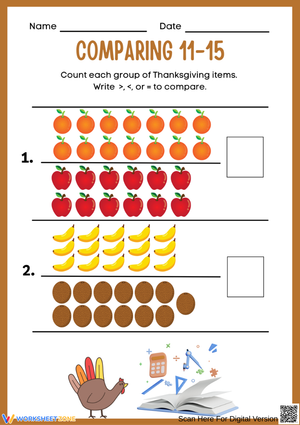
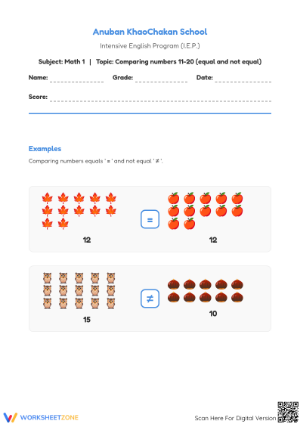
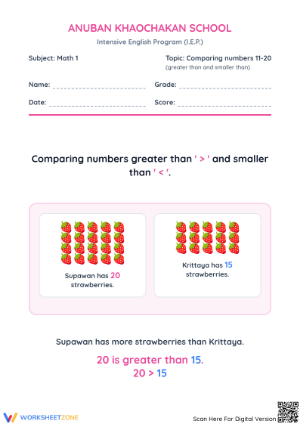
A reliable lesson sequence for this skill moves through three stages across several days rather than all at once. Day one uses hands-on ten-sticks and loose cubes so students physically build both numbers before comparing. Day two shifts to ten-frame pictures on worksheets, where students circle the frame with more dots or write the number of ones under each frame before deciding which is greater.
- Concrete stage: build both numbers with linking cubes or base-ten blocks
- Pictorial stage: compare ten-frame images and count visible ones
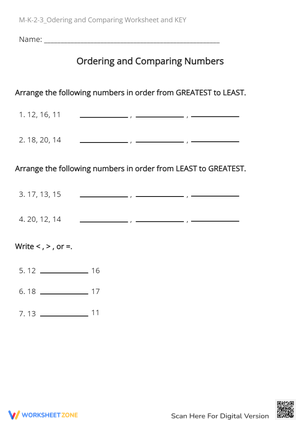
- Abstract stage: compare printed numerals using greater than, less than, and equal to symbols
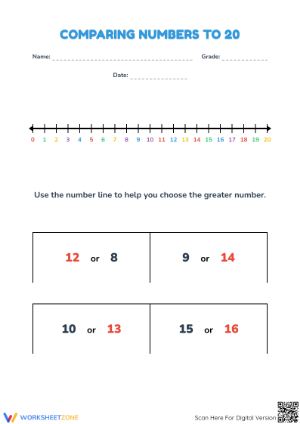
- Application stage: mixed practice with number lines and word problems using comparison vocabulary
Only in the final stage should students work with printed numerals alone, comparing pairs like 15 and 19 and recording their answer with the correct symbol. Rushing straight to this stage without the earlier steps tends to produce shaky performance that falls apart under any variation in worksheet format.
Classroom Implementation
For whole-class instruction, a five-minute daily warm-up comparing two teen numbers with cubes, followed by a quick partner check using worksheet pairs, keeps the skill fresh without requiring a full reteach every day. Display an anchor chart with the vocabulary words greater than, more than, less than, fewer than, equal to, and same as so students have consistent academic language to draw on during discussions.
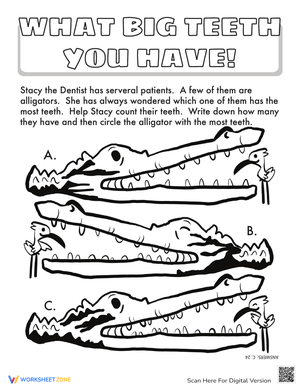
For small-group intervention, pull students who are still counting on fingers to determine which number is bigger rather than using place value. Give them a set of two ten-frames per pair of numbers and have them physically point to the ones column before making a decision. For enrichment, extend confident students into three-number comparisons or ordering sets of four teen numbers from least to greatest, which requires holding multiple comparisons in mind at once.
Frequently Asked Questions
1. What Common Core standard covers comparing numbers 11-20 in first grade?
CCSS.MATH.CONTENT.1.NBT.B.3 covers comparing two two-digit numbers based on the meanings of the tens and ones digits, using the symbols greater than, less than, and equal to.
2. What strategies help students compare teen numbers that share the same tens digit?
Focusing explicitly on the ones digit through ten-frames, linking cubes, and guided verbal reasoning helps students understand why the ones place, not the tens place, determines order within 11-20.
3. How can teachers use manipulatives or ten-frames to teach comparing numbers 11-20?
Teachers can have students build each number with a ten-stick plus loose ones or fill in ten-frame pictures, then visually compare the extra ones before introducing greater than and less than symbols.
4. What are common student errors when comparing numbers in the 11-20 range?
Common errors include reversing the greater than and less than symbols, relying on counting order instead of place value, and misreading boundary numbers like eleven and twenty.
5. How should teachers assess mastery of comparing two-digit numbers in first grade?
Quick exit tickets with symbol writing, true or false comparison statements, and card-sorting tasks that require verbal justification all give reliable formative evidence of mastery.













 Interactive Worksheet Maker
 Quiz Maker
 Word Search Maker
 Crossword Puzzle Maker
 Word Scramble Generator
 Sentence Scramble Generator
 Handwriting Worksheet Generator
 Name Tracing Generator
 Fill In The Blank Generator