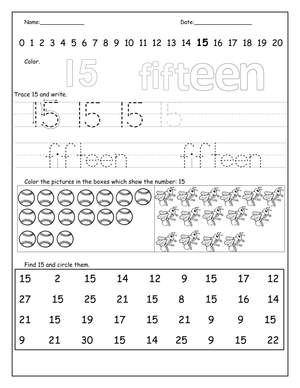
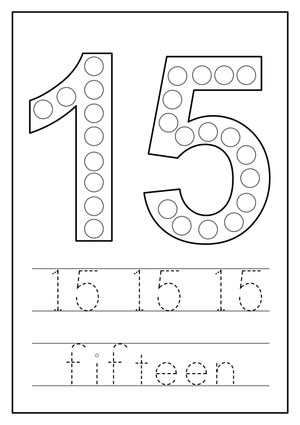
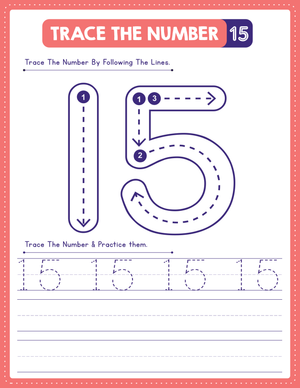
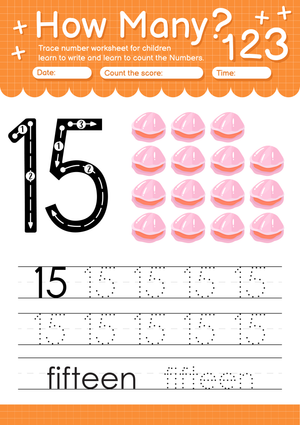
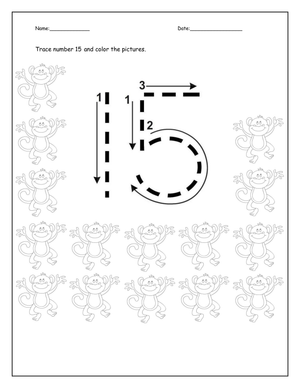
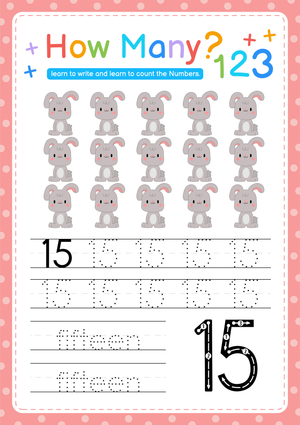
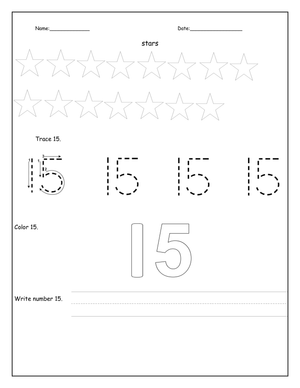
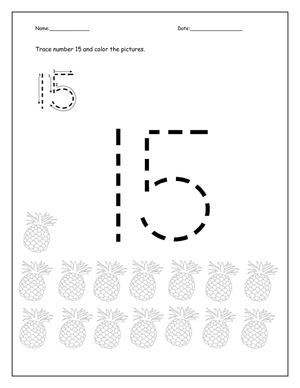
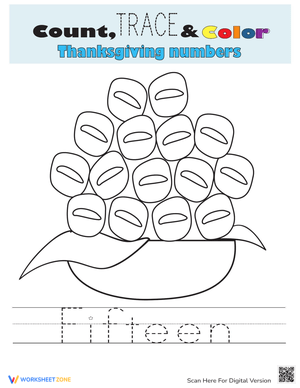
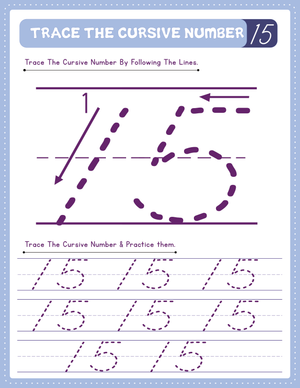
These 1st grade number 15 pdf worksheets target one of the more instructionally productive stops in the teen number sequence — not because 15 is harder than 13 or 17, but because it sits at the midpoint of the teens and gives teachers a clean checkpoint for seeing how firmly students hold the concept of one full ten and five more. Each worksheet covers a distinct task format, so teachers can build a short rotation or assign them across several days without repeating the same experience.
Why Number 15 Is Worth Its Own Practice Set
Teen numbers expose a genuine gap that rote counting often conceals. A student can recite "...thirteen, fourteen, fifteen..." on Friday and still hesitate at the numeral 15 on Monday morning. Speaking a number in sequence and reading it cold in print are separate skills, and they don't develop at the same rate. English complicates this further: "fifteen" doesn't announce "one ten and five" the way "twenty-five" does when students encounter larger numbers, so 15 needs visual reinforcement that spoken counting alone won't provide.
At the Grade 1 level, 15 also functions as an early gateway to base-ten reasoning. When students fill a ten frame to show 15 — completing all ten spaces, then adding five more — they are doing conceptual work that carries directly into later two-digit addition. Focused number-15 practice is early groundwork, not just review.
The Specific Skills Each Worksheet Targets
Each worksheet concentrates on a few task formats rather than stacking every format onto a single sheet, so students can give each task genuine attention.
- Numeral recognition: identifying 15 among other teen numbers, both in isolation and in short sequences
- Guided numeral formation: tracing a correctly formed 15 before writing it independently in a lined space
- Object counting: counting bounded picture groups and writing the matching numeral
- Ten-frame representation: filling frames to show 15 as one complete ten and five additional ones
- Tally marks: converting between tally groups and the numeral, reinforcing both counting and grouping
- Matching tasks: connecting representations — numeral, picture set, tally — to one another
Tally marks deserve a note. Many students can fill a ten frame correctly but lose track when drawing 15 in tallies because they cannot hold group boundaries in their heads while also tracking the total count. Worksheets that include tally tasks reveal a different layer of understanding than ten frames alone do.
Where Students Stumble and What the Patterns Tell You
The most consistent error with 15 is numeral reversal — students write 51. This happens more with 15 than with other teen numbers because neither digit provides a strong visual anchor. Unlike 12 or 13, where the second digit has a distinct curve, 1 and 5 look plausible on either side to a developing reader. Watch for students who trace 15 accurately with the model visible but flip to 51 the moment they work from memory. That transition reveals whether automaticity is actually there.
A second pattern: students who count out 15 objects correctly but write 16. The extra count almost always comes from double-counting one item at the edge of the picture group — the one their finger crosses last. The worksheets use clearly bounded picture sets arranged in rows with visible spacing, which makes that finger-tracking error far less likely than on pages where objects are scattered randomly.
A third issue appears on ten-frame tasks. Some students fill the frame to show 10 and 5 but reverse the conventional orientation — five in the top row, ten split across two rows below. That is a spatial confusion, not a counting error, and it matters because the standard top-row-first layout is what makes a ten frame readable at a glance. Students who flip the orientation still have to recount every time, which means the frame is not functioning as a number sense tool yet.
How to Work These Worksheets Into Your Lesson Plans
The most reliable placement is morning work during the week you introduce or review teen numbers. One worksheet at the start of the day settles students into a familiar, low-stakes routine and gives you a fast read on who can write 15 independently before the math block begins. The patterns in morning work often tell you exactly where to direct small-group attention later.
For centers, pair a counting or matching worksheet with a small bin of snap cubes. Students complete the paper task, then build the same number with cubes and verify — a self-correction loop that doesn't require your presence. For intervention, run a tight daily sequence: say the number, trace the numeral, count 15 counters, fill a dry-erase ten frame, then compare it to the paper. Repeating that exact sequence across four or five days builds recall more efficiently than switching the activity each session.
These 1st grade number 15 pdf worksheets also work as a fast exit task — one section, the last four minutes of math, enough data to sort students into instructional groups for the next day without adding grading time.
Standard Alignment
This set aligns to CCSS.MATH.CONTENT.K.CC.A.3 (writing and representing numbers to 20) and CCSS.MATH.CONTENT.1.NBT.B.2 (understanding two-digit numbers as bundles of tens and ones). In classroom terms, the second standard is where this practice does its most important work: giving students a concrete picture of "1 ten, 5 ones" before teachers introduce formal place-value vocabulary and procedures in later Grade 1 units. The ten-frame and object-counting tasks on these worksheets directly support that conceptual foundation.
Adapting the Set for a Mixed-Ability Class
Students not yet secure below 15 manage the counting and ten-frame tasks more reliably when they place physical counters on the printed frame circles before marking anything. That extra step — moving an object onto each circle — provides a concrete bridge to the abstract task of drawing. Pull the counters once students can complete the task accurately on their own.
For students who already recognize 15 without hesitation, extend the ten-frame section by asking them to write a matching number sentence: 10 + 5 = 15. That one step begins connecting the visual representation to symbolic addition, which appears in later Grade 1 work. It costs no extra prep — a verbal prompt when you hand out the sheet is enough.
These 1st grade number 15 pdf worksheets also serve kindergarteners working above grade level or second graders who missed early number instruction. The format is clean enough that it doesn't feel remedial, and the tasks target exactly the foundational skills those students need.
Frequently Asked Questions
Why do students write 51 instead of 15?
Numeral reversal for 15 is common because neither digit signals which side it belongs on. Unlike 12 or 13, where the second digit is visually distinct, 1 and 5 look interchangeable in position to a student still building numeral automaticity. Tracing with numbered stroke order helps, but the real diagnostic is whether a student can write 15 correctly without any model present. Use the tracing-to-independent section on the worksheet as a data point, not just a practice step.
How do I know when a student is ready to move past number 15?
A practical check: the student can write 15 independently, count out a set of 15 objects without losing track, and explain what a completed ten frame showing 15 means — unprompted. If all three are solid, move forward. If one is shaky, especially the ten-frame explanation, another round of practice on a different worksheet format will do more good than pushing to the next number too soon.
Can families use these at home without extra guidance?
Generally yes. The directions are short and the tasks are visual enough that a parent can understand the expectation without reading a paragraph of explanation. The one exception is the ten frame, which is unfamiliar to many families. A brief note — "fill the top row first, then start the bottom row" — prevents confusion and saves the student from learning an incorrect orientation at home that has to be corrected later.
Do these fit a number-of-the-day routine?
Directly. Use the tracing section, counting section, and ten-frame section as three sequential morning tasks. Students say 15, write it, count a set, and fill the frame — the full routine in under ten minutes. Using 1st grade number 15 pdf worksheets as the number-of-the-day anchor for the week keeps practice consistent and the format predictable, which matters for early learners who move into independent work faster once a routine is established.













 Interactive Worksheet Maker
 Quiz Maker
 Word Search Maker
 Crossword Puzzle Maker
 Word Scramble Generator
 Sentence Scramble Generator
 Handwriting Worksheet Generator
 Name Tracing Generator
 Fill In The Blank Generator