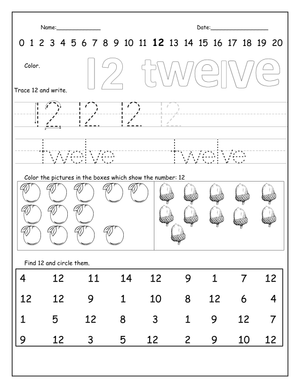
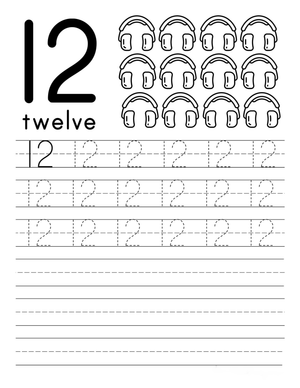
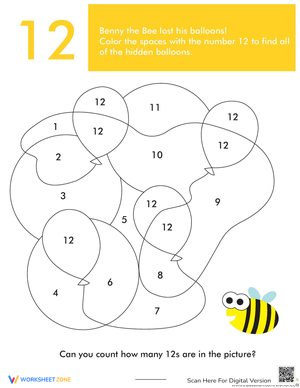
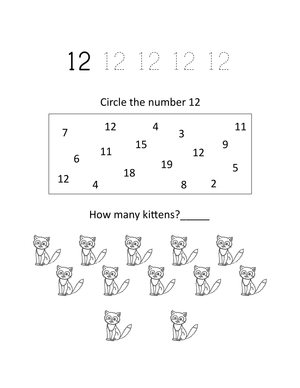
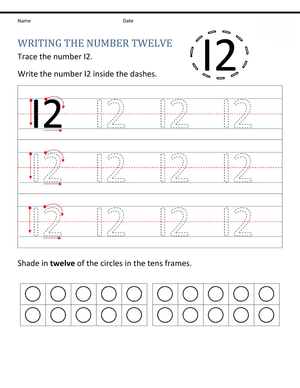
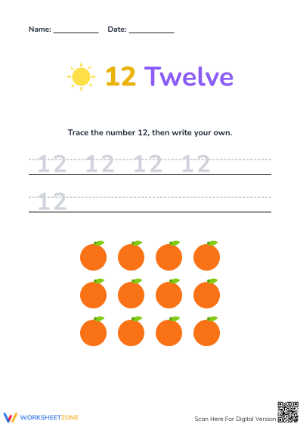
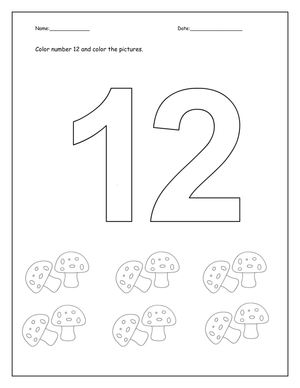
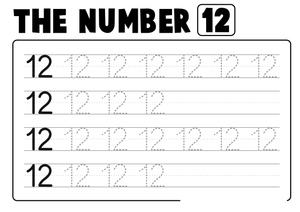
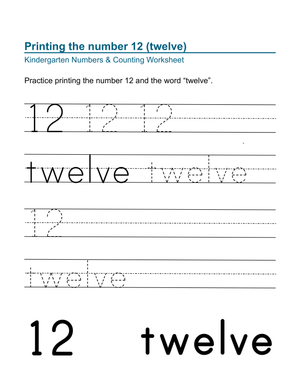
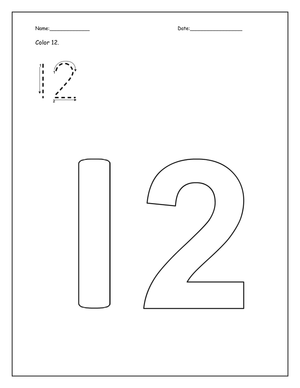
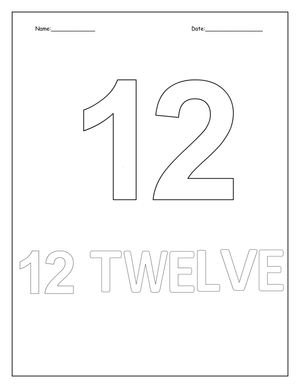
These number 12 printable worksheets for 1st grade address a genuinely tricky conceptual moment — the point where a child who can count fluently from one to ten must now accept that a single numeral can contain a hidden ten. Each worksheet isolates a specific skill: forming the numeral with correct stroke sequence, filling in a double ten-frame, matching the word twelve to its numeral, or breaking twelve apart into tens and ones. The set moves from recognition toward decomposition without ever asking students to do both at once on the same worksheet.
The Specific Skills Each Worksheet Builds
Twelve sits at a peculiar spot in early numeracy. Unlike numbers below ten, it demands that first graders hold two ideas simultaneously — a complete group of ten and a remainder of two. The worksheets address that demand directly rather than treating twelve as just the next number in a sequence.
- Numeral formation — Tracing worksheets use directional arrows to show stroke order for writing 1 and 2 in sequence. Students who skip this step often develop a cramped or reversed habit that takes weeks to undo.
- Double ten-frame completion — Students fill the first frame to capacity and then place exactly two dots in the second. This is the clearest visual proof that twelve is a structured quantity, not a standalone one.
- Quantity identification — Worksheets present multiple sets of objects — some showing twelve, some showing eleven or thirteen — and students mark the sets that match. This is harder than it looks; students must count all, not estimate.
- Number bonds — Students record 10 + 2 = 12 and then explore other pairs: 6 and 6, 8 and 4, 9 and 3. Early exposure to multiple compositions of the same number builds the flexible thinking that later addition strategies depend on.
- Word-form recognition — Students match the written word twelve to the numeral and to picture groups, reinforcing math vocabulary without pulling the lesson away from its mathematical purpose.
Student Errors Worth Watching For and Addressing
Twelve trips students up in ways that eleven and thirteen do not. Eleven has a visual symmetry that makes it stick; thirteen carries the phonetic signal "teen" that primes students to think of a ten inside it. Twelve offers neither advantage. A student who correctly identifies that 13 is "one ten and three ones" will often pause at twelve and guess "one ten and one" — because the spoken word gives no cue that two ones are hiding in it. Listen for that specific miscall when reviewing ten-frame work aloud; it signals a gap in conceptual understanding, not just a careless error.
The other pattern appears in numeral formation. First graders frequently write 21 instead of 12. This is not carelessness — it mirrors the same reversal logic that produces b for d. The digit 2 feels prominent because it's the less familiar one, and students write it first. Tracing worksheets with numbered stroke sequences interrupt this habit before it solidifies. If reversals persist after two weeks of tracing practice, check whether students are looking at the model while they trace or copying from memory — that distinction tells you immediately what needs to change.
How to Work These Worksheets Into Your Lesson Plans
These worksheets belong in the representational phase of instruction — after students have handled physical objects but before they're working with abstract number sentences alone. A productive sequence: give students twelve linking cubes, have them snap ten into a tower and hold two aside, then hand them the ten-frame worksheet and ask them to draw what they just built. The worksheet becomes a record of something they already understand rather than a task that introduces an idea cold. Introducing the paper activity before the concrete work almost always produces shallower results.
Number 12 printable worksheets for 1st grade also fit naturally into the five minutes before a transition — enough time for students to complete one targeted skill without starting something they can't finish. Keep a small stack at the math center so early finishers aren't waiting idle. Monday morning warm-up is another reliable slot: a single numeral-writing or counting worksheet reactivates the previous week's learning before new instruction begins, consistent with what spaced retrieval research consistently recommends for consolidating number sense.
Standard Alignment
These worksheets align primarily to CCSS.MATH.CONTENT.1.NBT.B.2b, which requires students to understand that the numbers 11–19 are composed of a ten and some number of additional ones. The ten-frame and number bond worksheets directly address the decomposition that standard targets, and twelve is explicitly within its scope. The numeral formation and word-recognition tasks also support CCSS.MATH.CONTENT.K.CC.A.3 for students still consolidating the ability to write numerals to 20. In most first-grade pacing guides, teen numbers appear in the late first or early second quarter, following the transition from counting within 10 to place value concepts in the teens.
Adjusting the Set for a Range of Learners
For students still developing one-to-one correspondence, the counting worksheets work better with fewer objects displayed per row. Reducing visual density lowers cognitive load without changing the mathematical target. These students should also have physical counters at hand — the worksheet then functions as a recording tool for work they're doing concretely, rather than as the primary learning experience.
Students who have already grasped the basic composition of twelve need a different entry point. Use the number bond worksheets and ask them to find every pair that sums to twelve, not just 10 + 2. Presenting the open number sentence 10 + __ = 12 on an index card before letting them check the worksheet adds a retrieval step that deepens retention. Students who move through number 12 printable worksheets for 1st grade quickly are often ready for informal work on adding a one-digit number to ten, which bridges directly to 1.NBT.C.5.
Frequently Asked Questions
Why does twelve seem harder for students than thirteen or fourteen?
Thirteen through nineteen carry the suffix "teen," which gives students an auditory hint that a ten is involved. Twelve has no such cue — nothing in the spoken word connects it to "ten and two." Students have to learn that composition explicitly rather than hearing it in the name, which is why twelve typically requires more deliberate oral practice and more time on the ten-frame visual than most other teen numbers.
When in the school year should these worksheets be introduced?
Most first-grade pacing guides place teen numbers in the late first quarter or early second quarter, after students have consolidated writing numerals through 10 and counting objects reliably to 20. Introducing these worksheets before one-to-one correspondence is solid means students are managing handwriting and counting simultaneously — that split attention tends to produce sloppy work that doesn't reflect actual understanding. Wait until counting through 10 feels automatic before moving into the teens.
How do I tell whether a student has genuinely internalized twelve or just memorized the numeral?
Ask the student to show you twelve on a blank ten-frame without looking at a completed worksheet. A student who understands the concept fills the first frame and places exactly two dots in the second without counting up from one each time. A student who has only memorized the numeral often loses track and produces eleven or thirteen dots. The number bond worksheet gives you the same diagnostic window: ask the student to fill in the parts with the whole covered. Unprompted recall of 10 and 2 signals genuine understanding; hesitation or guessing signals reteaching is needed.
Can these worksheets double as formative assessment checkpoints?
Number 12 printable worksheets for 1st grade work well as quick formative checks when collected and reviewed the same day. Focus first on the ten-frame worksheets: a student who fills both frames completely to ten has not understood that twelve requires one full ten and two extras — a misconception that needs direct correction before instruction moves to 13 and 14. The numeral-writing section tells you separately whether a formation issue is obscuring mathematical understanding that may actually be in place.













 Interactive Worksheet Maker
 Quiz Maker
 Word Search Maker
 Crossword Puzzle Maker
 Word Scramble Generator
 Sentence Scramble Generator
 Handwriting Worksheet Generator
 Name Tracing Generator
 Fill In The Blank Generator