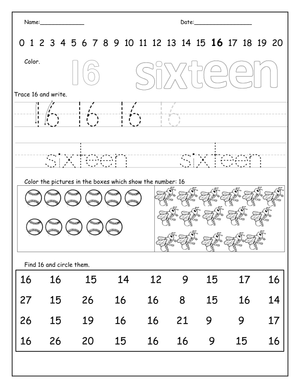
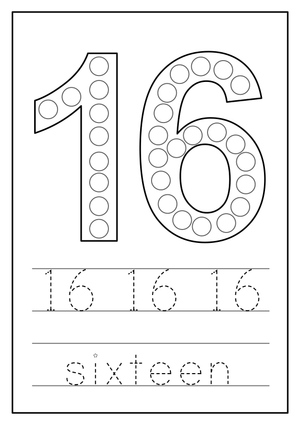
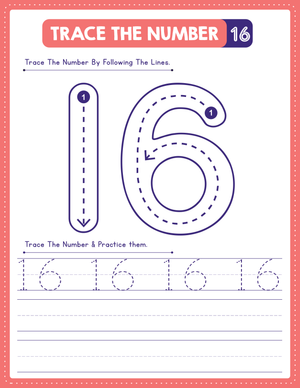
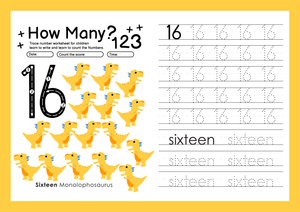
These number 16 worksheets for 1st grade are built around a specific challenge: the English number-naming system gives first graders almost no information about the structure of "sixteen." Unlike "twenty-one" or "thirty-four," where the tens digit is spoken first, "sixteen" leads with the ones and buries the ten at the end — a mismatch that trips up students who are paying close attention to language. The worksheets address this by anchoring every task to visual models before asking students to work symbolically.
What Students Practice Across the Set
The activities target these specific skills:
- Double ten-frame completion: students fill the top frame entirely before placing six in the bottom, making the one-ten-and-six-ones structure visible rather than assumed
- Base-ten block identification: matching the numeral 16 to a block representation of one rod and six units
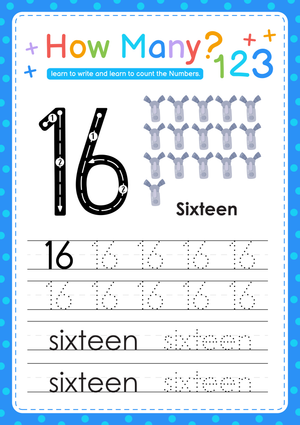
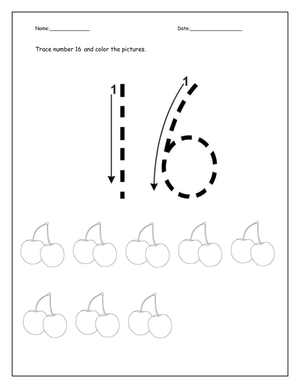
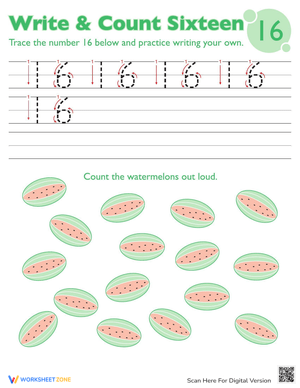
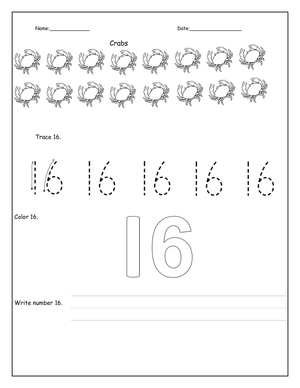
- Numeral tracing and independent writing for "16," with attention to starting point and stroke direction
- Word tracing and writing for "sixteen," connecting the written symbol to its spoken and printed form
- One-to-one counting: marking or coloring exactly sixteen objects within a pictorial scene, practicing accurate quantity production
- Number line placement relative to 15 and 17, reinforcing positional understanding of where sixteen sits
Each worksheet isolates one or two of these representations, giving teachers the flexibility to select tasks that match where students are on a given day rather than moving through a fixed sequence.
The Place Value Reasoning Behind Teen Numbers at This Grade
First graders typically arrive at teen numbers thinking sequentially — sixteen is "the number after fifteen," not a quantity with compositional structure. The shift from sequence-thinking to structure-thinking is one of the most significant conceptual moves in Grade 1, and sixteen is a useful focus precisely because it is structurally unremarkable but linguistically irregular. The word does not say "one ten six"; it says "sixteen," which in isolation sounds like a single indivisible word rather than a bundled quantity.
Ten-frame models carry more instructional weight here than base-ten block representations do, at least on introduction day. A fully filled top frame communicates "one complete ten" with immediate visual clarity. A base-ten rod requires students to already know the rod equals ten units — a more abstract convention that depends on prior teaching. These worksheets introduce the ten-frame model first and use base-ten block tasks as a consolidation activity, which respects both the visual logic and the order in which students are most likely to internalize the concept.
Errors That Show Up Consistently in First-Grade Work on This Number
Two errors appear across classrooms reliably. First: when asked "how many ones are in 16?" a large portion of students answer "16," because they have not yet separated the number into its component parts. This is not carelessness — it reflects a genuine conceptual gap about what "ones" means inside a two-digit number. Second: on double ten-frame tasks, students treat both frames as interchangeable counting spaces, distributing dots in whatever configuration totals 16. A student who places eight in the top and eight in the bottom has produced the right total and has entirely missed the lesson.
In the number 16 worksheets for 1st grade, the ten-frame tasks use a fill-top-first format — a structural constraint that prevents the second error at the point of production rather than catching it during a correction conversation afterward.
Fitting These Worksheets Into Your Planning Without Disrupting Instructional Flow
The tracing and numeral-writing worksheets work well as morning warm-up material — five to seven minutes of focused, low-stakes practice while students settle before the math block begins. Reserve the ten-frame and base-ten block worksheets for the introduction day, after students have physically built 16 with linking cubes: one stick of ten and a loose set of six. That physical construction gives students something to reconstruct mentally when they encounter the printed model. The pictorial counting tasks slot naturally into math center rotations or early-finisher work.
For review, pull a number 16 worksheets for 1st grade into the last eight to ten minutes of a math block roughly a week after the initial lesson. Spaced retrieval at that interval consolidates the place-value understanding before the class moves on to 17 and 18 — and it surfaces students who held the concept for one day but did not retain it, which is more common than teachers expect with teen numbers.
Standard Alignment
CCSS.MATH.CONTENT.1.NBT.B.2 addresses understanding that the two digits of a two-digit number represent amounts of tens and ones. Substandard 1.NBT.B.2a is most directly relevant: it specifies that students recognize 10 as a bundle of ten ones called a "ten" — the conceptual core of every task in this set. In most Grade 1 pacing guides, this standard lands in the fall semester, roughly October through November, after students have solidified rote counting to 20 but before regrouping in addition is formally introduced. Sixteen sits at the midpoint of the teen-number window, following work on 11–15 and preceding 17–20, which makes this set a natural fit within a two-week teen-number instructional block.
Adapting the Set for the Range of Learners in the Room
Students still developing reliable one-to-one correspondence can work through the pictorial counting worksheets with a physical marker — a penny or counting chip placed on each object as it is counted, then removed before the student records the total. This gives them a self-correction mechanism without requiring a different activity. For students who have already internalized the ten-and-six structure, the extension move is writing the equation (10 + 6 = 16) beneath each completed ten-frame, then explaining it verbally: "one ten and six ones make sixteen." That spoken justification reveals whether the understanding is genuine or procedural.
The word-writing portion of number 16 worksheets for 1st grade also serves a cross-curricular function for students who are ahead: once "sixteen" is written with confidence, ask them to use it in a comparison sentence — "Sixteen is two more than fourteen because..." Students who consistently reverse the numeral, writing 61 instead of 16, benefit more from a correctly written reference card taped to the corner of their desk than from additional tracing repetitions. The reversal is a production-order issue, and continuous visual access resolves it faster than drill alone.
Frequently Asked Questions
At what point in the Grade 1 sequence should these worksheets be introduced?
After students can successfully complete ten-frame tasks for numbers 11 through 15. The compositional structure of 16 is identical to those earlier teen numbers, so if students are still confused about why the top frame must be filled before the bottom frame is used, they need more time with 13 and 14 before moving forward.
My students can already count to 20. Will these worksheets still be useful?
Rote counting and structural understanding are different skills, and the gap between them is larger than it usually appears. A student who counts to 20 without error will still frequently claim there are 16 ones inside the number 16, rather than one ten and six ones. The ten-frame and base-ten block tasks in this set target that compositional understanding specifically — not counting fluency.
How does understanding the number 16 connect to addition work later in the year?
When students genuinely understand 16 as 10 + 6, the make-a-ten addition strategy becomes significantly more accessible later in the year. The reasoning is structurally identical: adding 8 + 8 means making a ten and having six remaining — the same mental construction students practiced when they filled the top frame first and counted what was left. These worksheets build that reasoning before addition contexts formalize it.













 Interactive Worksheet Maker
 Quiz Maker
 Word Search Maker
 Crossword Puzzle Maker
 Word Scramble Generator
 Sentence Scramble Generator
 Handwriting Worksheet Generator
 Name Tracing Generator
 Fill In The Blank Generator