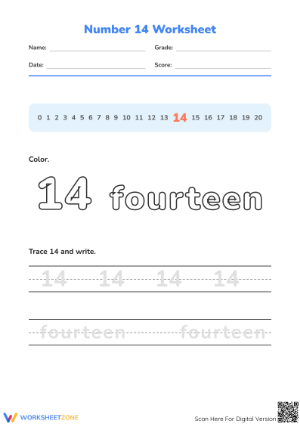
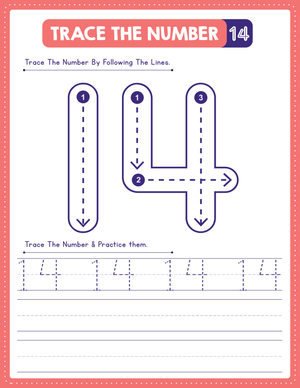
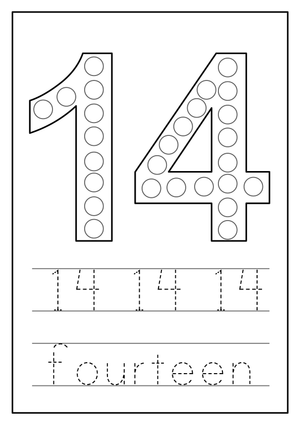
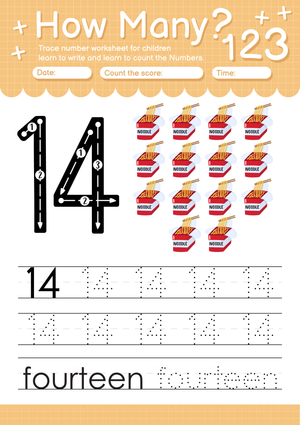
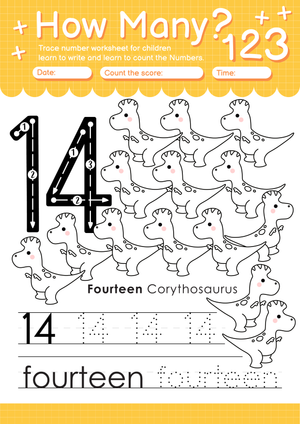
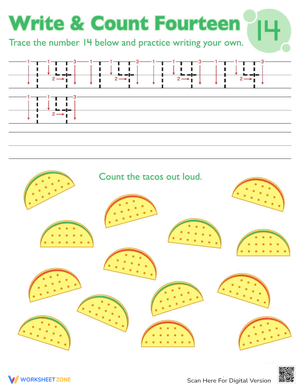
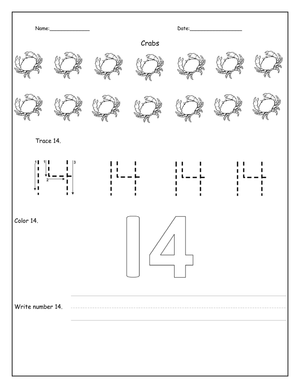
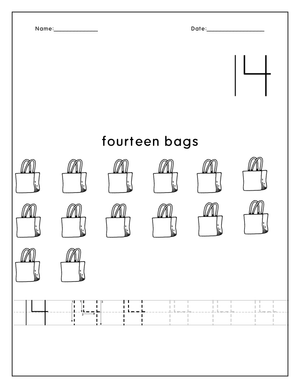
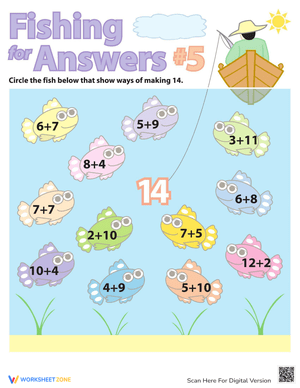
These 1st grade number 14 pdf worksheets give teachers a focused entry point into one of the trickiest stretches of early number instruction — the teen numbers. Fourteen sits in a range where the spoken name and written symbol part ways: the word fourteen sounds as if four comes first, yet the numeral places the 1 in the tens position. That disconnect is not trivial, and worksheets that treat it as such tend to shortchange students who need more than numeral tracing to build a genuine understanding of what 14 means.
What These Worksheets Build
Each worksheet asks students to engage with 14 across multiple representations rather than repeating one action. A child who traces the numeral neatly may still be unable to locate 14 on a number line or build it correctly on a ten-frame — so the set spans both fluency and conceptual work.
- Recognizing the numeral 14 among a row of mixed numbers
- Tracing and forming 14 with correct digit sequence — 1 before 4
- Counting out 14 objects with one-to-one correspondence
- Filling a ten-frame to show 1 ten and 4 ones
- Reading and writing the word fourteen
- Placing 14 on a number line between 13 and 15
- Drawing or circling groups of 14 items
The ten-and-ones structure deserves particular attention here. Early place-value thinking doesn't wait for second grade — it begins the moment students work seriously with teen numbers. When each worksheet names 14 as "1 ten and 4 ones" and shows it in a base-ten picture, it bridges numeral recognition and the grouping logic students will depend on through multi-digit addition and subtraction.
Common Misconceptions to Watch For and Correct
Three error patterns show up consistently in first-grade work on teen numbers. The first is digit reversal: a student asked to write fourteen produces "41." This isn't a random handwriting slip — it often reflects the spoken rhythm of the word, where four is heard before teen. The second is a ten-frame stall: a student fills both rows with five dots each, stops at ten, and labels the frame "10" because they've landed on a familiar landmark and don't yet know to press on and add four more. The third is counting drift: a student points to a row of 14 pictures, says the count aloud, and arrives at 13 because their finger and voice fell out of sync around the eighth or ninth item — and they write 13 with complete confidence. Each error calls for a different correction. Digit reversal needs explicit work on the spoken-to-written translation. The ten-frame stall needs direct instruction on what "and four ones" looks like in practice. Counting drift needs a physical strategy like sliding objects rather than pointing.
Lesson-Planning Ideas to Get the Most From These Worksheets
Because 1st grade number 14 pdf worksheets stay focused on a single number and a few task types, they don't require long explanations — a two-minute model is enough for most of the class to work independently. That makes them practical for the transitions and time pressures that shape a real first-grade day.
During a small-group reteach, pair each worksheet with linking cubes so students build a tower of ten, snap it together, and count on four more before they record anything. That physical sequence — build, count, then write — gives students a reason to use ten-and-ones language rather than just repeating vocabulary. In a math center, set the worksheet beside a double ten-frame card so students can check their thinking before writing. For the eight minutes before dismissal, a trimmed version of the worksheet functions as a fast formative check without eating into transition time. After a mini-lesson on teen numbers, these worksheets also work as exit evidence: who can show 14 three different ways without teacher prompting tells more than a thumbs-up check.
Standard Alignment
CCSS.MATH.CONTENT.1.NBT.B.2 specifies that students understand the numbers 11–19 as composed of a ten and some ones. Fourteen is among the central examples in that standard's language, and worksheets that include a ten-frame or base-ten model directly practice that understanding rather than just labeling it. CCSS.MATH.CONTENT.K.CC.A.3 — writing numbers 0–20 — remains a consolidation goal into first grade; numeral formation practice on these worksheets addresses real, ongoing work for students who still reverse digits or lose numeral shape under time pressure.
Adjusting the Worksheets for a Range of Learners
The worksheet content stays the same across ability levels; what changes is the support and the follow-up task. Students who are still building basic counting accuracy work with counters on the desk and a physical number line they can touch. Covering the lower sections of each worksheet so they focus on one task at a time reduces visual load without changing what they're practicing. Students who finish quickly and accurately move to a verbal extension: explain each representation to a partner using the sentence stem "This shows 14 because..." That oral rehearsal consolidates the concept in a way that additional writing tasks don't. Students working above grade level get a reverse task — given 14 objects, generate three different ways to record the quantity without looking at the worksheet. That production task reveals depth of understanding more directly than any matching or tracing item.
Frequently Asked Questions
What makes teen number worksheets harder for first graders than worksheets on single-digit numbers?
Numbers 11–19 introduce a place-value structure that has no parallel in the single digits. A worksheet on 7 asks students to match a numeral to a quantity. A worksheet on 14 asks students to understand that the 1 in the tens position means something fundamentally different from the 4 in the ones place — and to connect that to the word fourteen, which names the smaller part first. That layered demand is exactly why 1st grade number 14 pdf worksheets that include ten-frame models and base-ten pictures do more instructional work than simple tracing-only worksheets.
How many times should students practice with a single-number worksheet before moving on?
Once is not enough for most first graders, but the repetition should be spaced rather than massed. Use each worksheet during initial instruction, then return to a fresh worksheet a week later during independent practice. If a student completes every section accurately after that gap, the result carries more weight than two correct worksheets completed in the same lesson.
Can these worksheets work as homework without confusing families?
When directions are clear and tasks are visually obvious — a ten-frame to fill, a numeral to trace, a row of objects to count — most families can support the work without additional teacher explanation. The tasks are self-evident enough that a parent can check answers without needing to know the instructional sequence that preceded the assignment.
How do these worksheets fit alongside hands-on number activities?
Manipulative work and printable recording tasks serve different purposes. Counters and cubes let students build understanding through physical action; each worksheet shows whether students can transfer that understanding onto paper without objects in front of them. In a well-structured math block, 1st grade number 14 pdf worksheets follow the concrete activity rather than replacing it — that sequence, from hands-on to written, is where lasting understanding forms.













 Interactive Worksheet Maker
 Quiz Maker
 Word Search Maker
 Crossword Puzzle Maker
 Word Scramble Generator
 Sentence Scramble Generator
 Handwriting Worksheet Generator
 Name Tracing Generator
 Fill In The Blank Generator