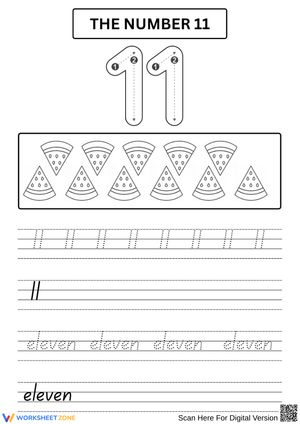
1st Grade Number 11 printable worksheets
These 1st grade number 11 printable worksheets resources give teachers a focused set of practice tools for one of the most conceptually dense stops in early math — the moment counting crosses from a single digit into genuine place value territory. Each worksheet targets a specific skill, from numeral tracing and ten-frame work to decomposing eleven into ten and one. The set covers both the numeral and the written word, because students who can write "11" fluently often cannot spell "eleven" without prompting.
What Each Worksheet Covers
The skills in this set reflect the multiple entry points students need when encountering a two-digit number for the first time in any meaningful way. Eleven is not simply the next number after ten — it is the first numeral that requires students to hold two distinct ideas simultaneously: a complete group of ten and a leftover one. Each worksheet approaches that concept from a different angle.
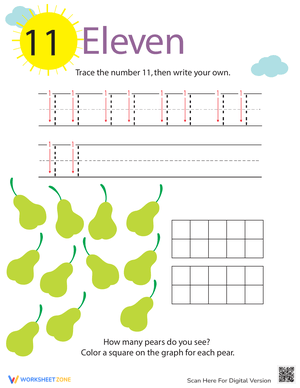
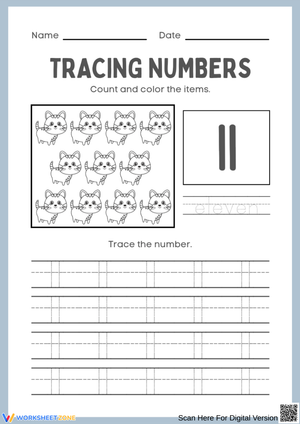
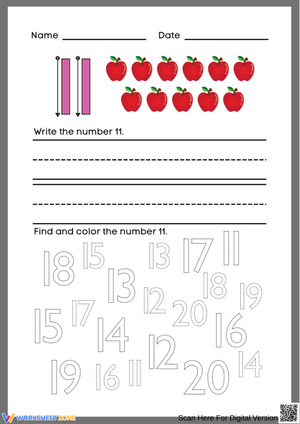
- Numeral and word tracing: Students trace and then independently write the digit 11 and the word "eleven." The tracing lines are dashed rather than dotted, which reduces the visual confusion younger writers experience when dots feel more like decoration than a path to follow.
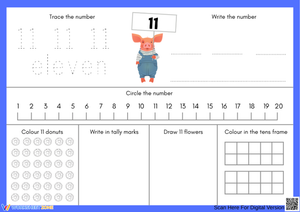
- Double ten-frame completion: One frame is shown fully filled; students color in a single dot on the second frame, then write the total. This keeps the ten-and-one structure visible without requiring verbal explanation every time.
- Base-10 block representation: Students draw or color one rod (ten) and one unit cube, then match the drawing to the numeral. Several worksheets reverse the task — given the blocks, write the number.
- Decomposition equations: Students write the equation 10 + 1 = 11 and fill in a part-part-whole model. This is the direct precursor to the addition strategies they will use all year.
- Tally mark practice: Drawing two groups of five marks plus one additional mark to total eleven reinforces both grouping and counting on from a known quantity.
- Number line placement: Students locate 11 on a number line running from 9 to 13, giving them a sense of magnitude without the distraction of the entire 0–20 span.
Student Mistakes That Surface Quickly With This Number
Eleven produces a specific, predictable cluster of errors. The most common is place value confusion with the numeral itself: because both digits are the identical symbol "1," many first graders assume the two ones are worth the same amount. A student might correctly build eleven with a ten-rod and a unit cube during a hands-on activity and then write "1 ten + 1 one = 2" on the worksheet — conflating face value with positional value. The fix is not to re-explain the rule but to point back to the ten-frame: "How many dots are in that first box altogether?" Returning to the visual breaks the arithmetic reflex faster than repetition of the same verbal instruction.
The word "eleven" creates a separate category of difficulty. Unlike fourteen or sixteen, it gives no phonetic hint that a ten is hiding inside it. Students who have internalized "thirteen" through pattern recognition stall when they hit "eleven" — the syllable structure doesn't map onto anything they've seen before. In completed student work, misspellings cluster around "elevin," "elaven," and the surprisingly common decision to write "11" wherever the word was requested, as if the numeral were an acceptable substitute. These 1st grade number 11 printable worksheets resources address this by pairing the word and the numeral on the same worksheet repeatedly, making the connection explicit rather than assumed.
Standard Alignment
The primary standard here is 1.NBT.B.2.a, which requires first graders to understand that numbers 11 through 19 consist of one ten and a specific number of ones. Eleven is the entry point for this standard — the simplest case, with only one leftover one — which is why most teachers address it before moving further into the teens. Every 1st grade number 11 printable worksheets in this set generates direct evidence of 1.NBT.B.2.a: when students fill in a part-part-whole model showing 10 and 1, or shade a complete ten-frame plus one unit, they are demonstrating the standard's core expectation. The tracing and word-writing tasks also connect to foundational number sense work embedded in the K–1 counting and cardinality progression, supporting the kind of fluency that later standards assume students already have in place.
How to Build These Worksheets Into Your Math Block
The most effective placement for these worksheets is the day after an initial concrete lesson — not as the introduction to eleven, but as the first independent practice after students have handled physical ten-rods and unit cubes. Sending students straight to paper before they've built the number with manipulatives consistently produces guessing rather than reasoning. Once they have constructed eleven with linking cubes and articulated what they built aloud, a worksheet becomes a record of understanding rather than a test of it.
During math rotations, these work well at an independent station while you pull a small group. The double ten-frame and base-10 block worksheets translate cleanly to a dry-erase pocket — slide one worksheet in, hand students a dry-erase marker, and the same sheet becomes reusable practice without consuming paper. One worksheet that holds up well as a quick formative check is the decomposition equation task. A student's completion of 10 + ___ = 11 tells you in about eight seconds whether the place value concept has landed, and a quick scan across the room during independent work reveals exactly who needs a follow-up conversation before the block ends.
Differentiating Across the Full Ability Range in Your Classroom
For students still consolidating single-digit counting, pair any worksheet with physical counters. Before they mark anything on paper, they count out eleven objects, group ten together, and verify the leftover. The paper then reflects what they already know rather than asking them to figure it out abstractly. Students who reverse numerals — writing the "1" with the stroke going in the wrong direction — benefit from having a numeral card taped to the corner of the worksheet as a formation reference; attempting to correct the motor habit mid-activity rarely produces lasting results.
For students who grasp 10 + 1 quickly, the same worksheets extend in two directions. First, ask them to generate all the addition pairs that make eleven: 0 + 11, 1 + 10, 2 + 9, and so on, recording each on the decomposition worksheet's blank lines. Second, use the number-line worksheet as a starting point for a discussion about what comes before and after, pushing toward 12 and 13. The 1st grade number 11 printable worksheets set is the launch point for the rest of the 1.NBT.B.2 standard for those students, not the stopping point.
Frequently Asked Questions
Why does eleven give first graders more trouble than twelve or thirteen?
Thirteen and fourteen contain the word "teen," which most students recognize as a signal that the number belongs to the double-digit range beyond ten. "Eleven" carries no such marker — the word sounds complete and self-contained, not like a combination of ten and something else. That mismatch between the sound of the word and its mathematical structure makes eleven harder to internalize, even for students who handle place value competently in other contexts.
How many worksheets should I use on the number 11 before moving on?
A practical signal is whether students can write 10 + 1 = 11 without referring to a model and correctly spell "eleven" without copying from a reference. Two to three worksheets distributed across two or three days — not completed in a single sitting — gives spaced retrieval a chance to work. Students who finish all their practice in one afternoon tend to perform noticeably worse on the same tasks a week later than students whose practice was spread out over time.
Do these worksheets work for kindergarteners who are ahead of grade level?
Yes. The double ten-frame and base-10 block worksheets align with what K.NBT.A.1 begins to introduce at the end of kindergarten — composing numbers 11 to 19 from a ten and some ones. A kindergartener working beyond grade level handles these tasks without modification; the tracing and word-writing portions remain appropriate because handwriting stamina is still developing regardless of how far ahead a student is in number sense.
Clear All