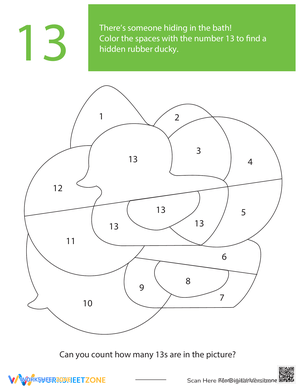
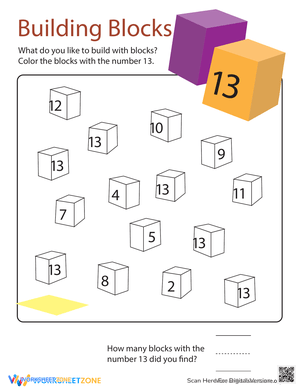
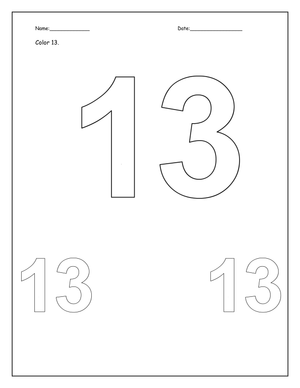
These number 13 worksheets for 1st grade give teachers a focused set of printable practice tools covering every angle of how young students encounter, misread, and eventually internalize this particular teen number — from tracing the numeral to decomposing it into one ten and three ones. Each worksheet targets a discrete skill so you can pull exactly what a student needs rather than working through a sequence from the top. The set spans numeral formation, ten-frame work, counting sets of objects, number-line placement, and the written word form thirteen.
The Specific Skills Each Worksheet Builds
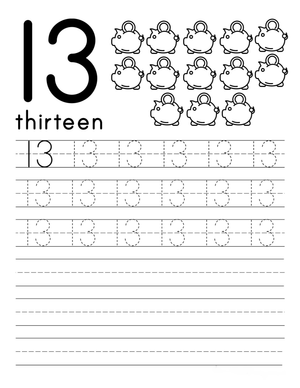
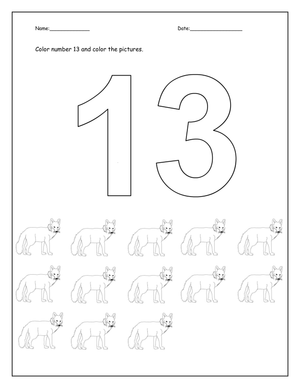
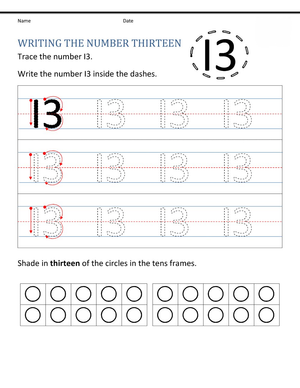
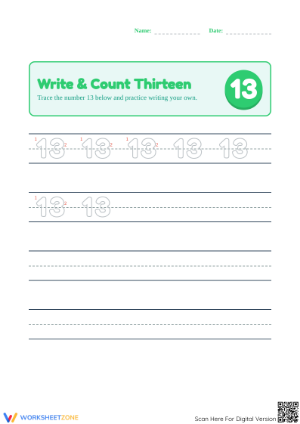
Numeral formation worksheets provide large directional models of the digit pair 1–3, with start-dot cues so students learn to write the left digit before the right. This detail matters more than it sounds: first graders who write each digit correctly in isolation will still fuse them into a single backwards shape when writing quickly under any time pressure. Ten-frame worksheets show a fully filled frame alongside a partial frame of three and ask students to record the total — or, in reverse, to fill in the frames when shown only the numeral. Counting worksheets present grouped illustrations — thirteen acorns, thirteen fish, thirteen stars arranged in scattered arrays rather than tidy rows — and ask students to mark off each item as they count, training one-to-one correspondence under conditions that resemble how counting actually breaks down in real student work.
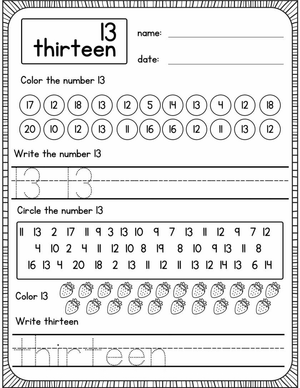
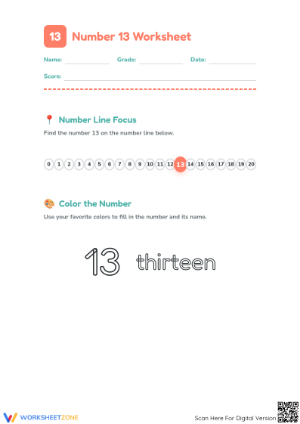
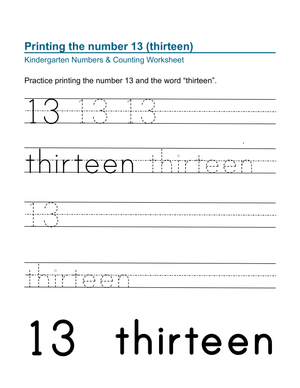
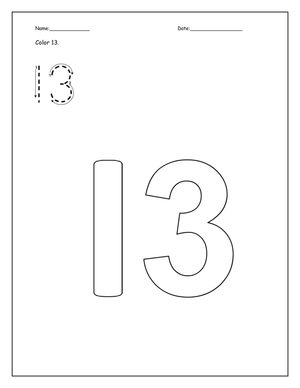
Number-line worksheets ask students to locate 13 between its neighbors on a labeled sequence, then mark the numbers one more and one less. The word-form worksheet pairs tracing practice on thirteen with a matching task that links the numeral, the spelled word, and a ten-frame image in the same visual field. The find-and-color exercises require students to pick 13 out of a field of similar-looking teen numbers — 12, 15, 18, and the reversal trap 31 — which trains the visual discrimination that prevents the most persistent error first graders make with this number.
The Mistakes Students Make With 13 — and the Reasons Behind Them
Teen numbers already sit awkwardly in English because the spoken word reverses the written order — we say the ones-sounding part first but write the ten first. Thirteen adds a second layer of interference: its spoken root doesn't obviously connect to the digit three the way fourteen does for four. Students who have just paired "four" and "fourteen" as a rhyming set will hear "thirteen" and lose the pattern entirely. In student work, this surfaces as a correct count of a set of 13 objects followed by the written answer 31 — the student heard the three-like sound at the start of the word and wrote the three first. This is a phonological interference error, not carelessness, and treating it as such changes how you address it.
A second error appears specifically in ten-frame work. Students who correctly fill ten cells and then add three more will still circle the wrong section when asked "which part shows the ten?" They point to the three — the part they added last — because recency creates salience in working memory. The worksheets address this directly: the completed ten-frame appears in a distinct shaded format before students are asked to reason about it, so the ten is visually anchored before any analytical question is posed.
Standard Alignment
CCSS Math 1.NBT.B.2 requires first graders to understand that the two digits of any two-digit number represent amounts of tens and ones, and that the numbers 11 through 19 are each composed of a ten and some ones. Thirteen is one of the numbers explicitly named within that standard. Classroom instruction on 13 typically lands in the second quarter of first grade, after students have established reliable counting-to-20 fluency but before the curriculum shifts to adding and subtracting multiples of ten. This set of number 13 worksheets for 1st grade sits squarely in that instructional window — each worksheet assumes students can reach 13 accurately through counting but are still forming the conceptual link between the spoken name, the written numeral, and the tens-and-ones structure underneath it.
Smart Ways to Work These Worksheets Into Your Week
The ten-frame and counting worksheets function well as math-center rotations on the same day you introduce 13 with physical manipulatives. Run a brief whole-group lesson using linking cubes — ten in one color snapped together, three in a second color attached to the end — then send students to a center where they complete the corresponding ten-frame worksheet. The transition from physical cubes to a printed representation holds better when both happen in the same period, before the concrete model fades from working memory.
The numeral formation worksheet works best as morning warm-up on day two, when students need a low-stakes re-entry into the previous lesson without requiring full teacher facilitation. Five minutes of tracing at the start of class activates prior knowledge and frees you to pull a small group immediately. The number 13 worksheets for 1st grade that include word-form matching are well-suited to the last ten minutes before dismissal — short, self-contained, and calm enough not to accelerate the energy in the room. Save the find-and-color discrimination worksheet for the end of the instructional sequence, once students have had multiple exposures; it asks them to distinguish 13 from look-alike teen numbers under mild pressure, and students who haven't had enough practice will guess rather than discriminate.
Adjusting the Set for Mixed-Ability Classrooms
Students who are still developing fine motor control find the numeral formation worksheet more productive when they trace with a crayon rather than a pencil — the added friction slows the hand enough to prevent the rushed combined stroke that produces reversals. For students who have already internalized the numeral shape, skip the tracing entirely and assign the ten-frame decomposition worksheet directly, then extend it: after completing the worksheet as printed, ask them to write a number sentence (10 + 3 = 13) beneath each ten-frame image. The task grows in depth without requiring a different resource.
Students who are working above grade level can use the number 13 worksheets for 1st grade as a quick informal review — one worksheet, timed loosely — before moving to a related extension like composing their own find-and-color grid using teen numbers of their choice. That extension produces a practice tool another student can later use, which keeps stronger students productively engaged while you work with those who need additional repetition at the concrete level. For students who are still struggling, the ten-frame worksheet pairs directly with two-color counters; let them build the number first with physical counters, then record what they built on the worksheet. The paper task documents their thinking rather than driving it.
Frequently Asked Questions
Why do so many first graders write 31 instead of 13?
The spoken word "thirteen" leads with a sound that resembles "three," so students processing auditorially write the three first. This is a phonological interference error — it happens reliably across classrooms and is worth addressing directly rather than correcting repeatedly after the fact. Have students say "the ten goes first because it's bigger" while pointing to the 1 in the numeral. Pairing that verbal rule with the find-and-color worksheet, where 31 appears as one of the decoys, lets students catch the distinction in a low-stakes context before they encounter it in any graded setting.
How many repetitions does a first grader typically need before numeral writing is automatic?
Fluent, correctly formed numeral writing for most first graders requires somewhere between eight and fifteen successful repetitions across multiple sessions — not counting instances where the student wrote it incorrectly and continued without noticing. A single tracing worksheet with six or seven cells is not sufficient on its own. Spaced practice across two or three days, using the formation worksheet as a brief morning warm-up rather than one extended block, produces more durable results than a concentrated single session.
Can these worksheets substitute for hands-on work with manipulatives?
No. The ten-frame and decomposition worksheets work precisely because students have already handled physical objects and built the number concretely. Without that prior experience, the printed ten-frame is just a grid — students fill it in correctly by visual pattern without understanding that the full frame represents a grouped ten. Use linking cubes or two-color counters during the initial lesson, then move to the printed worksheet as a representation of what students have already built with their hands.
Which worksheet should a student start with if they have no prior exposure to teen numbers?
Start with the counting worksheet, where students mark off objects in a scattered array of exactly thirteen. This confirms the student can reach 13 accurately through counting before you ask them to write, trace, or decompose the numeral. If a student miscounts the array — arriving at 12 or 14 — that tells you the gap is in counting accuracy rather than numeral recognition, and you can address it directly before any of the other worksheets in the set will be productive.













 Interactive Worksheet Maker
 Quiz Maker
 Word Search Maker
 Crossword Puzzle Maker
 Word Scramble Generator
 Sentence Scramble Generator
 Handwriting Worksheet Generator
 Name Tracing Generator
 Fill In The Blank Generator