




























Views
Downloads


Grade K-1 More or Less Numbers — Printable No-Prep Worksheet

Paste this activity's link or code into your existing LMS (Google Classroom, Canvas, Teams, Schoology, Moodle, etc.).
Students can open and work on the activity right away, with no student login required.
You'll still be able to track student progress and results from your teacher account.
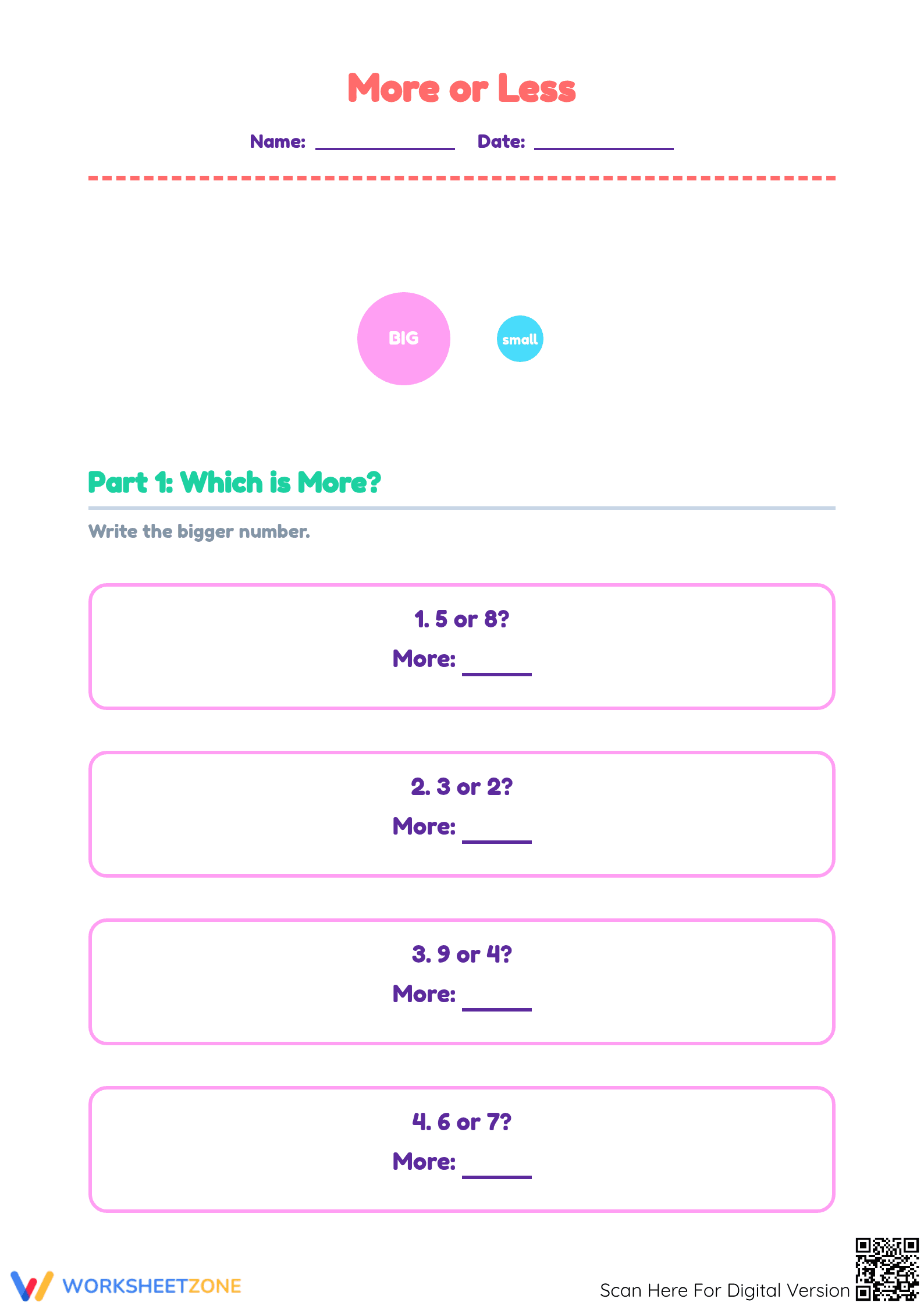
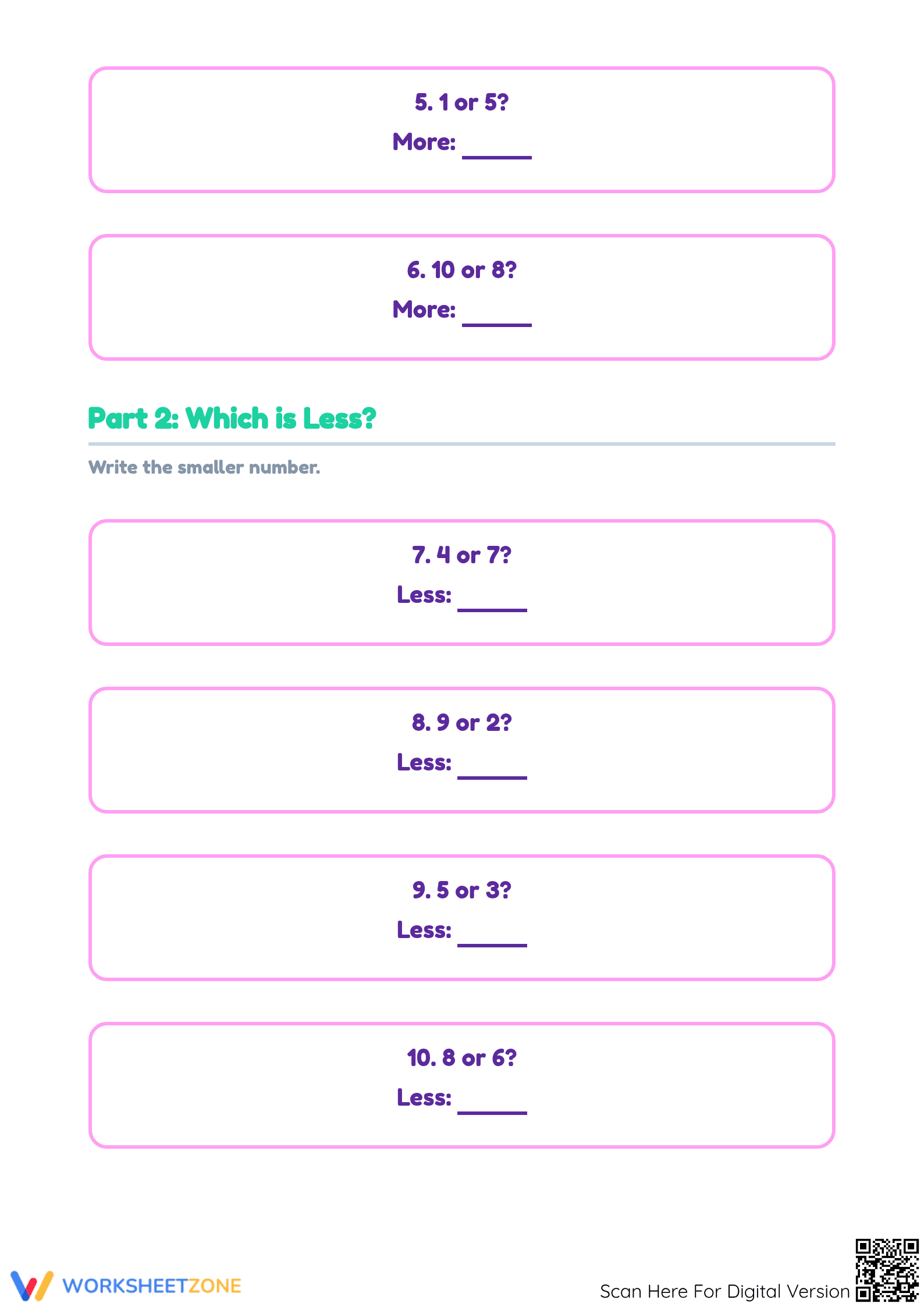
This 3-page math worksheet helps early learners master the fundamental skill of comparing numerical values. By using standard mathematical symbols, students develop a concrete understanding of number relationships, building the essential foundation required for higher-level arithmetic and algebraic reasoning.
At a Glance
- Grade: K–1 · Subject: Math
- Standard:
CCSS.MATH.CONTENT.K.CC.C.7— Compare two numbers presented as written numerals using comparison symbols- Skill Focus: Comparing numbers (Greater Than, Less Than, Equal To)
- Format: 3 pages · 30 problems · Answer key included · PDF
- Best For: Independent practice and quick skill reinforcement
- Time: 15–20 minutes
This comprehensive set includes three distinct pages, each featuring 10 comparison problems for a total of 30 tasks. The layout is clean and distraction-free, providing ample space for students to circle or write the correct equality sign between pairs of numbers. Every page is accompanied by a full-color answer key, allowing for immediate feedback and easy grading in any classroom or home-school setting.
The zero-prep workflow for this resource is designed to save valuable instructional time. First, print the three content pages directly from the PDF (30 seconds). Second, distribute the worksheets to students during centers or as a bell-ringer activity (1 minute). Finally, use the included answer keys to review student work individually or as a whole-group check (under 1 minute). Total teacher preparation time is less than two minutes.
Aligned to CCSS.MATH.CONTENT.K.CC.C.7, this resource requires students to compare two numbers between 1 and 20 presented as written numerals. It also supports CCSS.MATH.CONTENT.1.NBT.B.3 by introducing the symbolic representation of number relationships. Both standard codes can be copied directly into lesson plans, IEP goals, or district curriculum mapping tools to ensure instructional compliance and tracking.
Use this worksheet as a formative assessment during your "Comparing Numbers" unit. Observe students as they work to identify if they confuse the direction of the "greater than" and "less than" signs—a common hurdle for early learners. It also serves as an excellent fast-finisher activity or a straightforward sub-plan component. Expect students to complete one page in approximately 5 to 7 minutes, totaling 20 minutes for the set.
This resource is tailored for Kindergarten and Grade 1 students who are moving from concrete counting to abstract numerical comparison. It is particularly effective for learners requiring additional visual structure or repetitive practice to gain symbol fluency. Pair this worksheet with a physical number line or base-ten blocks for students who benefit from tactile reinforcement during the transition to symbolic math.
Early numerical literacy depends on the ability to recognize and compare quantity, a prerequisite for mathematical fluency. According to research from RAND AIRS 2024, consistent exposure to symbolic comparison tasks significantly improves a student's number sense and their ability to estimate values in more complex operations. This worksheet provides the structured repetition necessary to move these skills into long-term memory. By engaging with 30 focused problems, students internalize the logic of the CCSS.MATH.CONTENT.K.CC.C.7 standard, transitioning from simple identification to logical comparison. The inclusion of the equal sign ensures that students understand identity as a core mathematical relationship. This mastery is a critical predictor of later success in algebraic thinking and data analysis. Educators can rely on this validated practice format to bridge the gap between counting and calculating in early childhood mathematics.


