Number 20 printable worksheets for 1st Grade
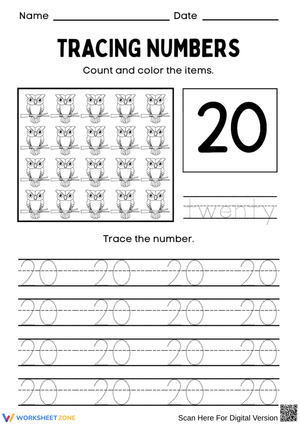
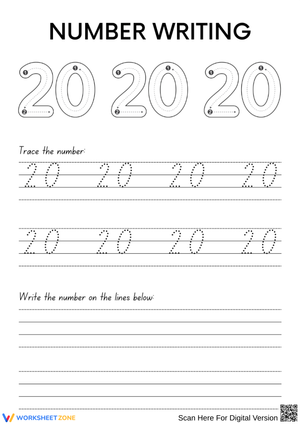
These number 20 printable worksheets for 1st grade give teachers a focused set of standalone activities aimed at one of the most instructionally significant numbers in the early elementary sequence. Each worksheet isolates a specific skill — tracing the numeral with correct stroke order, completing a double ten frame, writing the word "twenty," placing 20 on a number line between 10 and 30 — so teachers can select exactly what a group needs without sifting through a broader packet.
Why the Number 20 Deserves Its Own Focused Practice
Students moving through the teen numbers are essentially memorizing a list of irregular spoken names — thirteen, fourteen, fifteen — where the spoken word gives almost no place-value information. Twenty changes that. The word itself encodes the decade: twen-ty, two tens. Teachers who point explicitly to that linguistic structure during instruction, then follow up with written practice on a matching worksheet, see students connect the spoken name to the base-ten composition far faster than when the two are left unlinked. The number 20 is also the first opportunity for students to encounter a two-digit numeral with a zero in the ones place — which, as the error section below explains, produces its own predictable confusion on paper.
The Specific Skills Targeted Across the Set
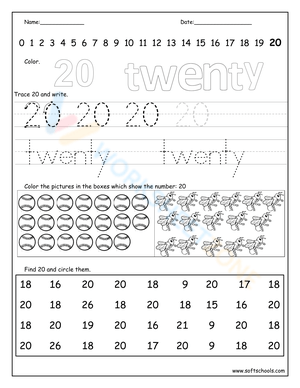
Each worksheet approaches the number 20 from a different angle, which is deliberate. Students who can recognize 20 as a numeral but can't represent it on a ten frame haven't fully internalized the number — they've memorized a symbol. The activities distribute practice across several forms of representation:
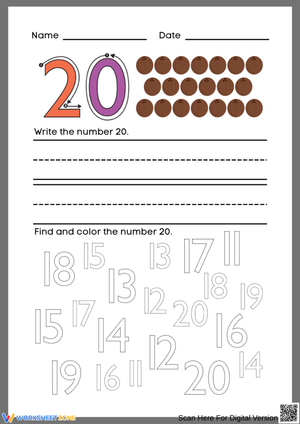
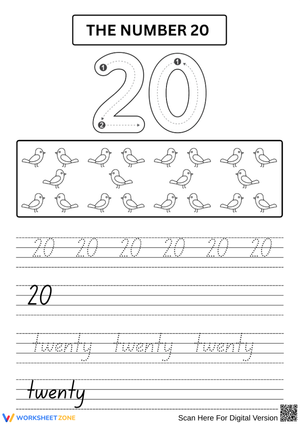
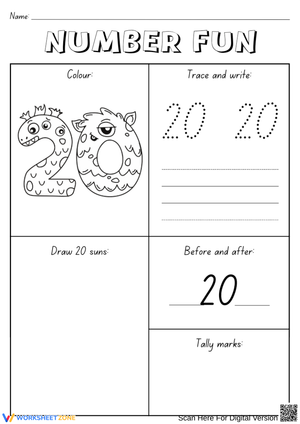
- Tracing and writing the numeral 20, with the 2-stroke practiced before the 0
- Completing a double ten frame and reading the total it shows
- Drawing tally marks to 20, reinforcing grouping by fives into four complete sets
- Matching the numeral 20 to pictures of base-ten rods
- Circling or coloring exactly 20 objects within a larger field
- Tracing and independently writing the word "twenty"
- Marking the position of 20 on a number line spanning 0 to 30
The base-ten rod matching activity carries particular instructional weight. When students draw two rods and label them, they are doing the early work of place-value reasoning — connecting a visual model to digit meaning — before abstracting that thinking into a rule they've been told to apply.
Frequent Student Errors Worth Watching For and Correcting
The most reliable error is digit reversal: students write 02 instead of 20. They know both digits belong in the number but have not internalized that the tens digit always leads. This is distinct from a careless reversal — it signals a genuine gap in place-value understanding. When it appears, showing the student a base-ten rod worksheet and asking "which part do we write first, the two rods or the empty ones column?" usually resolves it faster than correcting the numeral directly.
A second error specific to word-form activities: students confuse "twenty" with "twelve." Both words start with tw, both carry a similar vowel sound, and students who are simultaneously rehearsing number words for the teens regularly write "twelve" in the blank even after spelling "twenty" correctly the day before. A word wall card displaying both words side by side during independent work reduces this error at the source.
Tally mark worksheets produce a third consistent issue: count loss between marks 12 and 16. Students start with focused grouping, then accelerate through the middle range and arrive at 19 or 21. Teaching students to treat each group of five as a complete, discrete unit before beginning the next — draw five, stop, count the group, then draw five more — addresses this more effectively than asking them to recount after the fact.
Smart Ways to Work These Worksheets Into Your Week
The number 20 printable worksheets for 1st grade that focus on numeral tracing work well as arrival tasks during the five or six minutes before morning meeting. Students come in, find the sheet on their desk, and begin independently — no directions needed, low cognitive entry, immediate reinforcement of the number. The double ten frame and tally mark worksheets are better suited to the instructional block itself, where a brief teacher model beforehand prevents the count-loss errors described above.
For math centers, slide the worksheets into dry-erase pockets. Students mark answers with a whiteboard marker, erase, and pass to the next group. One laminated copy of each worksheet runs a full week of rotations without additional printing. For small-group intervention, use the base-ten rod worksheet as a physical overlay: have students place actual rods directly on the printed images before drawing, making the dimensional and printed representations overlap. That one extra step — placing before drawing — addresses the 02/20 reversal error more efficiently than verbal explanation alone.
Standard Alignment
These worksheets address CCSS 1.NBT.B.2, which requires students to understand that the two digits of a two-digit number represent amounts of tens and ones — specifically, that 20 represents two tens and zero ones. In classroom pacing terms, this standard typically receives direct instruction in late fall or early winter of first grade, after students have worked through single-digit numbers and the teen sequence, and before the curriculum shifts to adding and subtracting within two-digit numbers. The number line worksheets also connect to 1.NBT.A.1, which addresses counting to 120 starting at any number, and the counting and object-identification worksheets extend foundational work from K.CC.B.5 for students who need to consolidate their counting-to-20 base from kindergarten.
Adapting the Worksheets for Different Student Levels
Among the number 20 printable worksheets for 1st grade, the tracing and object-circling activities are the most accessible entry points for students still building fluency with numbers 1–10. Pair either with a set of counting bears or linking cubes placed on the desk — students build the quantity with objects first, then record it on the sheet. That concrete-to-representational sequence keeps the task within reach without removing the written practice entirely.
On-level students move through the full sequence: numeral tracing, double ten frame, tally marks, base-ten rods, word form, number line. Students who complete these accurately and quickly are ready for extension work in the margins — ask them to write the number that is ten more than 20, ten less than 20, and one more and one less. Four additional numerals written in colored pencil in the white space of a completed worksheet extends the activity without requiring separate materials. For students ready to push further, the number line worksheet can be extended by hand: they draw the line longer and mark 30, 40, and 50, previewing the decade pattern they'll work with formally later in the year.
Frequently Asked Questions
When in the school year do these worksheets fit into instruction?
Most first-grade pacing guides reach the number 20 in mid-October through November, after students have moved through single-digit numbers and the teens. That said, assessment data frequently surfaces students in January or February who are still uncertain about the teen-to-twenty transition — these worksheets work as targeted intervention at any point in the year, not only during initial instruction. They also serve as useful review before any cumulative assessment covering two-digit number concepts.
What hands-on materials pair best with these worksheets?
Base-ten rods are the most direct pairing for the place-value worksheets — students align physical rods with the printed images before drawing them. Linking cubes work particularly well with double ten frame activities: snap ten together, set them in one row of the frame, repeat for the second. For tally mark practice, craft sticks work better than pencil-only drawing because students physically arrange them into groups of five before recording, which builds the grouping habit the worksheet then reinforces in writing.
How do I know whether a student truly understands 20 or is just completing the worksheet?
The clearest indicator is transfer: ask the student to show you 20 a completely different way — with blocks, with a freehand drawing, on a number line they construct themselves. Students with genuine understanding shift formats without hesitation. Students who followed visual cues on the printed page without conceptual grounding stall when those cues disappear. The number 20 printable worksheets for 1st grade produce a paper record of practice and give you observable data during seat work, but a two-minute verbal check after any completed worksheet — "tell me what the 2 means and what the 0 means" — reveals more about actual understanding than the finished sheet alone.
Clear All