Why a 10 frame worksheet for Grade 1 works for teen numbers
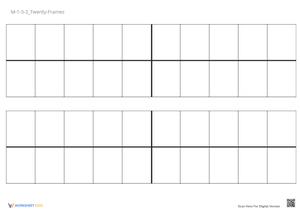
Teen numbers trip up first graders for a reason that has nothing to do with effort. The English words eleven, twelve, and thirteen hide their structure. Unlike twenty-one or thirty-one, they never say the ten out loud, so students hear a new mystery word instead of "ten and one more." A 10 frame worksheet for Grade 1 fixes that gap by making the ten visible. Each frame is a two-row, five-column grid of ten boxes, and a double ten frame extends the model to 11-20 so kids can see one full ten plus a few extra ones.
When a student fills the first frame completely and starts a second, the structure of a teen number becomes obvious. Fourteen is a full ten and four more. That ten-and-some-ones read is exactly the place-value foundation Grade 1 students need before they move into addition within 20 and early regrouping.
What students actually learn from the model
The ten frame is more than a counting picture. It builds subitizing, the ability to recognize a quantity without counting one by one. After enough practice, a full top row reads as five instantly, and a complete frame reads as ten. That frees up working memory so students can focus on the ones that spill into the second frame.
Ten Frames: Developing Number Sense and Fact Fluency, drawing on John Van de Walle's work, notes that the fixed 10-box grid lets learners anchor every number to benchmarks of five and ten, so a teen number becomes a quick "one full ten and some more" read rather than a slow count from one. That single shift is what makes 11-20 manageable for six-year-olds.
Sequence single frames before double frames
Order matters more than most pacing guides admit. Van de Walle recommends moving students from five-frames to ten-frames, and only then to numbers beyond ten. Rushing a double ten frame onto a student who cannot yet fill a single frame to ten reliably usually backfires.
Here is the practical sequence I'd build a unit around. Spend the first week on single frames for 1-10 until students can build any number and name it without recounting. Then introduce the double ten frame, but keep the first frame pre-filled to ten so the only new work is the ones in the second frame. Only after that should you ask students to fill both frames from empty. Skipping the pre-filled stage is the single most common reason teen-number worksheets feel too hard in late fall.
Five activity types on these worksheets
A strong set of Grade 1 ten frame pages cycles through a few reliable formats, each targeting a slightly different skill:
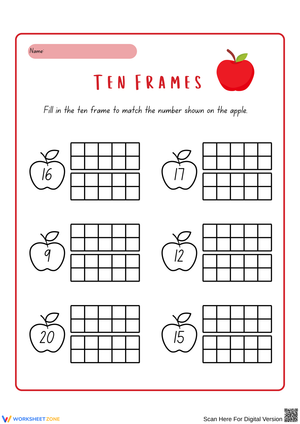
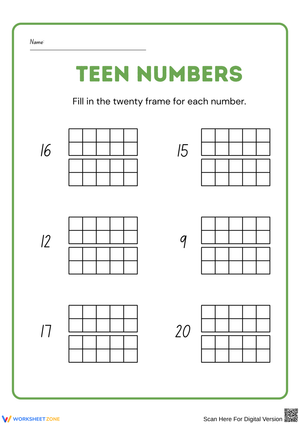
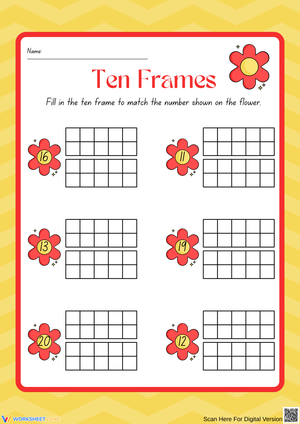
- Fill-in-the-frame: students color or stamp counters to show a given teen number, building one-to-one correspondence.
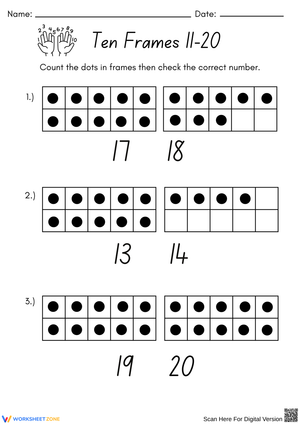
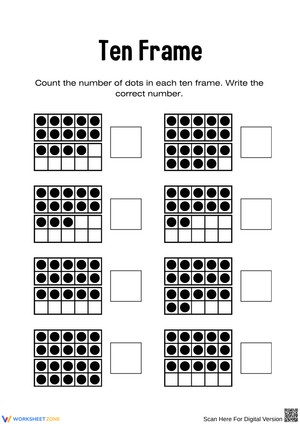
- Count-and-write: students read a filled double frame and write the numeral, connecting the picture to the symbol.
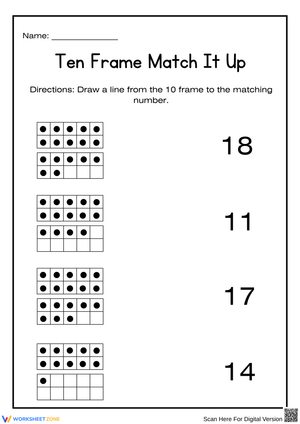
- Match the frame: students draw a line or mark to pair a frame with its numeral, reinforcing recognition.
- Compare two frames: students decide which teen number is greater, using the visible ones to reason.
- Missing number: students find the empty boxes needed to reach a target, an early bridge to addition within 20.
Rotating these formats keeps practice from turning into rote coloring and gives you several angles on the same standard.
Differentiate without making new pages
The same worksheet stretches up and down with small moves. For students who need scaffolding, pre-fill the first ten boxes so they only manage the ones, or reduce the range to 11-15 for a week. Sentence frames like "___ is ten and ___ more" give them language to attach to the picture.
For students ready for more, switch to ordering three teen numbers from least to greatest, or ask them to write the matching addition sentence (10 + 4 = 14) beside each frame. A missing-number variant where students figure out how many more counters reach 20 pushes reasoning without changing the page format your class already knows.
Frequently asked questions
1. What is a ten frame and why is it used in Grade 1 math?
A ten frame is a 10-box grid arranged in two rows of five. It gives students a fixed visual anchor for quantities, so they learn to see five and ten as benchmarks instead of counting one by one. That makes it a natural tool for early number sense.
2. How do ten frame worksheets help students learn numbers 11-20?
A double ten frame shows a teen number as one full ten plus extra ones. Seeing fourteen as a complete frame and four more makes the hidden place value in teen number words visible, which is exactly where many first graders struggle.
3. When should teachers introduce double ten frames for teen numbers?
Introduce them only after students can build and name any number 1-10 on a single frame without recounting. Start with the first frame pre-filled to ten, then move to filling both frames from empty once students are steady.
4. How can ten frame worksheets be used in math centers or small groups?
Pair a printable page with two-color counters so students model a number before recording it. In small groups, use compare-two-frames pages and ask students to explain their thinking, which reveals whether they reason from the ten or count all.
5. What skills do fill-in-the-frame and count-and-write activities build?
Fill-in-the-frame builds one-to-one correspondence and counting accuracy. Count-and-write connects the visual frame to the written numeral, strengthening number recognition and the picture-to-symbol link students need before addition within 20.













 Interactive Worksheet Maker
 Quiz Maker
 Word Search Maker
 Crossword Puzzle Maker
 Word Scramble Generator
 Sentence Scramble Generator
 Handwriting Worksheet Generator
 Name Tracing Generator
 Fill In The Blank Generator