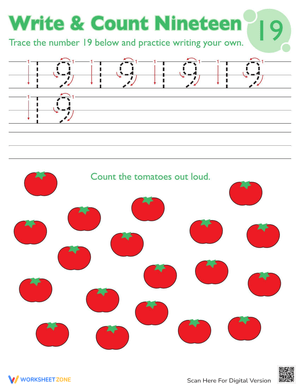
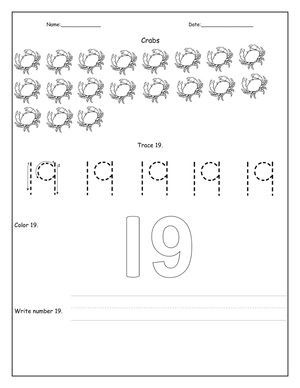
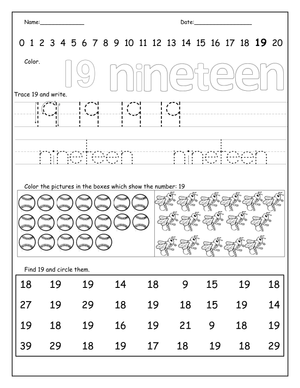
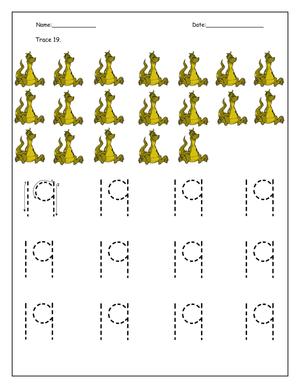
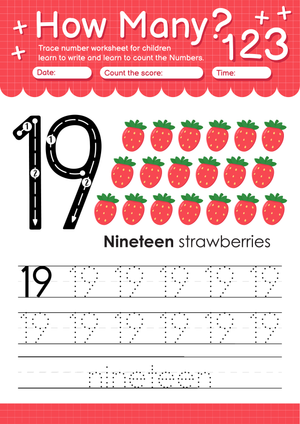
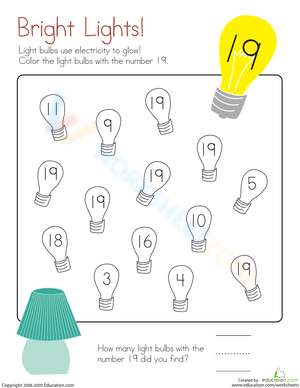
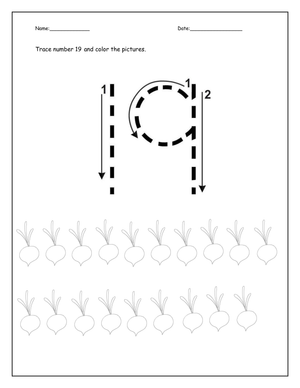
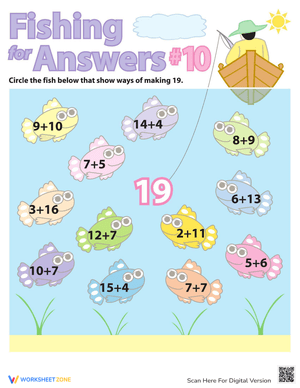
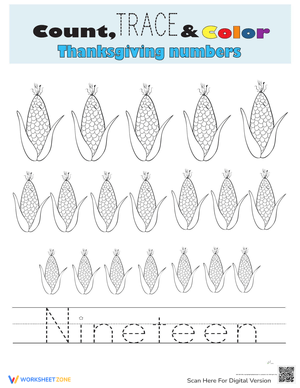
These number 19 printable worksheets for 1st grade give teachers focused practice materials for the last teen number — the one that reliably surfaces place value gaps right before students hit the benchmark of 20. Each worksheet isolates a specific skill: tracing the numeral, reading a double ten-frame, writing decomposition equations, or counting scattered arrangements of exactly nineteen objects. The set stays tight on 19 rather than mixing in adjacent numbers, which is the design choice that makes it genuinely useful for targeted instruction.
What Each Worksheet Covers
The number 19 sits at a developmentally significant point in the first-grade sequence. It closes out the 11–19 place value work before students move into counting by tens to 100. Students who appear comfortable with earlier teen numbers often falter here because 19 pushes the nine-ones side of the ten-frame to its maximum — one away from a full frame — and that visual can be disorienting without enough repetition.
Each worksheet in the set addresses one of the following skill areas:
- Numeral formation: tracing the 1 and 9 with direction cues, starting from a guided dot, practicing each digit in isolation before writing the full numeral independently
- Word form: writing "nineteen" in print and connecting the spelled form to the numeral in both directions
- Ten-frame reading: identifying 19 on a double ten-frame — one frame completely filled, a second frame holding nine counters
- Decomposition notation: completing equations in the form 10 + 9 = ___ and 10 + ___ = 19, tied directly to the visual models on the same worksheet
- Counting and cardinality: counting a scattered arrangement of nineteen objects using a cross-out strategy to avoid recounting
- Odd-number pairing: circling pairs within a group of 19 to discover that one object is always left unpaired — a concrete first encounter with the concept of odd numbers
Standard Alignment
These worksheets address CCSS 1.NBT.B.2b, which requires first-grade students to understand that each teen number is composed of a ten and some ones. For 19 specifically, the standard calls for students to recognize 1 ten and 9 ones — and the decomposition and ten-frame tasks in this set build exactly that understanding. Teachers working with Bridges in Mathematics or Eureka Math typically address 1.NBT.B.2b in the first trimester; these worksheets fit into either sequence as practice following whole-group instruction on the teen number concept. The counting tasks also connect to cardinality work established in K.CC.B.4, since students must demonstrate that the last number counted names the total quantity of the set.
Frequent Mistakes That Signal Missing Foundations
The most visible error is writing 91 instead of 19. It almost always reflects a specific confusion: students hear "nine-teen" and process the nine first, writing digits in the order they arrive phonologically rather than in tens-ones order. Tracing practice helps with muscle memory, but the real fix is a return to the place value chart — having the student say "one ten first, nine ones second" before picking up a pencil. Students who can articulate the structure rarely continue reversing the numeral.
A subtler and more instructionally important error appears during counting tasks. First graders who have not internalized the ten-plus-ones structure count all nineteen objects starting from one, even when a filled ten-frame is sitting directly in front of them. Watching for this during independent worksheet time is the most productive formative data you can collect — it tells you immediately which students need more concrete work with physical tens before paper practice will transfer.
Expect to see "ninteen" in word-form activities. The double-e in "nineteen" is a genuine spelling challenge at this stage, not inattention, and it merits a brief explicit lesson on the word's construction rather than a simple correction mark.
Building These Worksheets Into Your Instructional Week
The optimal moment for these materials is the ten-minute window between the whole-group mini-lesson and independent work time. When students have just built 19 with linking cubes — a train of ten snapped together, nine loose ones held in the other hand — the worksheet that follows that physical experience produces markedly different results than one assigned without that warm-up. The concrete-to-representational-to-abstract sequence works precisely because students bring a kinesthetic memory to the paper task.
Number 19 printable worksheets for 1st grade also fit naturally into a Monday-through-Friday warm-up cycle during the week you formally introduce the number. Assign one worksheet each morning: numeral tracing on Monday, ten-frame reading on Tuesday, decomposition equations on Wednesday, a scattered-counting task on Thursday, and a free-response drawing activity on Friday where students draw and label 19 of anything they choose. By the end of the week, the number has had five distinct points of contact.
For math centers, the counting tasks run with almost no teacher management once students understand the cross-out strategy. That frees the teacher to work with a small group at the table — the center handles its own accountability because students record their count directly on the worksheet.
Adjusting These Worksheets for a Range of Learners
Students who are still uncertain about ten-frames benefit from having the ten-side pre-filled before the lesson begins. On the worksheet, that means covering or pre-marking the first frame so the student only handles the nine ones. Working from a completed ten toward nineteen is a far more accessible entry point than reading a full double ten-frame cold and translating it immediately to an equation.
For students who grasp 10 + 9 quickly, the same worksheet supports extension with a marginal prompt written beside the task: "Write two other ways to make 19" — which pushes toward combinations like 15 + 4 or 11 + 8. A second extension: "Is 19 odd or even? Draw a picture that proves it." These additions take ten seconds to write and generate substantive mathematical thinking from students who would otherwise disengage in two minutes. The number 19 printable worksheets for 1st grade at the on-level do not require modification for most students — the range of skills across the set naturally provides variety in a mixed-ability class without additional preparation.
Frequently Asked Questions
How do I use these worksheets if my students were already introduced to 19 earlier in the year?
Assign the decomposition and counting worksheets two to three weeks after your original instruction on 19. Spaced retrieval practice consolidates learning in a way that massed practice right after a lesson does not. Students who appeared solid the first week will still make errors on the ten-frame tasks two weeks later, and that information is worth having before you move to two-digit addition.
My students can count to 19 with no trouble. Do these worksheets still serve a purpose?
Oral counting fluency and structural understanding of a number are separate skills. A student who can rattle off the count sequence to nineteen may still write the numeral backwards, misread a ten-frame, or fail to recognize 19 as 1 ten and 9 ones in symbolic notation. These worksheets address the written, visual, and compositional understanding of the number — none of which oral counting practice builds on its own.
Which worksheets in the set work well as homework, and which are better kept for classroom use?
Tracing and word-form worksheets travel home reliably — families can support that practice without needing specialized math knowledge. Ten-frame and decomposition tasks are better used in class, where you can observe student strategies and redirect errors in real time. Sending home number 19 printable worksheets for 1st grade that involve place value notation without classroom context risks students practicing incorrect procedures, and entrenched habits take considerably longer to undo than gaps do to fill.













 Interactive Worksheet Maker
 Quiz Maker
 Word Search Maker
 Crossword Puzzle Maker
 Word Scramble Generator
 Sentence Scramble Generator
 Handwriting Worksheet Generator
 Name Tracing Generator
 Fill In The Blank Generator