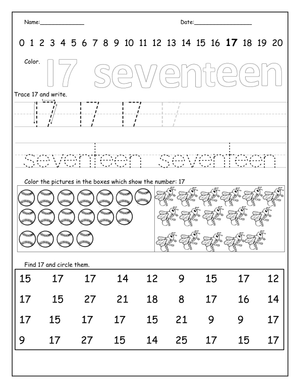
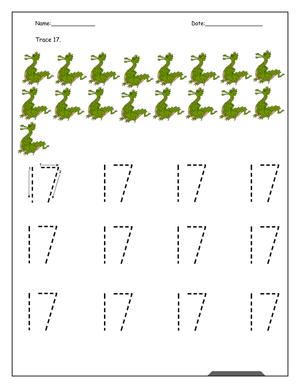
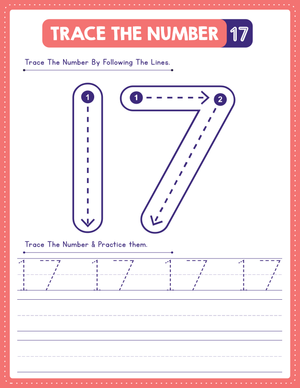
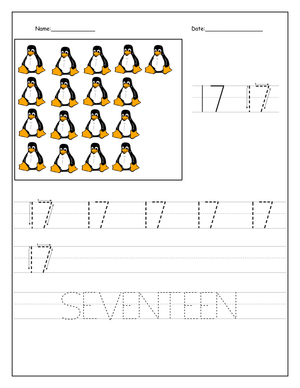
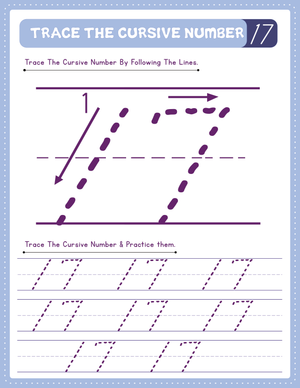
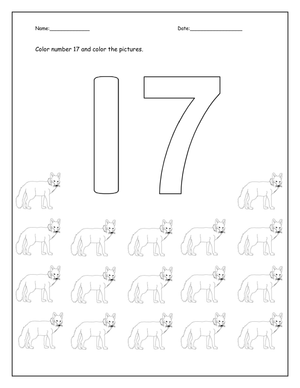
These 1st grade number 17 printable worksheets resources zero in on what makes this particular teen number harder than neighbors like 14 or 16: the spoken word "seventeen" names the ones digit first, which is the exact opposite of the order students write on paper. Each worksheet targets a distinct component — numeral formation, double ten frame interpretation, sequential placement, and quantity recognition — so teachers can assign based on where a student actually needs work rather than starting everyone from scratch.
Skills These Worksheets Build
The set covers four areas that together constitute a complete, functional understanding of 17.
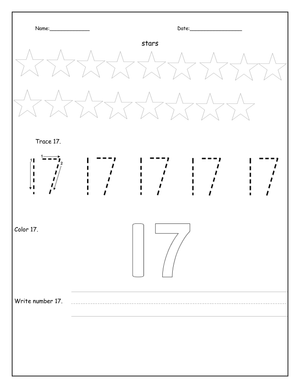
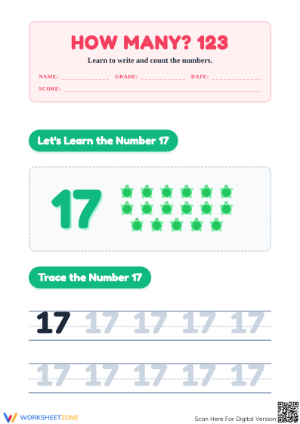
- Numeral tracing and independent writing: Students follow directional arrows to trace the digits 1 and 7 as a two-digit numeral, then write 17 without guidance in the rows below. The written word "seventeen" appears beside the numeral throughout, pairing the symbol with the language name.
- Double ten frame work: One completely filled frame represents the ten; a second partially filled frame holds seven dots. Students count, color, complete, and interpret these frames — activities that push toward the structural understanding that 17 is a group of ten plus seven more, not just seventeen loose objects.
- Number line sequencing: Students locate 17 on a partial number line, fill in missing values in the 15–19 range, and identify the numbers immediately before and after 17. This grounds the number in its position relative to the rest of the teen sequence.
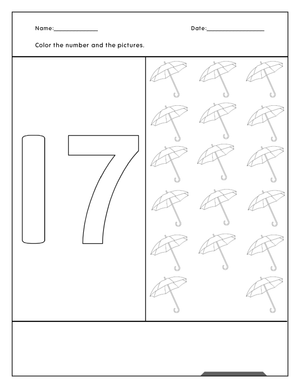
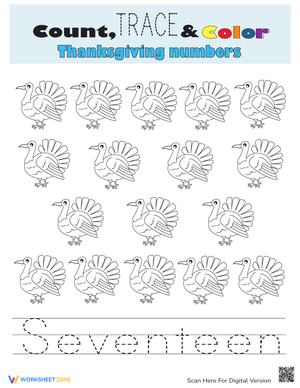
- Object counting and cardinality: Students count a set to verify it equals 17, cross out objects to reduce an overset, or draw exactly 17 items. These tasks confirm one-to-one correspondence and reinforce that the final count names the total quantity.
Mistakes Students Make That These Worksheets Help You Catch
The reversal — writing 71 rather than 17 — is the most predictable error in this unit, and it is not carelessness. Students who have correctly written 12 and 15 without flipping them will still flip 17 because "seventeen" genuinely does say the seven-sound first. They are writing what they hear. The fix is not to repeat "the one goes first" until frustration sets in, but to anchor the digit order in place value: the 1 is written first because it represents the complete group of ten, which is the larger part. Once a student can articulate that reasoning, reversals stop.
The double ten frame task surfaces a second pattern. Students who have not fully internalized the purpose of the structure distribute seventeen dots however feels natural — nine in the first frame, eight in the second — rather than filling the first frame completely before moving to the second. They arrive at a total of 17, but the representation no longer makes the ten visible, which defeats the entire purpose of the tool. During independent work, a quick scan of student papers catches this. A first frame with nine dots and a second frame with eight means a brief redirect, not a full reteach.
Number line tasks reveal a third gap: students who correctly place 17 by spatial reasoning — it looks like it belongs here — but cannot state what comes immediately after 17 without recounting from the beginning. A thirty-second oral check ("without looking at the line, what is one more than 17?") separates students who are reasoning numerically from those who are reading spatial cues on the page.
Standard Alignment
These worksheets address CCSS.MATH.CONTENT.1.NBT.B.2, which requires students to understand that the two digits of a two-digit number represent amounts of tens and ones. The standard specifically uses 17 as an anchor example — one ten and seven ones — and that is not incidental. The standards writers chose teen numbers for this benchmark precisely because they expose whether a student genuinely understands place value or is simply reciting a counting sequence. A student who writes 71 and cannot explain why 17 starts with a 1 has not met this standard, even if they count to 17 without error. The ten frame and place value tasks on these worksheets make that distinction visible in student work, giving teachers documentable evidence for small-group decisions.
How to Build These Worksheets Into Your Lesson Plans
The tracing and formation worksheet earns its place as morning work. The task is predictable enough that students begin independently the moment they sit down, and writing the numeral repeatedly across the worksheet builds the kind of distributed, low-stakes practice that improves formation more reliably than a single extended session. Save the ten-frame and object-counting worksheets for the math block, when students have just handled physical manipulatives and are better prepared to make sense of a printed representation.
Within the math block, the ten-frame worksheet belongs after guided instruction, not before it. Students who approach it cold tend to draw scattered dots rather than structured groups. A brief manipulation first — ten cubes of one color, seven of another, kept physically separate — primes the visual logic of the worksheet. When students color the ten frame on paper, they are reproducing something they just built with their hands rather than decoding an abstract diagram. 1st grade number 17 printable worksheets tasks that follow concrete manipulation consistently produce more accurate student work than the same worksheets assigned without that predecessor step.
The number line worksheet fits the warm-up slot on days two and three of the unit, after initial instruction has already happened. By then, students have seen 17 in multiple forms, and placing it on a partial line asks them to synthesize rather than recall. Five minutes of this gives you immediate information about which students are still uncertain about the teen sequence before the lesson moves forward.
Differentiating Across the Range of Learners in Your Class
For students still working on stable one-to-one correspondence, the object-counting worksheet is more productive when objects appear in rows rather than scattered arrangements. If the printed version shows scattered images, hand the student a crayon and ask them to cross through each object as they count it. That marking habit turns the worksheet into a self-monitoring tool without changing the underlying task. These students also benefit from doing the tracing worksheet with a teacher nearby to catch reversals as they happen rather than after an entire row has been written incorrectly.
Students who have already secured place value understanding can extend the ten-frame worksheet by writing two different addition sentences that total 17 — the ten-frame decomposition (10 + 7 = 17) and a second decomposition of their choosing, such as 8 + 9 = 17. This asks them to treat 17 as a flexible quantity with multiple compositions rather than a single fixed arrangement. Most 1st grade number 17 printable worksheets materials include open space at the bottom of the worksheet specifically for this kind of extension writing, making it easy to differentiate without preparing a separate assignment for advanced students.
Frequently Asked Questions
Why does 17 produce more numeral reversals than teen numbers like 12 or 14?
"Twelve" does not begin with a prominent ones-digit sound, and "fourteen" carries its own irregular rhythm. "Seventeen," by contrast, opens with a clear, forceful seven — so students who write what they hear in sequence produce 71. Making the place value logic explicit ("the 1 is written first because it stands for the complete group of ten") corrects this more permanently than marking the digit order wrong and moving on.
Can these worksheets be used for intervention with 2nd graders who are still uncertain about teen numbers?
Yes. The ten-frame interpretation and cardinality tasks transfer directly to 2nd grade intervention. The tracing component is developmentally calibrated for 1st grade — it can feel repetitive to an older student in a way that reduces engagement rather than building skill. For a 2nd grader, skip the formation rows and assign the place value and sequencing tasks instead.
Should manipulatives come before or after the worksheet?
Manipulatives come first, every time. Students build 17 with physical objects — base-ten blocks, two-color counters, or linking cubes grouped by color — before they touch the paper. The worksheet then gives them a place to record what they already understand concretely. Reversing that sequence produces students who go through the motions on the page without constructing any real understanding of what the ten frame is showing them.
Do the worksheets need to be completed in a set order?
Each worksheet stands alone and addresses a specific skill. There is no required sequence — teachers assign based on what a particular student or small group needs rather than working through the set from front to back. The 1st grade number 17 printable worksheets set is organized by skill type, so the ten-frame worksheet goes to students with place value gaps, the number line worksheet goes to students with sequencing confusion, and the tracing worksheet goes to students whose formation is still inconsistent.













 Interactive Worksheet Maker
 Quiz Maker
 Word Search Maker
 Crossword Puzzle Maker
 Word Scramble Generator
 Sentence Scramble Generator
 Handwriting Worksheet Generator
 Name Tracing Generator
 Fill In The Blank Generator