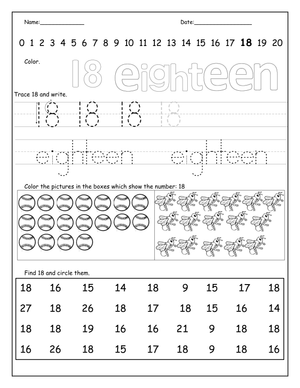
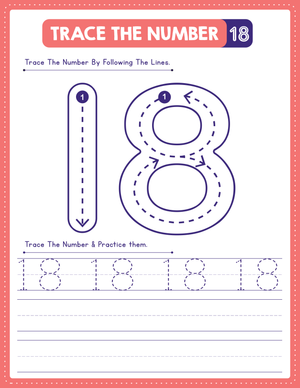
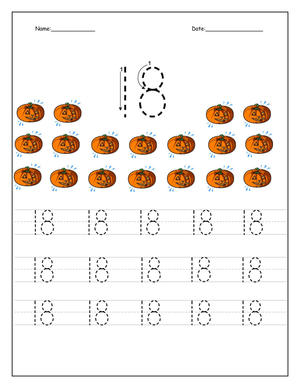
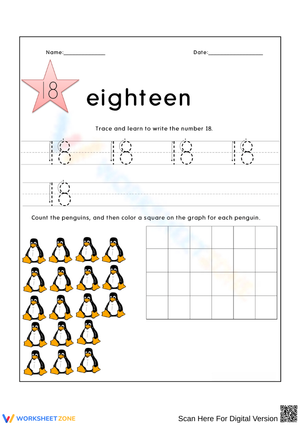
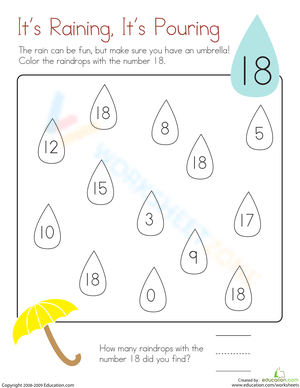
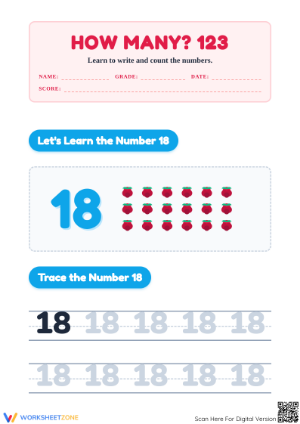
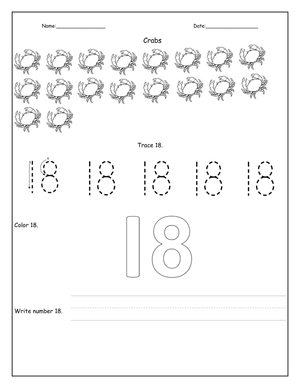
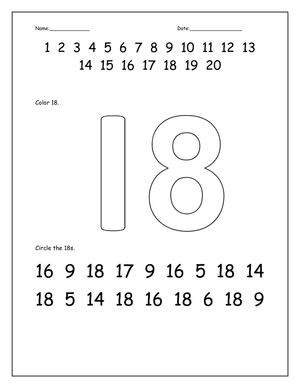
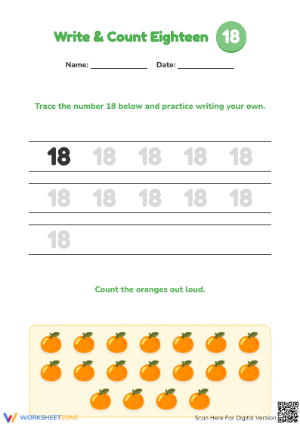
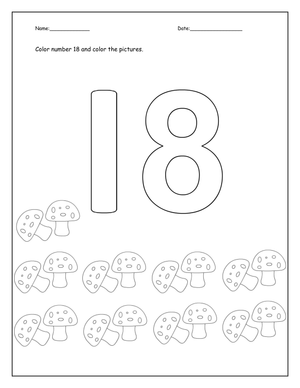
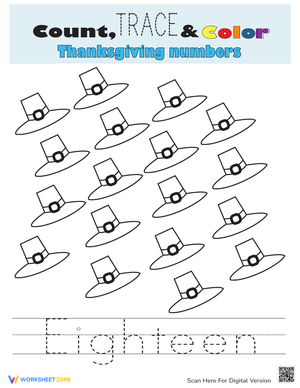
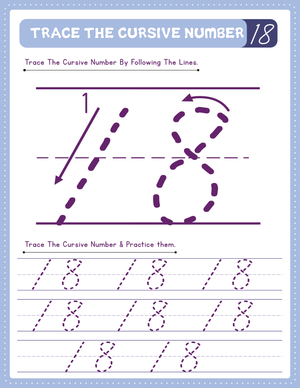
These number 18 printable worksheets for 1st grade arrive at exactly the right instructional moment — when students are moving past rote counting and need to attach meaning to the teen numbers. Each worksheet in the set links the numeral, the number word eighteen, and visual quantity models so that students build 18 as a concept rather than a stop on the number line.
Why 18 Deserves Its Own Focused Practice
Teen numbers are a known pressure point in Grade 1, and 18 sits near enough to 20 that students can sometimes guess their way through counting tasks without fully understanding the structure. The linguistic problem is real: say "eighteen" aloud and you hear the eight before the one, which is why digit reversal — writing 81 for 18 — appears so often in first-grade work. Students who say the number correctly can still write it backwards, not because they are careless but because the spoken word front-loads the wrong digit. Worksheets that ask students to trace, then independently write, and then represent 18 as a quantity slow that process down in a useful way.
The place-value piece matters here too. Grade 1 is where students first internalize that teen numbers mean one ten and some ones. Eighteen is one complete group of ten plus eight more. When students fill a ten-frame to capacity and then count 8 additional dots, they see that structure physically — and that image carries forward into later addition and subtraction in a way that numeral tracing alone does not.
The Specific Skills Each Worksheet Targets
- Numeral writing: Students trace and then write 18 independently, building automatic, correctly sequenced digit formation.
- Number word recognition: Students read or trace eighteen, connecting the written word to the numeral they just practiced.
- Counting sets: Students count collections of pictures or dots up to 18, practicing one-to-one correspondence at a quantity where errors are common.
- Ten-frame modeling: Students represent 18 on a double ten-frame, filling one row completely before moving to the second.
- Quantity comparison: Quick more/less/equal tasks place 18 in relation to nearby numbers like 16 and 20.
- Number sequencing: Students identify what comes before and after 18, reinforcing its position in the counting sequence.
Mistakes Students Make That These Worksheets Help You Catch
Digit reversal is the most common writing error, but it is not the only one worth watching. Students who write 18 correctly often miscount sets containing exactly that many objects. The pattern shows up predictably around 13–15, where students either skip a count or recount the same item — and then arrive at 16 or 17 and write 18 anyway because that is the number they expected to reach. Catching this on a worksheet, before it becomes a habit, matters more than checking digit formation.
Ten-frame errors tell a different story. A meaningful share of first graders fill the top row of a double ten-frame with 8 dots instead of 10, then stop. They are representing "eight and something" rather than "ten and eight" — directly traceable to the fact that "eighteen" sounds like it starts with eight. Asking those students to touch the top row and count aloud, confirming it holds exactly ten, usually corrects the error quickly. The worksheet surface makes that misconception visible in a way that mental practice does not.
Fitting These Worksheets Into Your Weekly Lesson Planning
A reliable entry point is the last 10 minutes of a math block, after whole-class instruction on teen numbers has closed. Students work independently while the teacher circulates and notes who is reversing digits, who loses count at 14 or 15, and who fills the ten-frame incorrectly. That window produces more usable information than a verbal exit ticket for this particular skill.
For small-group intervention, pull each worksheet during a Tuesday or Wednesday session after Monday's whole-class introduction. Give students linking cubes in two colors — one for the first ten, one for the eight — and have them build 18 before touching the paper. The physical build slows down students who rush to write without understanding. Morning work placement also works well on review days, when the goal is consolidation rather than new instruction. These are the mornings when students need a familiar, manageable format to start the block with confidence.
Adjusting the Worksheets Across a Range of Learners
For students who need more support, reduce the counting set to a smaller subset and pre-fill the first five frames so they are completing the model rather than building it from scratch. Providing counters for touch-counting is not accommodation for weakness — it is appropriate structured support for early Grade 1. Students who lose track at 14 or 15 benefit from circling groups of five as they count, which reduces the memory demand of tracking an 18-item set.
Students who are ready for extension can compare 18 to 15 and 20 on the same worksheet, write a number bond showing 10 + 8, or sketch two groups that together total 18. None of those additions require a new page — they fit in the margin or a blank space already on each worksheet. That keeps prep time flat while the math demand increases meaningfully for faster finishers.
Standard Alignment
These worksheets address CCSS.MATH.CONTENT.1.NBT.B.2, which requires students to understand that the two digits of a two-digit number represent amounts of tens and ones — specifically noting that numbers from 11 to 19 are composed of one ten and one through nine ones. In classroom terms, this is the standard that makes ten-frame modeling central to 1st-grade instruction rather than optional enrichment. Every task that asks students to show 18 as a full ten plus 8 ones is direct, targeted practice for this expectation. Numeral writing connects back to CCSS.MATH.CONTENT.K.CC.A.3 as a carried-forward fluency skill for students who did not consolidate numeral formation in kindergarten.
Frequently Asked Questions
Do students need manipulatives alongside the worksheet, or is the printed page enough?
For most first graders encountering teen numbers for the first time, the printed page alone is insufficient. Counters or linking cubes help students confirm their counts and build the ten-plus-ones structure before they record it on paper. Once students can explain why the ten-frame shows 18, the printed models can stand on their own. Use number 18 printable worksheets for 1st grade alongside hands-on materials during initial instruction, then shift to independent use during review and consolidation phases.
How do I know whether a student truly understands 18 or is just completing the worksheet correctly?
Ask the student to cover the worksheet and build 18 using two colors of counters — one color for the ten and one for the eight. Students who have only memorized the surface task often hesitate or build 8 and 10 in the wrong mental order. The hands-on build bypasses the rote pattern and reveals whether the teen-number concept is actually in place. This takes under two minutes and produces clearer diagnostic information than reviewing the completed paper alone.
Can these worksheets serve as an assessment tool?
They work well for informal, formative checks. A completed worksheet shows whether a student can write both digits in the correct order, count a set of 18 accurately with one-to-one correspondence, and model the number on a ten-frame. That is not the same as a scored summative assessment, but for daily instructional decisions — whether to reteach, consolidate, or extend — the page gives enough information. When number 18 printable worksheets for 1st grade are collected after independent practice, teachers typically surface two or three distinct error types within the same class period, which is enough to form the next day's small groups.
Are these worksheets useful after the initial unit on teen numbers has ended?
Yes, particularly as spaced retrieval practice in the weeks after direct instruction closes. Students who seemed secure on 18 in October sometimes show counting errors in November once the class has moved to addition. A brief worksheet revisit — assigned during morning work or used in a five-minute warm-up — reinforces the teen-number concept before it fades. Number 18 printable worksheets for 1st grade are low enough in prep demand that teachers can return to them without disrupting the current unit's pacing.













 Interactive Worksheet Maker
 Quiz Maker
 Word Search Maker
 Crossword Puzzle Maker
 Word Scramble Generator
 Sentence Scramble Generator
 Handwriting Worksheet Generator
 Name Tracing Generator
 Fill In The Blank Generator