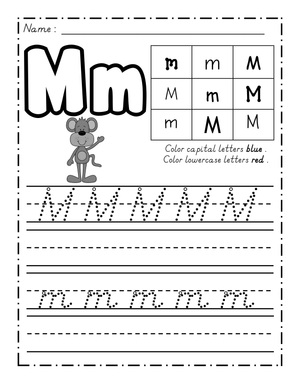
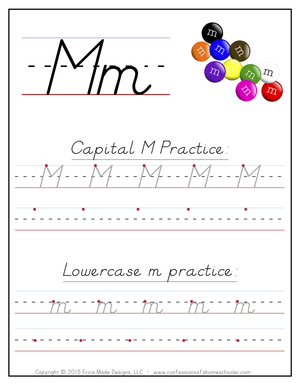
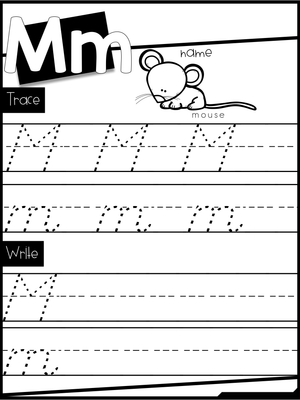
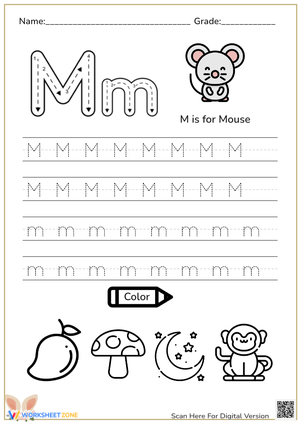
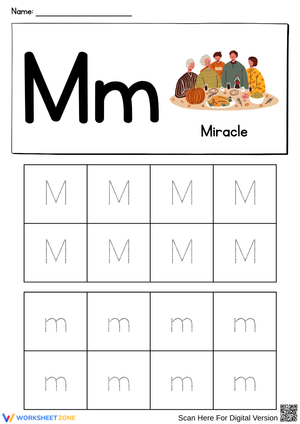
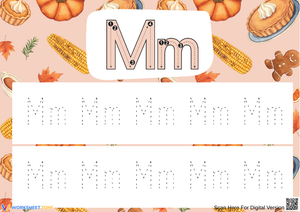
When a child in your class writes an M with three uneven bumps or starts the stroke from the bottom up, that habit does not stay small. Letter M handwriting worksheets give preschool and kindergarten teachers a repeatable way to model correct strokes before shaky habits set in. M is one of the trickier capital letters because it asks young hands to manage four straight lines in one continuous sequence, so it deserves more than a single worksheet page.
Handwriting instruction can begin effectively in preschool and prekindergarten as long as it is paired with consistent teacher modeling of stroke order. Letter-of-the-week routines that include M give teachers a natural checkpoint to observe pencil grip, line awareness, and whether students track left to right, all of which feed directly into reading readiness.
Stroke Order for Uppercase and Lowercase M
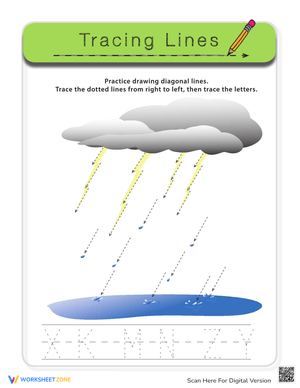
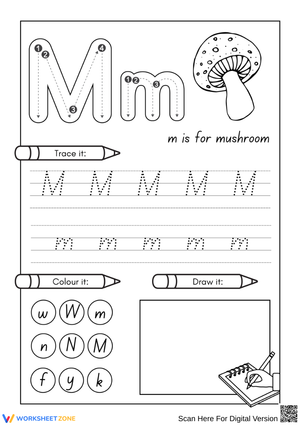
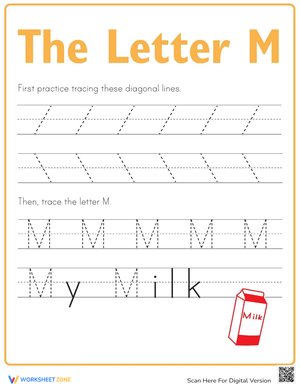
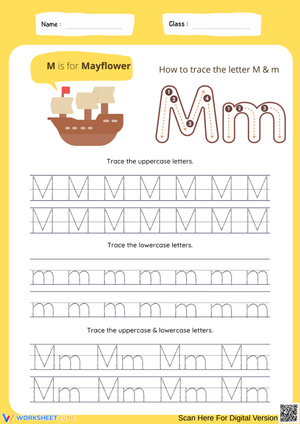
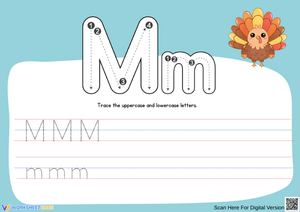
Uppercase M breaks into a simple three-motion sequence: pull straight down for the first line, angle down to the middle point, angle back up to the top, then pull straight down again for the final line. Say the cues out loud as you model: down, down-up, down-up, down. Lowercase m follows a related but distinct pattern: start at the midline, pull down, hop back up and over into the first hump, back down, hop up and over into the second hump, and back down again.
Teaching both cases side by side helps students notice that lowercase m is really two humps built on the same up-and-over motion, rather than two random shapes to memorize. Saying the stroke cues aloud while tracing on a worksheet reinforces the motor pattern through both sight and sound.
Sequencing Letter M Worksheets Across a Lesson
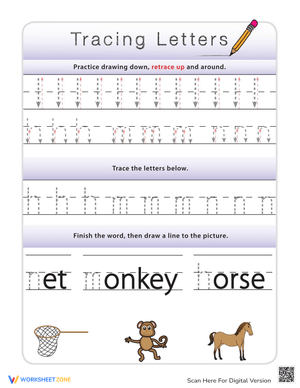
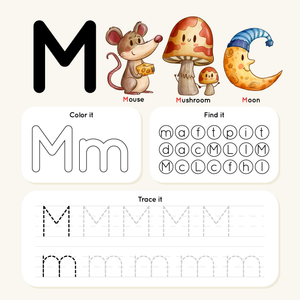
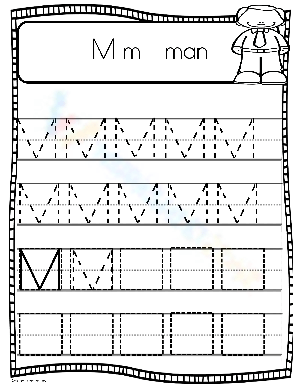
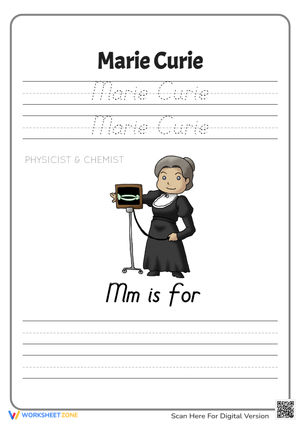
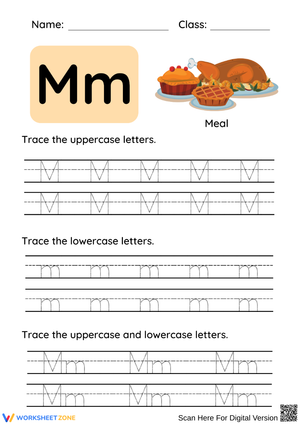
A single letter M worksheet rarely builds lasting accuracy on its own. Effective letter practice routines typically move through three stages: tracing along dashed guide lines, copying the letter next to a visual prompt, and finally writing independently on blank lines. Structuring a 15-20 minute literacy block around these three stages keeps students engaged without overwhelming their attention span.
- Warm-up: air-trace or sky-write the letter M three times while saying the stroke cues
- Guided practice: trace dashed-line M worksheets while a teacher or aide circulates
- Independent writing: copy M on blank lines using a model at the top of the page
- Formative check: circle the child's three best-formed letters and note one correction
Rotating this sequence across small groups lets you give quick, individual feedback rather than correcting an entire class of finished pages at once.
Common Formation Errors and Quick Teacher Corrections
Most letter M errors fall into a few predictable patterns. Some students start the first downstroke from the baseline instead of the top line, which throws off the whole letter's height. Others draw humps that do not touch the top line, leaving a letter that looks more like a w or an n. A third common error is reversing the direction of the diagonal strokes so the middle point sits too high or too low.
Quick, specific corrections work better than general praise. Point to the exact stroke that went wrong, model it once more with the verbal cue, and have the student trace over your model before trying again independently. Keeping a small stack of blank M practice strips at a center lets you send a student back for two or three extra reps without pulling out a whole new worksheet.
Building Fine Motor Readiness Before Pencil Practice
Not every student arrives ready to hold a pencil with a controlled grip. Multi-sensory approaches such as tracing letter M in sand, forming it with playdough ropes, or writing it in shaving cream on a table build the same up-down-up-down motor pattern without the pressure of a worksheet. These activities are widely recommended as groundwork for preschool letter formation because they build hand strength and motion memory before fine pencil control is required.
For classes with a wide range of fine motor development, keeping a rotation of these hands-on stations alongside paper worksheets means every student practices the correct stroke pattern, even if a few are not yet ready for consistent pencil work.
Teacher Tips
Set a consistent routine so letter M practice takes the same shape every time it appears in your week, whether during morning work, a literacy center, or whole-group instruction. Consistency matters more than volume for young learners still building motor memory.
- Model on a whiteboard first so students see the stroke in real time before touching a worksheet
- Use verbal stroke cues every single time, not just during the first introduction
- Keep a folder of completed M pages to show families concrete formation progress
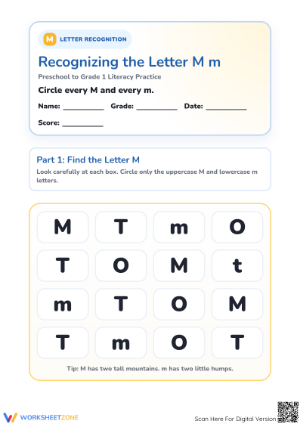
- Mix worksheet formats: dashed tracing, dot-to-dot, and free-write pages within the same week
- Watch pencil grip during independent writing time, not just the finished product
According to guidance summarized in Handwriting in Early Childhood: A Strategy for School Success from Zaner-Bloser, repeated practice of incorrect letter formation makes those habits progressively harder to correct as students get older, which is why early, closely observed practice with letters like M carries more long-term weight than later remediation.
Frequently Asked Questions
1. What is the correct stroke order for writing uppercase and lowercase letter M?
Uppercase M uses four strokes: straight down, diagonal down to the middle, diagonal up to the top, then straight down again. Lowercase m uses a short down stroke followed by two up-and-over humps, each returning to the baseline.
2. At what age or grade level should students practice letter M handwriting worksheets?
Letter M worksheets fit best with preschool and kindergarten students, generally ages four through six, once they can hold a pencil or crayon with a basic grip and have practiced simple pre-writing strokes.
3. How can teachers help students who reverse or malform letter M?
Point out the exact stroke that went wrong, restate the verbal cue, and have the student trace your model once before writing independently again. Short, specific corrections in the moment work better than general reminders after the page is finished.
4. How often should letter M practice be repeated for mastery?
Most students benefit from short, repeated exposure across several days rather than one long session. Five to ten minutes of focused M practice spread across a week tends to build stronger motor memory than a single 20-minute worksheet block.
5. What activities pair well with letter M worksheets to reinforce phonics?
Picture-sound matching with words like moon, mitten, or mouse works well alongside tracing practice. Sensory activities such as forming M in sand or playdough also reinforce the stroke pattern before or after paper practice.