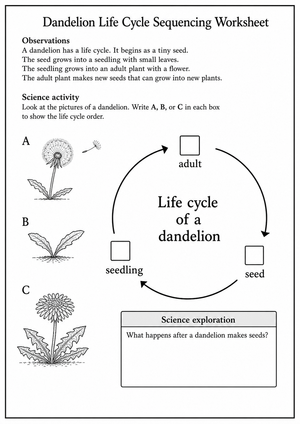
If you are planning a plant unit and searching for life cycle of a dandelion worksheets, you likely need a resource that breaks the process into stages young learners can actually track: seed, germination, rosette growth, and flowering. Dandelions work well for this because students already recognize the plant from the playground, which makes the science concepts easier to anchor. This guide walks through how to use a dandelion life cycle worksheet in a K-2 or grade 3 classroom, what stages to expect students to label, and how the resource supports formal science standards.
The Four Stages Covered on the Worksheet
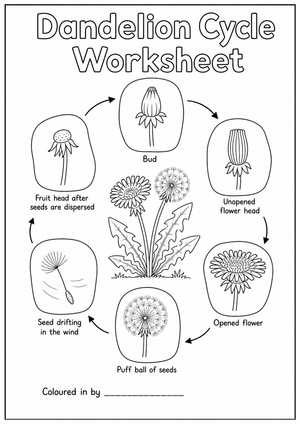
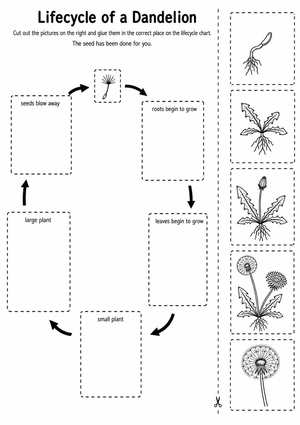
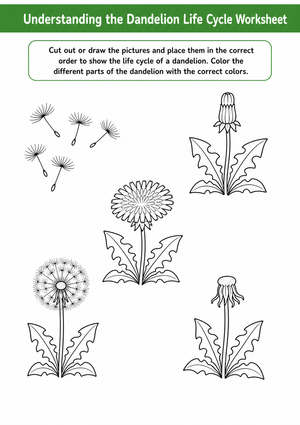
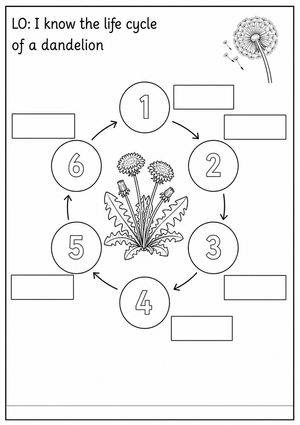
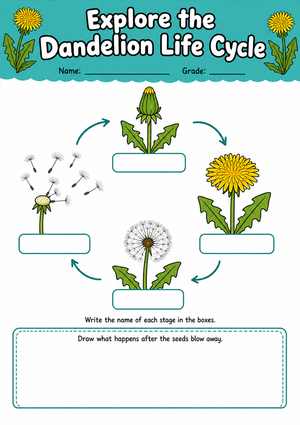
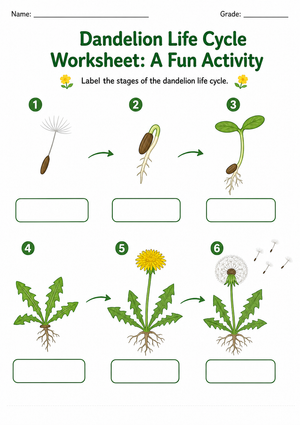
A dandelion life cycle worksheet typically sequences the plant into four clear stages. The seed stage shows a small, ridged seed attached to a feathery pappus. The germination stage shows a root pushing downward into soil while a shoot emerges upward. The rosette stage shows the plant growing a circle of jagged leaves low to the ground before it sends up a flower stalk. The flowering stage shows the yellow flower head, which later matures into a new round seed head ready for dispersal.
One detail worth calling out during instruction: the pappus is not simply fluff, it is a specialized structure that allows wind to carry a single seed a measurable distance from the parent plant, which is why dandelions can spread across a schoolyard in a single season without any human planting.
Aligning the Worksheet with NGSS 3-LS1-1
Grade 3 teachers working toward science standards will find that dandelion life cycle worksheets map directly onto NGSS 3-LS1-1, which asks students to develop models that show organisms go through unique but comparable life cycles including birth, growth, reproduction, and death. Using the worksheet as a labeling or sequencing task gives students a concrete model to reference when they later compare a dandelion life cycle to another plant or an animal life cycle during the same unit.
According to the Next Generation Science Standards documentation for 3-LS1-1, students are expected to construct an argument that plants and animals have unique and diverse life cycles but all share common features, a requirement that a labeled dandelion diagram directly supports as physical evidence students can point to and describe in their own words during a class discussion or written response.
Classroom Implementation
Use the worksheet as a station rotation during a plant unit. One station can have students color and label the four stages, another can have students cut and sequence stage cards in the correct order, and a third can send small groups outside with a clipboard to find a real dandelion at whatever stage they can locate that day. This rotation keeps the pace lively for younger students who cannot sit through a single 30-minute lesson without a change in activity type.
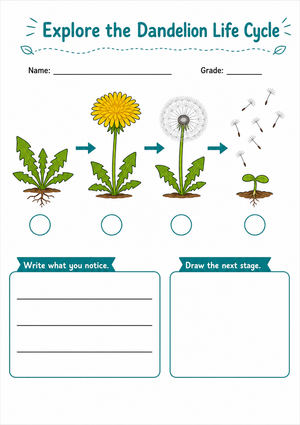
For grade 3 classrooms working toward the modeling expectation in 3-LS1-1, ask students to draw their own version of the cycle after completing the worksheet, using arrows to show the sequence rather than copying the printed diagram directly. This step moves students from recognition to recall, which is a stronger indicator that the concept has transferred into long-term understanding rather than short-term matching.
Frequently Asked Questions
1. What grade level is the dandelion life cycle typically taught at?
Dandelion life cycle content is most commonly used in K-2 and grade 3 elementary science, with grade 3 classrooms often tying the worksheet directly to NGSS 3-LS1-1 life cycle modeling.
2. How many stages are in the dandelion life cycle worksheet?
Most dandelion life cycle worksheets cover four stages: seed dispersal, germination, rosette leaf growth, and flowering, which leads back to a new seed head.
3. How can teachers use this worksheet for NGSS-aligned instruction?
Teachers can use the worksheet as a modeling task under NGSS 3-LS1-1, having students label, sequence, or redraw the stages to show they understand that organisms share common but unique life cycle features.
4. What classroom activities pair well with a dandelion life cycle worksheet?
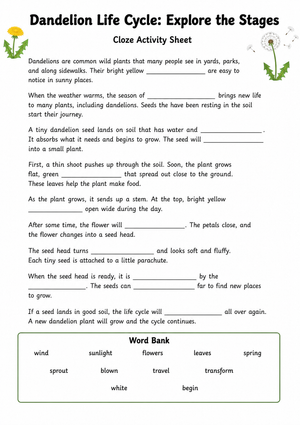
Station rotations, sequencing card sorts, outdoor observation walks, and fill-in-the-blank diagram checks all pair well with this worksheet during a plant unit.
5. How is a dandelion life cycle different from other flowering plants?
The clearest difference is seed dispersal: dandelions rely on a wind-carried pappus structure rather than fruit, pods, or animal carriers used by many other flowering plants, which makes for a strong comparison point once students know the four core stages.












 Interactive Worksheet Maker
 Quiz Maker
 Word Search Maker
 Crossword Puzzle Maker
 Word Scramble Generator
 Sentence Scramble Generator
 Handwriting Worksheet Generator
 Name Tracing Generator
 Fill In The Blank Generator