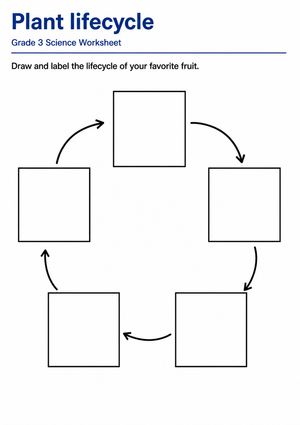
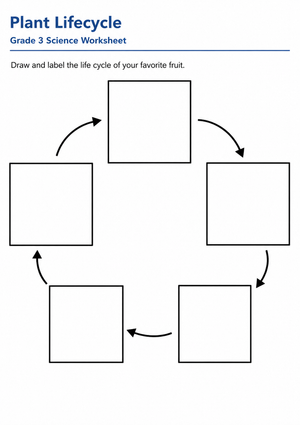
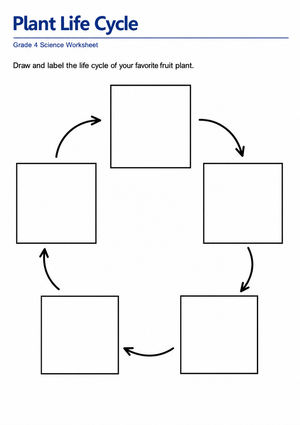
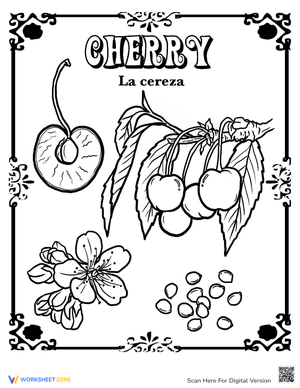
A fruit life cycle worksheet narrows a broad plant unit down to a single, teachable sequence: seed, seedling, flowering plant, pollination, fruit formation, and seed dispersal back to seed. This narrower focus matters because fruit-bearing plants give students a visible, familiar example, think apples, strawberries, or tomatoes, that makes pollination and seed dispersal easier to picture than abstract plant vocabulary alone.
Because the sequence repeats in a loop, worksheets that ask students to arrange stages in a circle rather than a straight line reinforce the idea that life cycles continue rather than end. That distinction is worth calling out explicitly when you introduce the worksheet, since some students will default to thinking of the sequence as having a clear start and stop point.
Aligning Worksheets to NGSS Life Cycle Standards
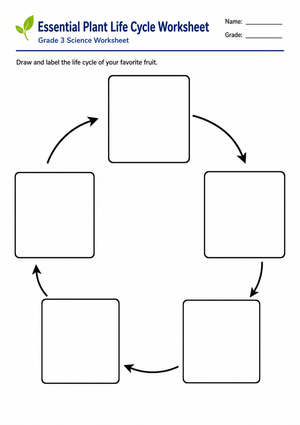
NGSS 3-LS1-1 asks third graders to develop models showing that organisms have unique and diverse life cycles but all share stages of birth, growth, reproduction, and death. A fruit life cycle worksheet that has students draw or label each stage functions as exactly this kind of model, making it a natural fit for grade 3 instruction rather than an add-on activity.
According to the Next Generation Science Standards topic arrangement for Inheritance and Variation of Traits, the life cycle expectation at grade 3 is explicitly modeling-based rather than recall-based, meaning a fill-in-the-blank vocabulary sheet alone does not fully meet the standard. Source: Next Generation Science Standards, nextgenscience.org, topic 3.Inheritance and Variation of Traits: Life Cycles and Traits. Pairing a diagram-and-label worksheet with a short written explanation of each stage gets closer to the model-building expectation the standard describes.
For grade 1 classrooms, NGSS 1-LS1-1 focuses on how external plant structures, roots, stems, leaves, flowers, help the organism survive and grow. A fruit life cycle worksheet at this grade level works best when it pairs each stage with the plant part responsible for it, such as connecting the flowering stage to the flower's role in reproduction.
Worksheet Formats: Sequencing, Labeling, and Cut-and-Sort
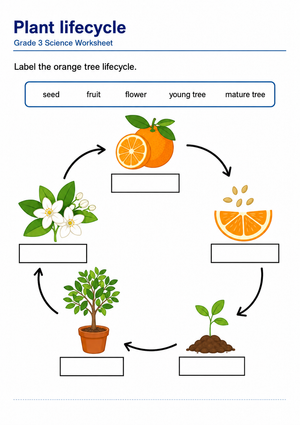
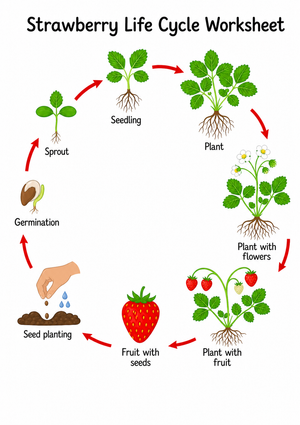
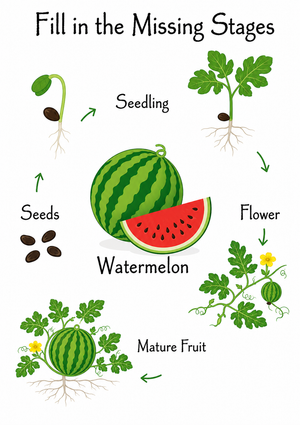
Three worksheet formats cover most classroom needs. Sequencing worksheets present the stages out of order and ask students to number them correctly, which works well as an independent warm-up. Labeling worksheets show a diagram with blank lines pointing to each stage, useful for vocabulary practice during whole-class instruction. Cut-and-sort worksheets give students individual stage cards to physically arrange and glue, which suits small-group intervention because it lets you watch a student's reasoning in real time rather than only checking a finished answer.
For a whole-class lesson, start with a labeling worksheet so every student builds the same vocabulary base. Save cut-and-sort formats for small groups or centers, where you can observe whether a student is sequencing by logic or by guessing.
Using Worksheets for Formative Assessment
A blank label-the-stage worksheet, given without a word bank, works well as a quick formative check partway through your unit. If most students can correctly label four or more of the six stages, you likely have room to move into pollination and dispersal detail. If labeling is inconsistent, spend another lesson on direct instruction before introducing the cut-and-sort activity, which requires more independent reasoning.
Keep assessment worksheets short, one diagram with six labels, rather than combining sequencing and labeling into a single assessment. Separating the skills makes it easier to see whether a student understands the stages themselves or just the order they occur in.
Frequently Asked Questions
1. What grade level are fruit life cycle worksheets best suited for
These worksheets fit grades 1 through 3 most naturally. Grade 1 classrooms can focus on plant structures and basic stages, grade 2 can add pollination and seed dispersal modeling, and grade 3 can use the full six-stage sequence to build a life cycle model as required by 3-LS1-1.
2. How do fruit life cycle worksheets align with NGSS standards
They support 1-LS1-1 by connecting plant structures to survival and growth, 2-LS2-2 by modeling pollination and seed dispersal, and 3-LS1-1 by having students build a model of the full life cycle sequence shared across organisms.
3. What stages should a fruit life cycle worksheet include
A complete worksheet should show seed, seedling, flowering plant, pollination, fruit formation, and seed dispersal back to seed, presented as a repeating cycle rather than a one-way sequence.
4. How can teachers use these worksheets for assessment versus practice
Use labeling and sequencing worksheets with word banks or answer keys visible for practice, then remove the word bank and shorten the diagram to a single label-the-stage task when using the worksheet as a quick formative assessment.
5. How do fruit life cycle worksheets differ from general plant life cycle worksheets
General plant life cycle worksheets often stop at flowering or seed production, while fruit life cycle worksheets add the fruit formation and dispersal stages explicitly, which makes them a better match for lessons connected to pollination and seed dispersal standards like 2-LS2-2.












 Interactive Worksheet Maker
 Quiz Maker
 Word Search Maker
 Crossword Puzzle Maker
 Word Scramble Generator
 Sentence Scramble Generator
 Handwriting Worksheet Generator
 Name Tracing Generator
 Fill In The Blank Generator