


























Views
Downloads

Dandelion Life Cycle Worksheet | Grade 1-2 Essential
Paste this activity's link or code into your existing LMS (Google Classroom, Canvas, Teams, Schoology, Moodle, etc.).
Students can open and work on the activity right away, with no student login required.
You'll still be able to track student progress and results from your teacher account.
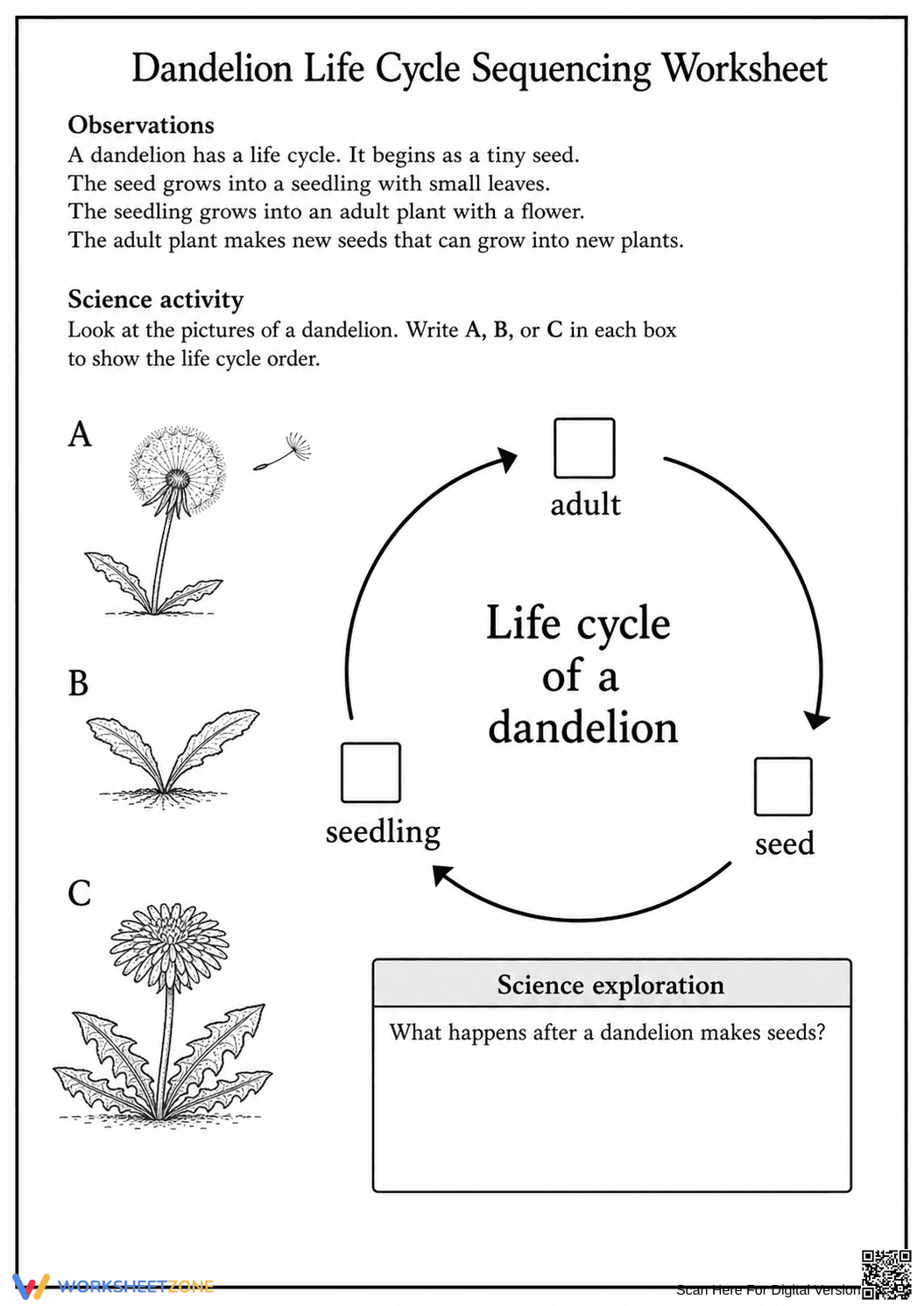
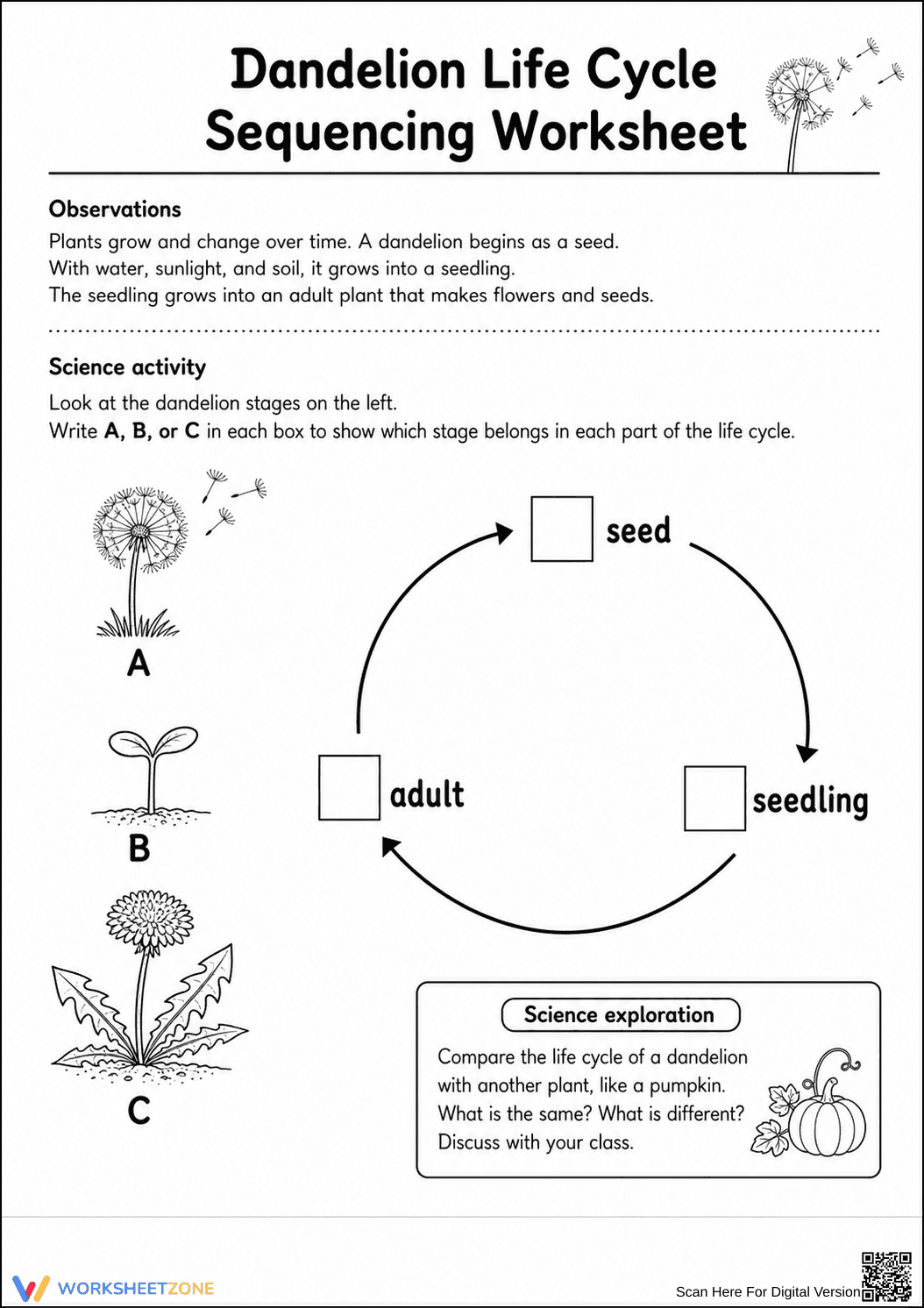
This Grade 1 and Grade 2 science worksheet helps students master the chronological stages of plant development through the familiar dandelion. By identifying and sequencing specific growth phases, learners build a foundational understanding of biological cycles and the relationship between seeds, seedlings, and adult plants. It provides a clear path from observation to scientific conclusion.
At a Glance
- Grade: 1-2 · Subject: Science
- Standard:
1-LS1-2— Read texts and use media to determine patterns in behavior of parents and offspring- Skill Focus: Life Cycle Sequencing
- Format: 2 pages · 8 problems · Answer key included · PDF
- Best For: Independent practice or quick formative assessment
- Time: 15–20 minutes
The resource contains two distinct pages of activities. The first page provides a visual diagram of a dandelion's life cycle with three labeled stages (A, B, and C) and corresponding input boxes for sequencing. It includes a "Science exploration" prompt to encourage critical thinking about what happens after seed dispersal. The second page offers a comparative analysis, prompting students to relate the dandelion's growth to other seasonal plants like pumpkins, reinforcing the concept that all living things follow predictable patterns.
The zero-prep workflow is designed for maximum efficiency in the busy classroom. First, print the two-page PDF (30 seconds). Second, distribute the sheets to students and read the "Observations" header aloud to provide necessary context (1 minute). Third, review the completed sequencing diagrams using the provided answer key for immediate feedback (1 minute). This resource is an ideal candidate for emergency sub plans or as a transition activity between core science units, requiring no additional materials beyond a pencil.
This worksheet aligns with 1-LS1-2, focusing on how plants change as they grow from seeds to adults. It also supports 2-LS2-1 by illustrating the life cycle requirements of flowering plants and the dispersal of seeds. Both standard codes can be copied directly into lesson plans, IEP goals, or district curriculum mapping tools to ensure compliance with state and national science frameworks.
Use this worksheet during the "Explain" phase of a 5E lesson model to solidify vocabulary like "seedling" and "adult plant." It also serves as an effective formative assessment after a nature walk or outdoor observation. Teachers should look for students who can correctly identify that the "adult" stage is the one capable of producing new seeds, indicating a grasp of the circular nature of life cycles. Expected completion time is approximately 15 to 20 minutes.
This material is designed for early elementary students, including English Language Learners who benefit from the clear visual scaffolding and labeled diagrams. It pairs naturally with a classroom seed-planting project or a read-aloud about seasonal changes. The inclusion of the pumpkin comparison makes it particularly relevant for autumn science rotations or cross-curricular units on nature and the environment.
According to Fisher & Frey (2014), the use of visual sequencing tools in early science education significantly improves a student's ability to internalize complex biological processes. This worksheet utilizes that research-backed approach by requiring students to map the 1-LS1-2 standard onto a concrete, observable plant. By moving from simple identification to comparative analysis, the resource ensures that Grade 1 and Grade 2 learners do more than just memorize facts; they begin to recognize the universal patterns of life. The 2-page structure provides enough repetition to ensure mastery while the open-ended exploration questions satisfy higher-order thinking requirements. This balance of direct instruction and inquiry-based learning is essential for meeting NGSS benchmarks in the primary grades. The clear layout and focused tasks make it a reliable tool for building scientific literacy in young learners.


