


























Views
Downloads
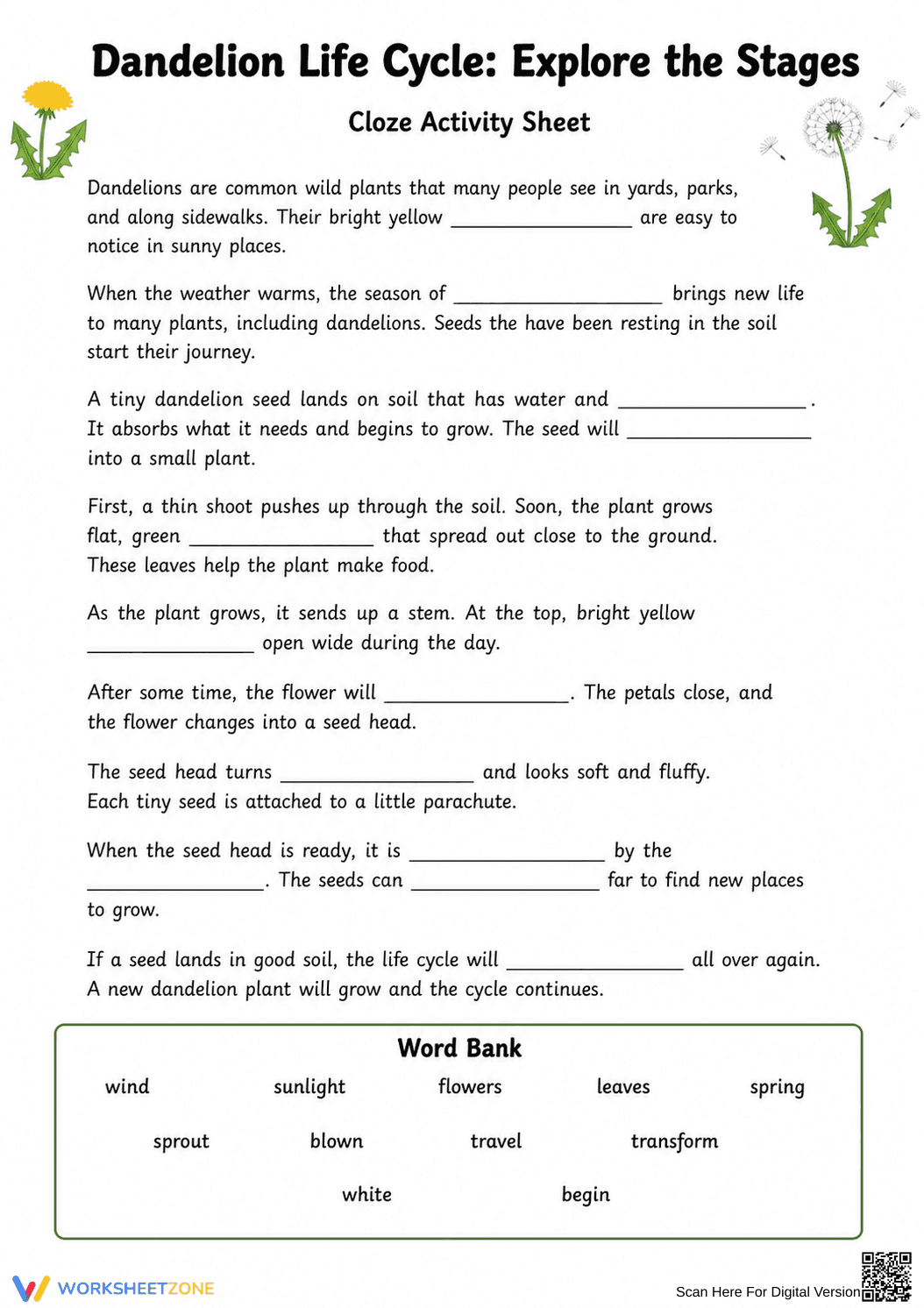
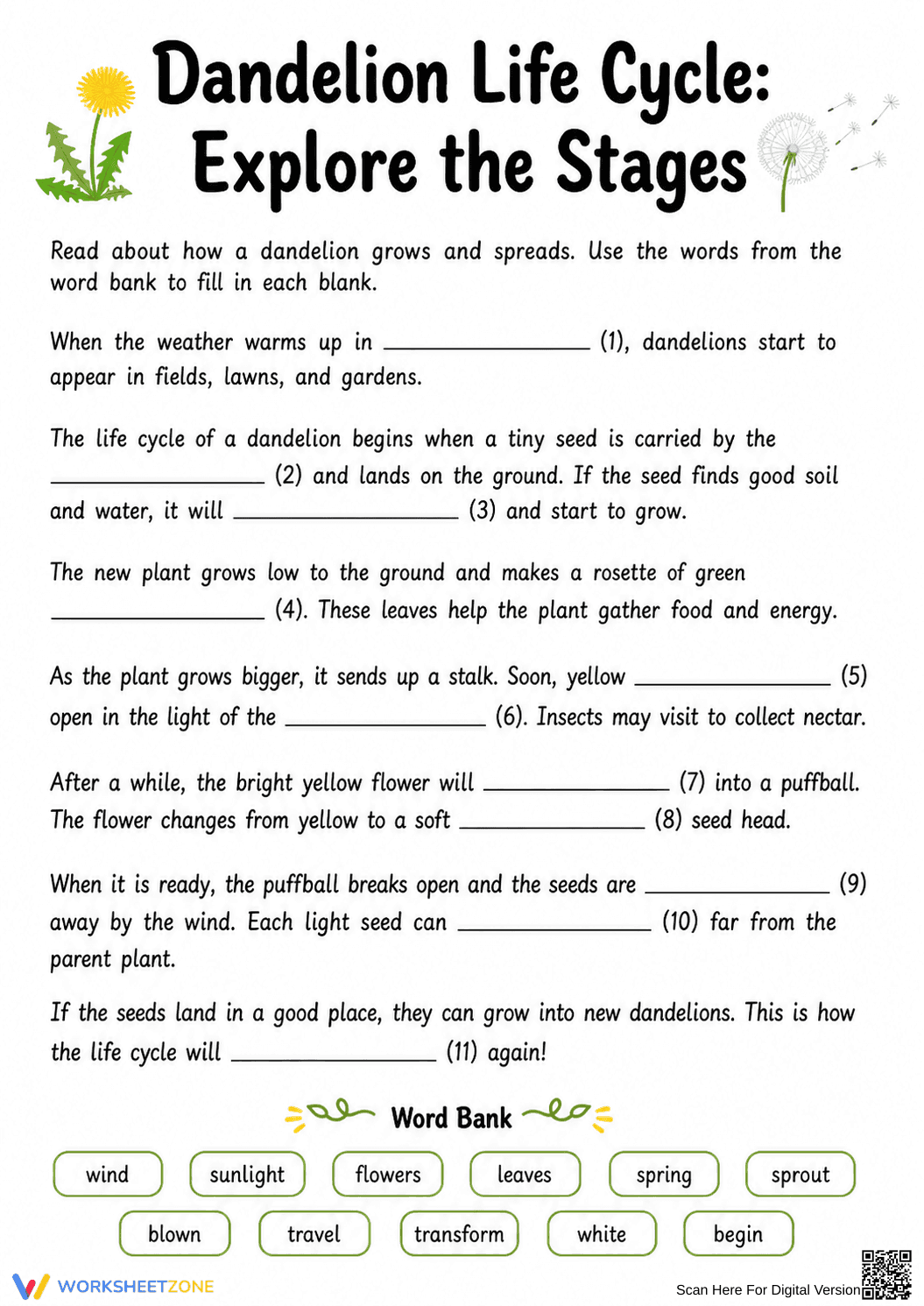

Grade 3 Dandelion Life Cycle — Printable No-Prep Worksheet
Paste this activity's link or code into your existing LMS (Google Classroom, Canvas, Teams, Schoology, Moodle, etc.).
Students can open and work on the activity right away, with no student login required.
You'll still be able to track student progress and results from your teacher account.
This ready-to-use science worksheet helps students master plant life cycles by completing a targeted cloze reading activity. By filling in the missing vocabulary words, learners actively process the stages of a dandelion's growth, from seed dispersal to blooming, strengthening both reading comprehension and core biology concepts.
At a Glance
- Grade: 3 · Subject: Science
- Standard:
3-LS1-1— Describe the unique and diverse life cycles of organisms- Skill Focus: Plant Life Cycles
- Format: 2 pages · 11 problems · Answer key included · PDF
- Best For: Independent practice or science centers
- Time: 15–20 minutes
This resource features a two-page reading comprehension activity focused on the dandelion life cycle. Students are provided with an informational text passage containing eleven strategic blanks. A comprehensive word bank at the bottom of the page supplies the necessary vocabulary, including terms like "sprout," "sunlight," and "transform." The clear layout and built-in vocabulary support make it highly accessible for young readers.
- Print (1 minute): Simply download the PDF and print the desired number of copies. No special materials or complex teacher setup are required.
- Distribute (1 minute): Hand out the activity sheets along with pencils. The instructions are self-explanatory, allowing students to begin immediately.
- Review (3 minutes): Use the included answer key to quickly check student responses or conduct a whole-class review of the correct vocabulary placement.
This streamlined process keeps total teacher prep time under two minutes, making it an excellent option for emergency sub plans or quick science center rotations.
Aligned to primary standard 3-LS1-1: Develop models to describe that organisms have unique and diverse life cycles but all have in common birth, growth, reproduction, and death. This activity specifically reinforces the growth and reproduction stages of flowering plants. Both standard codes can be copied directly into lesson plans, IEP goals, or district curriculum mapping tools.
This worksheet serves as an excellent independent practice assignment following a direct instruction lesson on plant biology. Teachers can also use it as a formative assessment tool during a science center rotation. While students work, observe their ability to use context clues to select the correct vocabulary words from the bank. Expected completion time ranges from 15 to 20 minutes.
This activity is primarily designed for third-grade science students, though it is easily adaptable for second or fourth graders needing review or extension. The included word bank provides built-in differentiation for emerging readers and English language learners. It pairs perfectly with a visual anchor chart detailing the stages of seed germination and plant growth.
Understanding scientific processes requires strong content-area literacy skills, particularly when students are first introduced to complex biological sequences. By integrating reading comprehension with core biology concepts, this targeted cloze activity directly supports standard 3-LS1-1 by having students describe the unique and diverse life cycles of organisms. According to Fisher & Frey (2014), combining domain-specific vocabulary practice with structured, text-based reading tasks significantly improves students' long-term retention of complex scientific phenomena. The fill-in-the-blank format intentionally encourages active engagement with the informational text, prompting young learners to rely on both syntactic and semantic context clues to construct accurate meaning. This dual-focus instructional approach ensures that students do not merely memorize the isolated stages of a dandelion's life, but also actively develop the critical reading and analytical strategies that are absolutely necessary for their future academic success in advanced STEM disciplines.


